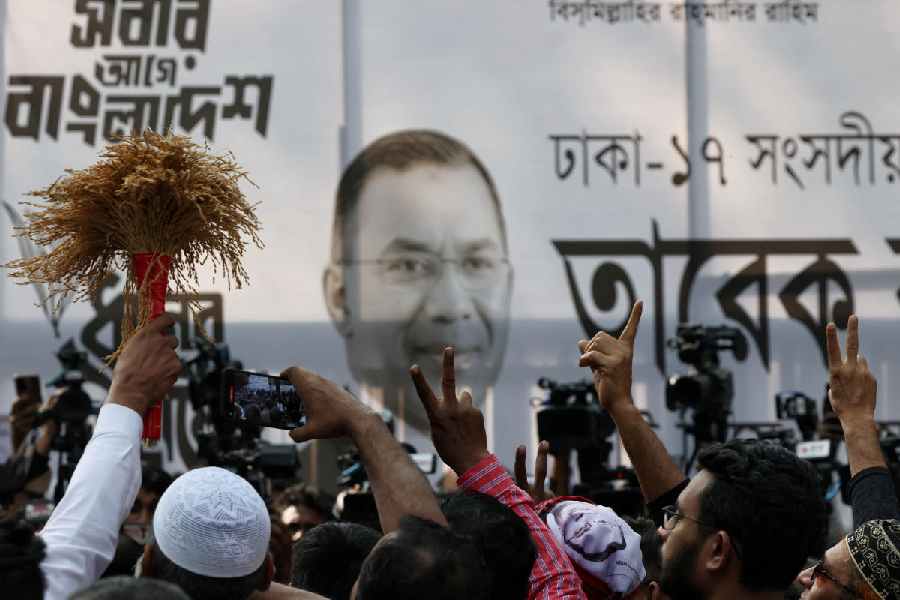
Cultural organisations in Bangladesh are relieved that the Bangladesh Nationalist Party’s (BNP) victory in the country’s national elections is likely to end “mobocracy” and sudden attacks on their institutions. However, they are apprehensive about the growing influence of the Jamaat-e-Islami.
Jamaat and its allies have secured 77 out of 299 seats in Bangladesh’s national elections, its best performance ever.
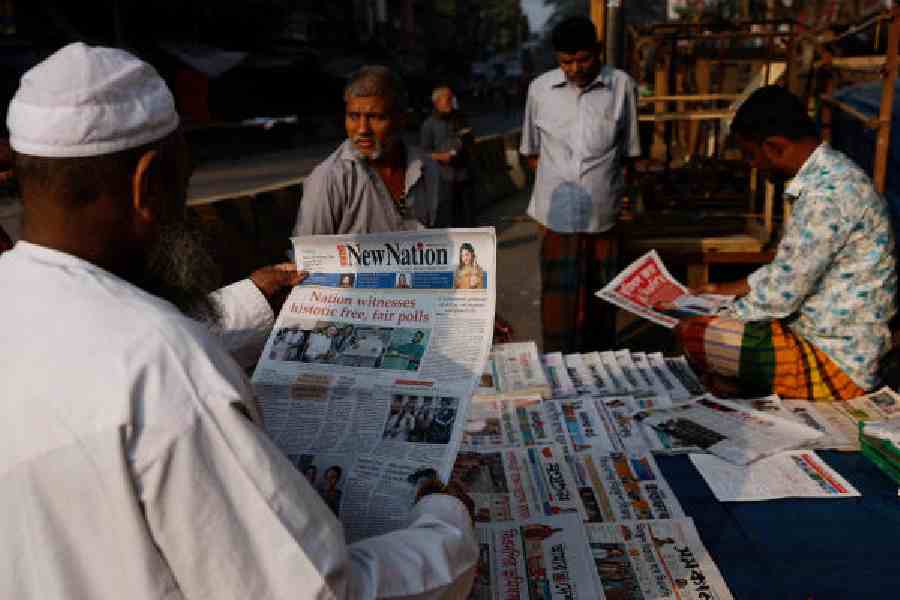
“The election results are a relief for cultural workers like us. We feared that the Jamaat-e-Islami would do even better, but the people of Bangladesh have resisted them. Some incidents were planned in the months before the elections to help Jamaat do well in the elections,” said a senior member of a cultural organisation, who spoke on condition of anonymity.
Two of Bangladesh’s prominent cultural institutions, Chhayanot and Bangladesh Udichi Shilpigoshthi, were attacked and torched when unrest gripped Bangladesh last December.
Several musical instruments, including tablas and harmoniums, were smashed and damaged by people who managed to barge into Chhayanot in Dhaka’s Dhanmondi, set up in the 1960s.
The attack took place around the same time a mob was on rampage inside the office of The Daily Star newspaper. A group had also attacked the office of the newspaper Prothom Alo.
The next evening, a group rampaged Bangladesh Udichi Shilpigoshthi, a Left-minded cultural organisation on Dhaka’s Topkhana Road. Its office was torched, and nearly 2,500 rare manuscripts, books and musical instruments were gutted.
Many feel the attacks were planned and meant to send a message that music and cultural performances will not have a free run in the country. The planned attacks were meant to scare symbols of free thought and liberalism, they said.
A member of Chhayanot told Metro that the BNP winning the elections with such a majority has given them confidence that mob attacks on cultural institutions will stop, or at least strong action will be taken against those who engage in such “mobocracy”. “It will be a government that has the legitimacy of people’s votes. They are unlikely to allow mobocracy,” he said.
After the attack on newspaper offices in December, many journalists said the media had become a victim of mobocracy. Mob violence in Bangladesh forced many journalists and media houses to practise self-censorship, fearful of publishing or broadcasting news that might provoke certain political forces, several journalists from Dhaka said.
Members and students from various cultural organisations, including Chhayanot, are currently engaged in rehearsals for the International Mother Language Day (Bhasha Dibas) on February 21.
Following this, rehearsals for performances celebrating Basanta Utsab, Poila Boishakh, and the birthday of Rabindranath Tagore on the 25th of Boishakh will commence.
“We have a packed calendar. We will keep singing songs of Rabindranath, Nazrul, Lalan, Hasan Raja and Shah Abdul Karim. We will keep singing songs of protest, for the oppressed and against the oppressor. We will find a way to do it,” said a member of Chhayanot.
Mahmud Selim, the working president of Udichi, said the election results show that the people of Bangladesh wanted their nation to remain in the path of “Muktiyudhha”, Bangladesh’s fight for liberation.
“People of Bangladesh want their country to remain in the spirit of Muktiyudhha. They have resisted the growth of fundamentalist forces,” said Selim.
Jamaat was accused of helping Pakistani forces during Bangladesh’s war of liberation, sharing information with the Pakistan Army and helping in the massacre of those fighting for the country’s liberation.
BNP, many said, has progressive and liberal voices within the party. “They have many Muktiyodhhas and believe in the spirit of Muktiyudhha,” said a man.
What worries many cultural institutions is Jamaat’s 77 seats.
According to a member of a cultural institution: “It reflects that there are many who support that ideology.”