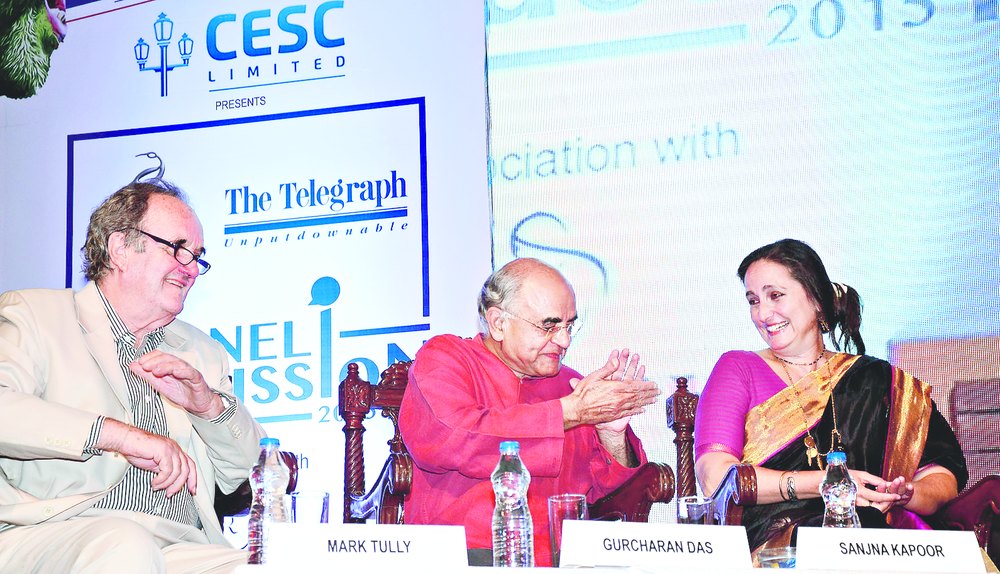


CESC presents The Bengal Club and The Telegraph Panel Discussion 2015, in association with Birth, brought together senior authors Mark Tully and Gurcharan Das, theatre personality Sanjna Kapoor, Congressman Shashi Tharoor, and the vice-chancellor of Presidency University Anuradha Lohia to talk about the subject, "Indian Culture. One or many?"
The discussion at ICCR was moderated by historian Rudrangshu Mukherjee, who began by mentioning an oft-quoted phrase, "unity in diversity", made famous in the writings of Jawaharlal Nehru and Rabindranath Tagore. "Is Indian culture too unified and, therefore, one-sided? Or is it defined by its diversity, its pluralism?"
Gurcharan Das said: "The subject of one or many cultures is a scary one in a polarised time. We are such an infuriatingly plural and diverse society that its absurd to imagine that we would have one single culture." A reason for such amazing diversity, said Das, was provided by John Henry Hutton, who likened the caste system to a fisherman's net, in which were caught many people who had migrated to India mostly from Central Asia. "Some of these people also went to China. In China, they assumed, mostly, a Han identity. In India, one could identify the thousands of jaatis who constitute the pluralism and diversity of Indian culture."
This might also explain, Das opined, why India is "rising from below while China is rising from above". "If China's rise has been orchestrated by the State, India's has been despite the State. India is and always has been a weak State and a strong society, while China has been a strong State with a weak society. You need a strong State to get things done, and a strong society to make the State accountable."
Underlying the idea of the "argumentative Indian" is the idea of "questioning". "When you read Shankara," said Das, "you see the argumentative Indian has become pretty intolerant."
The problem with social intolerance is, whenever one speaks with certainty about one's beliefs, one cannot help but suggest that what one believes is superior to what others believe. Hence, all statements about certainty are attempts at conversion. Here lies "the leap of tolerance of Hinduism to the intolerance of Hindutva".
"What stops one from trying to convert others is basically good manners," said Das. "Fundamentalists lack good manners. They threaten you with death if you don't believe what they believe. The ultimate source of fundamentalist intolerance is not belief, it is insecurity."
Sanjna Kapoor used her field, theatre, to illustrate her point. "Theatre has survived completely in spite of the government. Theatre is a communal act. These rich living forms in our country are not just a source of entertainment, they are a form of intellectual engagement. There is so much diversity all over the country. There is theatre created by completely marginalised populations who are struggling to keep them alive. All of this happens without any government support. All of this is worth celebrating. We need to celebrate each other instead of just tolerating each other. We need to be comfortable with our differences, even if at times we do not understand the differences."
"I owe India a huge debt of gratitude," said Sir Mark Tully. "It has taught me that the way to hold varieties together is a middle way or a balance. If you are balanced, then you will realise there are views different from your own and which you can learn from, and you will never go overboard with any one theory. One of the tragedies in the world today is the way we do our economics, which is an example of a failure to find the middle road.
"During the late 1940s and '50s, it was considered almost immoral to not be socialist. But we took socialism too far, we did not keep it in balance. As a result, instead of becoming more balanced, we swung right in the other direction and became obsessed with market capitalism and corporatism. The Indian way would be to learn from capitalism and socialism and come to a middle road. The economics that we do, unfortunately, is all based on greed. That is essentially an un-Indian thing."
"I came to India as a Church of England Christian. In India, the first time I went to Christmas Mass, I was amazed to see some Sikhs in the congregation; I remembered my English education and days at Cambridge where my Roman Catholic friends would not come to a service of another Christian denomination. I have learnt from the multi-religious nature of India that there are different ways to God," concluded Tully.
Anuradha Lohia spoke of how Indian culture was "supportive" of the multiplicity of her roles as a daughter, mother, wife, dancer and scientist. "The word 'culture' is a noun in the field of humanities. In science it is a verb. 'Culture' means growing microbes together. A healthy culture has a lot of cells in it."
"I trained with a remarkable man who taught me Kuchipudi," continued Lohia. "In my mind, he was the essence of pluralistic culture. His grandfather was Scottish, his grandmother was Burmese royalty. He came to Calcutta at the age of one as a refugee with his father. He grew up in Andhra Pradesh. He speaks fluent Burmese, Telugu, Bengali, English, and sings Carnatic, Hindustani classical, quotes from Abhinav Gupta and taught me the Natya Shastra. I never had to understand culture. It was by osmosis and absorption that I imbibed it. Everyone in this nation has received this osmosis without even asking for it. That is the pluralism and singularity of India culture."
Shashi Tharoor pointed out that the panel was missing a voice that would represent those who speak with certitude about ideas of "Bharatiya sanskriti". "These voices seem to thriving in what Gurcharan described as a polarised time. I believe that the singular thing about Indian culture is that you can only speak of it in the plural. It is an evolved hybrid.
Of course there is nothing sacrosanct about Indian culture, it is constantly evolving. Even 200 years ago, sati and untouchability would have had to be defended as part of Indian culture. Dare even the upholders of "Bharatiya sanskriti" defend those practices today?
The central battle in this debate about Indian culture is between those who believe we are vast and contain multitudes and those who have presumptuously taken it upon themselves to define in increasingly narrower terms what is truly Indian."
Do you think there is oneIndian culture or many? Tell ttmetro@abpmail.com