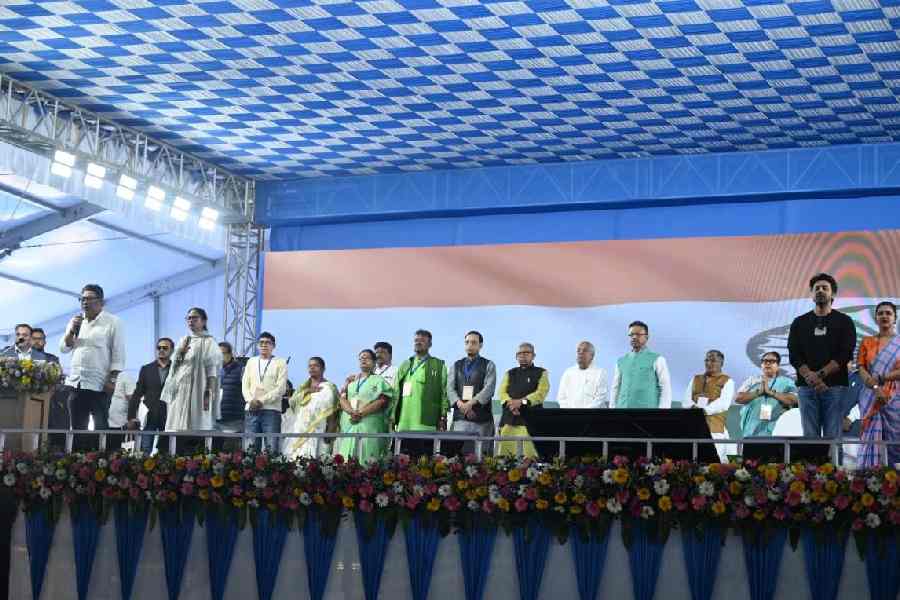
Expectations ran high in Singur when Mamata Banerjee visited the area on Wednesday, much like they had during Narendra Modi’s visit on January 18, but for many residents of this once-turbulent battleground, her address offered little that was new, even as it sought to reassure a region still negotiating its uneasy past.
Returning to Singur after a long gap, the chief minister sought to reframe the industry-agriculture binary that once defined the region.
“Industrialisation will happen, but not at the cost of agriculture,” Mamata told a public gathering, broadly underlining the stance that had shaped her rise to power nearly a decade and a half ago.
Seeking to address persistent concerns over employment, Mamata highlighted projects aimed at generating jobs through industrial growth. She said her government had set up the Singur Agro Industrial Park on eight acres of land at a cost of ₹9.2 crore. “Out of 28 plots, 25 have already been allotted. Many people will get employment in Singur. Agriculture and industrialisation will happen together,” she said.
She also announced a larger private industrial initiative under the State Approved Industrial Park scheme. “On 77 acres of land, a private industrial park in Singur is being set up. It will provide employment to thousands of people. Flipkart and Amazon will build their warehouses here. We have cleared the project (park) from our end,” said Mamata.
Singur remains one of Bengal’s most politically charged landscapes. The land acquisition for Tata Motors’ Nano car project and the movement opposing it forced the company’s exit from Singur, playing a decisive role in ending the Left Front’s 34-year rule in 2011. Yet, even 15 years after Mamata came to power, many in Singur remain conflicted about what they ultimately gained from that upheaval.
Mamata insisted that her government had honoured its commitments. “I do not believe in jumla, rather deliver on promises,” she said, stressing again that industry and agriculture would progress together.
Referring to those who lost land during the acquisition, Mamata added: “They continue to receive monthly financial assistance. They get the complete benefits of Khadya Sathi and Swasthya Sathi. From trauma care centres to agricultural markets to Lakshmir Bhandar (her government's monthly dole to women), everything is there.”
On May 20, 2011, Mamata had announced in her first cabinet meeting that the state would reclaim the 997 acres acquired for the Nano project and return the land to farmers. That promise, and her assurance that the land would be restored for cultivation, helped Trinamool dominate every election in the Singur Assembly segment since then. But while the land was returned, full agricultural revival in this Hooghly pocket has remained elusive.
Prime Minister Modi, during his January 18 rally in Singur, had offered no immediate development roadmap, instead promising to end what he described as Trinamool’s “maha jungle raj”.
Mamata in her address on Wednesday attempted to negate that charge by listing projects and invoking the emotional history of the movement.
“Singur is my favourite place. I had spent many days here between 2006 and 2008. I was on hunger strike for 26 days against the land acquisition here. From Tapasi Malik to every other person who fought and led the protest, I express my gratitude. You are our inspiration,” she said.
She sharply attacked the BJP again, accusing it of using the ongoing special intensive revision of the electoral rolls as a backdoor attempt to impose the NRC. “The NRC is being attempted in the guise of the SIR. I condemn those who have conspired to kill people,” she said, reciting her poem, Upahas (Mockery), which she described as an obituary for 140 people who allegedly died due to deportation fears.
She further alleged large-scale voter disenfranchisement. “You are deleting the names of legitimate voters in the guise of the SIR. Don’t you have faith in people? Will the Election Commission of India, by removing two crore names, decide who can vote? This is a democracy, not an autocracy,” Mamata said.
On Bengali identity, Mamata accused BJP-ruled states of targeting Bengali-speaking migrant workers and dismissed Modi’s claim that his government had recognised Bengali as a classical language. Calling it “a lie”, she said the recognition was achieved because her government “forced” the issue. “You beat us in Odisha, Bihar, Uttar Pradesh, Rajasthan, Delhi and Madhya Pradesh for speaking in Bengali. But we don’t beat anyone. We don’t take away anyone’s rights. How can you think of ruling Bengal when you beat and lynch people for speaking in Bengali?” she asked.
She announced fresh allocations under welfare and infrastructure schemes. She said ₹24,180 crore would be allocated under the second phase of the Banglar Bari housing scheme. On flood mitigation, she announced ₹1,500 crore for the Ghatal Master Plan, adding, “Out of the ₹500 crore that has already been given, work worth ₹300 crore has been completed. The rest will happen very soon.”