From tea estates in Bengal and hospitals in Karnataka to classrooms across the country, artificial intelligence is reshaping everyday work in India, guiding crop decisions, helping radiologists with brain scans and personalising lessons for students.
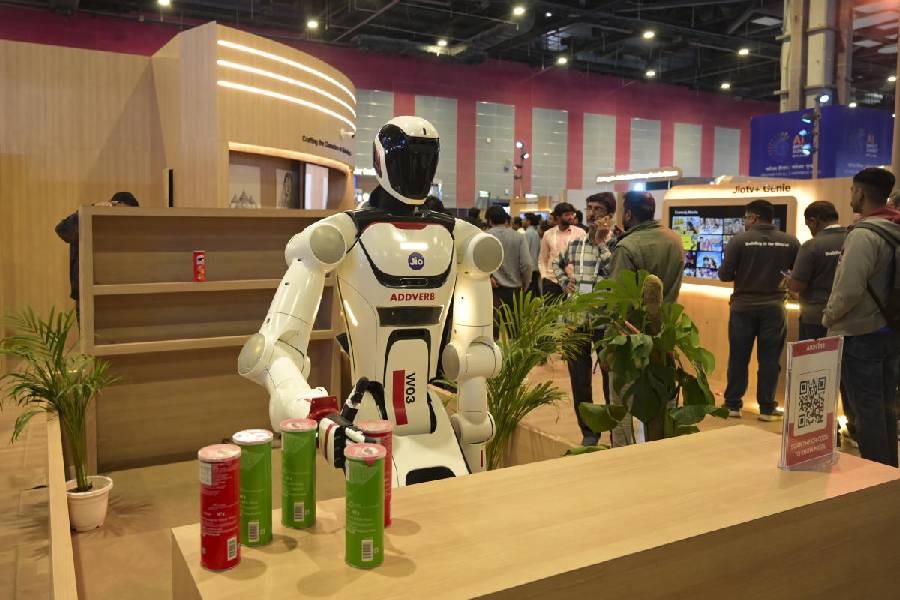
At India’s AI summit last week, controversy erupted briefly when a private university official described a Chinese-made robot dog as homegrown. But experts say the episode should not obscure India’s expanding AI deployment, although it underscores the persistent concerns that India trails China in investment and research.
At the summit, information minister Ashwini Vaishnaw announced plans to add 20,000 graphics processing units (GPUs) — chips essential to the running of AI models — to the country’s existing 38,000 GPUs.
Expanding domestic capacity, experts say, would strengthen infrastructure, reduce dependence on foreign cloud providers, and lower the costs for start-ups, government initiatives, students and developers by widening access to high-performance
computing.
Yet the scale of India’s ambitions is underscored by the size of the gap with the US and China.
A December 2024 paper from the Centre for Strategic and International Studies, a US-based think tank, estimated that the US would have 14 million GPUs by the end of 2025, while China would have 9.5 million.
Private investment reflects a similar disparity. A 2025 UN report ranked India 10th in AI funding, with $1.4 billion in 2023, compared with $67 billion in the US and $7.8 billion in China.
Research output shows the same imbalance. Indian researchers accounted for 10 per cent of global AI papers in 2025, compared with China’s 36 per cent, according to Jason Hung, an independent researcher who describes China as “the single most dominant contributor” to the global AI research volume.
Against that backdrop, many in academia and industry are arguing that India can leverage AI through rapid application rather than reinventing foundational research.
“We did not invent mobile telephony, yet we created the world’s largest and most affordable telecom networks; we did not invent chips, yet every fifth chip designer is Indian; we did not invent vaccines, yet we (supply vaccines) to the world,” V. Ramgopal Rao, former director of IIT Delhi, posted on X. “The same will hold true for AI.”
Rao argues that India’s strength lies in the rapid adoption and deployment of AI applications.
Nandan Nilekani, co-founder and chairman of Infosys, made a similar case at the summit in a session attended by Prime Minister Narendra Modi.
Nilekani cited the launch of an AI-powered app to guide dairy farmers, conceived after a January 8 meeting with Modi and released on February 8, as “an example of the speed of execution of AI diffusion in India”.
That emphasis on application is increasingly visible across sectors, according to a document titled Sectoral AI Impact Casebooks released at the summit, which drew heads of state, ministers, global technology executives and over 300 exhibitors from 30 countries.
In agriculture, a platform that combines soil chemistry data, satellite imagery and weather records is being used across 15,000 hectares in Bengal, including Darjeeling tea estates and paddy farms, reaching an estimated 27,000 smallholder farmers.
The system, designed to guide decisions on nutrients, irrigation and harvest timing, was associated with yield increases ranging from 20 to 32 per cent among 2,800 farmers during the 2023-24 season.
In sugarcane-growing regions, an intelligence platform analysing remote-sensing data to forecast pests and optimise harvest windows to maximise sucrose levels now guides 3,000 farms across Madhya Pradesh, Maharashtra, Karnataka and Tamil Nadu.
In healthcare, a tool that evaluates chest X-rays and flags patients for follow-up is deployed at more than 300 sites nationwide, said Shibu Vijayan, a physician who helped assess the system developed by Qure.AI, a Mumbai-based start-up.
An AI-enabled neuroradiology decision-support system operating in more than 30 hospitals across tier-2 and tier-3 districts has processed over 15,000 CT scans, assisting in the diagnosis of strokes, fractures and other conditions.
In education, the systems deployed include an audio tutor for rural schoolchildren aimed at improving English listening skills, a platform personalising competitive exam preparation by targeting weaknesses and reinforcing strengths, and a tool designed to reduce assessment time for teachers.
A legacy educational firm, Navneet, signed a pact with IIT Gandhinagar at the summit to train schoolteachers nationwide in using AI tools. IIT Gandhinagar faculty, for instance, can guide teachers on the choice of large language models for specific tasks.
“The goal is to empower teachers to make informed choices about the AI tools best suited to their needs,” said Harshil Gala, president of educational technology at Navneet, whose AI division has already reached out to some 2,000 teachers in 500 schools across 14 states.
The robot-dog episode briefly punctuated a summit that, analysts say, was focused on AI expansion.