 |
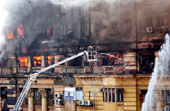
| As flames engulfed Stephen Court on March 23, 2010, an ill-equipped fire services department wasted precious time trying to figure out how to reach those trapped in the Park Street building. A Telegraph picture |
Fireman Rajib (name changed) had reached Stephen Court within seven minutes of the first flames being spotted, only to stand and stare helplessly as people trapped in the Park Street tinderbox jumped to their death.
A year since the most devastating highrise blaze in Calcutta claimed 43 lives, Rajib admits that should another fire of such a magnitude strike anywhere in the city, he would again have little choice but to stand and stare.
Metro spoke to the veteran of more than 100 fires and some of his colleagues on the eve of the first anniversary of the March 23, 2010, blaze to find out the lessons that the fire department chose not to learn from the tragedy.
SKYLIFT
The lift in the fire-ravaged Block II of Stephen Court was a ball of fire and the stairs and the corridors couldn’t be accessed because of thick, black smoke. The only way more than 200 people trapped inside that day could be rescued was by reaching them through a skylift or an electronic ladder.
Two skylifts were stationed at the fire brigade headquarters on Free School Street, both snag-ridden. A useable skylift kept in Sector V took around 75 minutes to reach Park Street, by which time five victims had jumped to their death.
A smaller skylift, acquired by the fire services department after the 2010 tragedy, now stands at the Free School Street headquarters. But is it enough to prevent a rerun of the Stephen Court tragedy?
Rajib shakes his head, as do his senior colleagues.
“The equipment we have is inadequate for a city like Calcutta, where fires break out at frequent intervals. What if there is a blaze in a highrise like South City or one in a Gariahat or Burrabazar building? Two or three skylifts will not solve the problem. Every fire station should have electronic ladders along with other equipment,” says an official.
On March 11, when flames engulfed Niharika Apartments on Alipore Road, residents ran to the terrace to be rescued, only to learn that the fire brigade team hadn’t brought the skylift with them. The trapped residents were left with no choice but to scamper down a flight of smoke-filled stairs at the risk of suffocating to death. A few elderly residents took ill after inhaling the smoke.
VIGILANCE
On an average, the city battles at least one small or medium-intensity blaze every two weeks. Fire department officials feel that the frequency of such fires can be brought down if the department becomes more vigilant, conducts inspections on a regular basis and penalises establishments that do not abide by the fire-safety guidelines.
The government had formed a high-power committee of representatives of Calcutta police, Calcutta Municipal Corporation, CESC and the fire services department after the March 23 tragedy to frame a set of guidelines to prevent a rerun of Stephen Court. According to the guidelines, a map each of every highrise should be submitted to the local police station. A copy of every such map is to be put up at any easily accessible spot in the building. If the terrace of any building is under lock and key, all flat owners and the attendant or caretaker of the building are required to have a duplicate key each.
A year on, the recommendations have been all but forgotten. “Those were meant to avoid a public backlash after the Stephen Court incident,” says a fire department official.
The few who are caught violating fire-safety norms go without punishment. A tinderbox cold storage in Ultadanga was back in operation within days of a big blaze. A fire broke out in the basement of Model House on Strand Road for the second time in two years because the fire services department didn’t follow up on the safety recommendations made after the first incident.
“The standard procedure is to file a complaint against the offender but no action is taken against anybody. In most cases, the charges are toned down for obvious reasons. We are forced to stay mum to save our jobs,” says Rajib.
APPARATUS
Firemen took at least two hours to enter Stephen Court and start a rescue operation because they didn’t have enough gas masks to combat the thick, black smoke that had filled up the cavernous corridors and stairways.
“Had our firemen been armed with proper breathing apparatus, they could have started the rescue operation inside the building straightaway and probably saved the 17 people who had choked to death after running towards the terrace, only to find it locked,” recalls Rajib, who entered the building after getting a gas mask brought from some other fire station.
Many of the trapped victims apparently couldn’t be rescued even after the skylift had arrived because the firemen didn’t have gas-cutters to get past the iron window grilles.
Singed by criticism, the government announced a Rs 14-crore grant to the fire services department to purchase all the equipment required to fight a blaze of the magnitude of the one that engulfed Stephen Court. A year later, that allegedly remains a mere announcement.
“No breathing apparatus or gas cutters have been purchased over the past year,” reveals a fire department official.
CUSHIONS
Four cushions that had been purchased for Rs 23 lakh were lying at the fire brigade headquarters, barely 500 metres from Stephen Court, even as people were jumping to their death on March 23 last year. The cushions could not be used allegedly because of a payment dispute with the company that had supplied these.
“Five out of the nine people who jumped from the building to escape the fire died. They could have been saved had the fire brigade brought along the cushions,” says Rajib.
Air-filled jumping cushions are part of the standard rescue equipment used by fire-fighting teams around the world, but not so in the city.
According to a fire brigade official, the dispute that prevented the four cushions from being used the day Stephen Court needed them most is still to be resolved.
The fireman’s verdict: Calcutta’s firefighting preparedness is what it was on March 23, 2010