The Shining (1980)
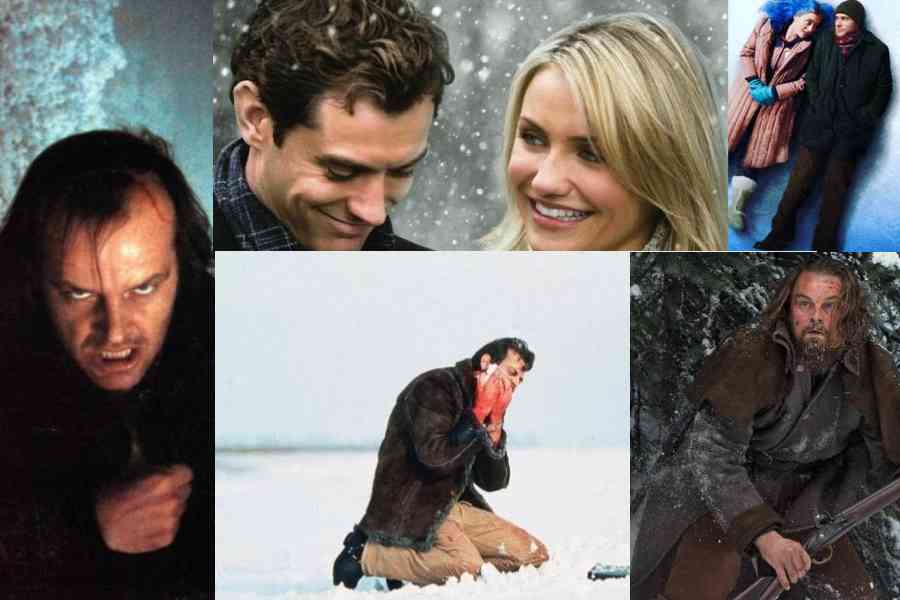
Long before the ending shot became a classic (and now a meme, which is another word for ‘classic’ in today’s parlance), Stanley Kubrick’s masterfully told and powerfully enacted psychological horror masterpiece used snow to confine a writer (Jack Torrance, played by Jack Nicholson) and his family to the isolated Overlook Hotel for the winter. The endless snowfall seals them off from the world and transforms the grand hotel into a claustrophobic cage where sanity unravels and ghosts appear.
The chase through the snowy maze at the end of The Shining is one of the most memorable climactic set pieces in the history of horror cinema. It is astoundingly made, with the camera angles, lighting, set design and editing all working in tandem to sell the terror, and also the biting cold. It actually feels chilly watching that scene, like you have been transported into the freezing-cold snow. Fun fact: the ‘snow’ used in the film’s most iconic exterior shots was a mix of salt and crushed Styrofoam.
Eternal Sunshine of the Spotless Mind (2004)
Any showreel encapsulating the history of cinema is bound to have that indelible image of Joel and Clementine lying side by side on the snow, her blue boho hair against the pristine whiteness making for a striking frame.
Michel Gondry’s visually arresting film explores the intricacies of relationships and the pain of loss. As Joel (Jim Carrey) desperately tries to hold on to his memories of Clementine (Kate Winslet) in this 2004 film, his mind drifts to the place they met. Believing that Clementine went to the brain-scrubbing firm Lacuna to have her memories of him erased, Joel does the same, only to realise during the procedure that he can’t forget her. He remembers a snowy day on the beach with her before she disappears. Written as just a beach day, the weather dumped inches of wet snow on the beach they were set to shoot on. So Gondry and his actors decided to improvise the scene, creating one of the film’s most memorable moments.
The Holiday (2006)
Nancy Meyers’s 2006 romantic drama may have used biodegradable snow flakes, but the warm, fuzzy feeling that a watch of The Holiday still brings on is far from manufactured.
The story follows two women (played by Kate Winslet and Cameron Diaz), hailing from two different countries, who swap homes during the Christmas season as a balm for heartbreak. However, their lives change unexpectedly when they meet and fall in love with two local men (Jack Black and Jude Law).
The Holiday — which had its winter scenes shot in Surrey, England, with that image of Rosehill Cottage remaining iconic — may be packed with cliche and schmaltz, but there is something about it that is always guaranteed to give us a festive glow.
The dash through the snowy climes in the final moments of the film is one which has an interesting backstory. In an interview, Cameron Diaz revealed the scene snowballed during filming, having not even been in the original script. “That whole scene took a week to shoot. They only used two shots, but we shot like 10 shots of me running across 10 different fields. And I am wearing that Valentino cashmere, wool trench coat, a turtleneck cashmere sweater. Literally, I was so fit by the end of that week. I ran probably seven miles a day in those heels. Through mud and hills. It was so hilarious!”
Fargo (1996)
Few films have used snow — and winter in general — to such profound effect as the Coen Brothers did in Fargo. Whiteness dominates the screen in the film’s many scenes that emphasise the flatness, coldness and monotony of the landscape. In the opening moments, for example, a car moves though a whited-out world, a snowy scene in which no distinction can be made between sky and land.
The characters in this film put up with a lot — including murder, extortion and kidnapping — but what is perhaps the harshest of them all is the snow fields of Fargo, North Dakota, a place as desolate as the moon. At the same time, they are some of the most resilient people seen on screen — tough like the hard-packed snow they trudge through —and it is this quality that makes Fargo so fascinating.
Fargo uses its distinctive snowy backdrop to enhance its dark comedy and crime thriller elements, with that picture of blood hitting the snow, and the poster of a dead man lying face down on the snow with his car upturned a few feet away, remaining iconic even three decades later.
The Revenant (2016)
The Revenant uses its snowy, brutal setting to highlight themes of survival, revenge and humanity’s struggle against nature, making the snow an active and challenging character in the film. Director Alejandro González Iñárritu’s decision to shoot the film only in real environs and using natural light contributed richly to the authentic look and feel of the film. On the flip side, cameras froze up and could no longer be moved from one shot to the next. Actors struggled with hypothermia and frozen eyelashes and beards.
It is fascinating how nature is no longer just a place or a setting in The Revenant. It becomes an independent figure, one of the adversaries that Hugh Glass (Leonardo DiCaprio won his Best Actor Oscar for this film) has to deal with. A memorable lighthearted moment in the film is also courtesy snow. It occurs when Glass meets a Native American, Hikuc (Arthur Redcloud) in his injured state. The two ride together, this being the first companionship Glass has had in around 40 minutes of screentime. It is then that we get this beautiful scene where the two share a moment of bonding that doesn’t require words. Hikuc sticks his tongue out, catching snowdrops on his tongue, chuckling as he does it. Glass mimics him, enjoying the moment. It is about the most joy he has had in the entire film. The two laugh. You smile.
Lootera (2013)
In his sophomore outing as director, Vikramaditya Motwane evocatively uses the changing landscape — the greens and browns of rural Bengal in the first half to the greys and whites of Dalhousie in Half Two — to mirror the fluctuating lives of its principal characters. In the last hour of the film, the depressing snowy atmosphere symbolises Pakhi’s (Sonakshi Sinha) increasingly failing battle against her illness, but it is this same backdrop that holds out hope when Varun (Ranveer Singh), the man who once loved and then ‘betrayed’ her, becomes her caregiver. It culminates in that redolent image of him, braving the harsh snow, to climb atop a wilting tree to fix a painted leaf on it, knowing that this is what gives Pakhi the will and strength to live.
Haider (2014)
Director Vishal Bhardwaj uses snow as both a backdrop and a metaphor in this hauntingly shot film, based on Hamlet, that rounded off his Shakespeare trilogy (Maqbool/ Macbeth and Omkara/ Othello). Pankaj Kumar’s evocative lens frames the snow as a living, breathing, pulsating entity in this film set in Kashmir, where the white landscape is not only employed for its stunning visuals but also used as an impactful reflection of the characters’ internal turmoil and the region’s political landscape, contrasting stark beauty with gory violence. The vast, cold landscape reflects Haider’s (Shahid Kapoor) internal disintegration, with many moments — the bloodied climax in the snowy graves is still goosebump inducing — defining the film. And then, of course, is Irrfan’s iconic entry in the snow, as Roohdar (aka The Ghost).
Saiyaara (2025)
In a film peppered with many memorable moments, Krish (Ahaan Panday) and Vaani’s (Aneet Padda) emotional reunion in the snow-scape of Manali forms a pivotal part of this 2025 blockbuster. The scene is a film in itself with Krish and Vaani (whose condition of early-onset Alzheimer’s disease means she barely recognises the love of her life) looking out at the beautiful snow-covered hills and plains even as a bunch of kids play cricket. Krish tries his hand at hitting the ball, all the while urging Vaani to recall at least a smidgen of their shared past. Just as he is about to give up, the blankness on her face recedes and she calls out his name, followed by: “I love you, Krish Kapoor!” It is a moment that holds out both hope and heartbreak and the pristine surroundings only add to it.