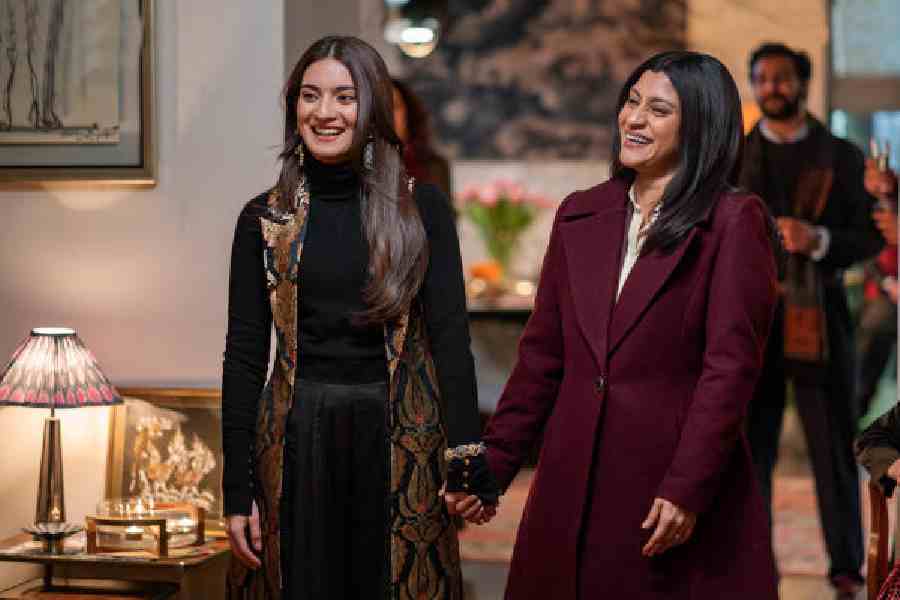
In Accused, Konkona Sensharma plays a queer doctor based in London whose successful career grinds to a halt when she is accused of sexual misconduct. Laapataa Ladies alum Pratibha Rannta plays her partner in this Anubhuti Kashyap-directed social thriller that will release on Netflix on February 27. t2 recently chatted with Konkona, Pratibha and Anubhuti about their film with a difference.
Anubhuti, what spurred the idea of Accused?
Anubhuti Kashyap: The germ of the idea came from Netflix, who shared it with me and the writers (Sima Agarwal and Yash Keswani). We haven’t seen films in India where a woman is accused of sexual harrassment. That is where we started from and then step by step, we built on it.
Konkona and Pratibha, what were the primary reasons that made you want to be a part of Accused?
Konkona Sensharma: When I read the script, I was pleasantly surprised. This seemed right up my street. This is exactly the kind of space I like to explore. There is a lot of nuance and layering within the screenplay, which I really enjoyed.
The character (Geetika Sen) that I play is unusual. It was a joy to depict the complexities of the character and the complexities within the screenplay itself. Anubhuti is someone I really wanted to work with. I also wanted to work with Pratibha (Rannta)... I really appreciate their work. So there was absolutely no reason to not do the film. I was very excited that it was offered to me.
Pratibha: For me, too, it felt like the right story to do with the right people. I liked how my character (Mira) was written. The film looks at how when a person is accused, not only does their world fall apart, it also affects the person who is most closely attached to them. In the case of Geetika, that is Mira. To be in that space and perform with Koko (Konkona) was the biggest challenge. I was very nervous, but Anubhuti ma’am always held my hand and Koko was super sweet to me on set (smiles).
Konkona: Pratibha is so good in the film! She shines as Dr Mira.
Anubhuti: We always expect Koko to be Koko, and she is fantastic in the film. But Pratibha was the real surprise package right from Day One.
Anubhuti, considering that this is a rare Indian film in this space, one that shows a same-sex couple and normalises it, did you have any dos and don’ts while approaching the subject?
Anubhuti: There were some dos and don’ts that we built for ourselves, and not because of any external factors. We wanted to tell a story that focused on the accusation against a woman, the drama around it, and what it does to her relationship. At the heart of the story, there is a queer couple and we wanted to tell the story without making any statement on their queerness or their relationship. From the writing stage, we decided that we would portray their queerness as a completely normalised relationship. That was pretty much the strongest guide we had in our heads.
Also, we want the story to be seen by as many people as possible, especially in India. But in this country, there is sometimes a stigma attached to queer people, which is unfortunate. We were conscious of not shooting the film in a way which could make some people uncomfortable. We want the viewer to end up with some kind of discomfort, but that is in relation to the story. We didn’t want the film to fall prey to any kind of unwarranted controversy. At the end of the day, we wanted to tell a nice, simple, pacy relationship drama, which ended up becoming a thriller.
Konkona, you played a queer character with great impact in the Netflix anthology Ajeeb Daastaans. That character had angst and agency but was also vulnerable and disenfranchised, much like Geetika. Did you find any parallels between the two characters even though they operate in a different time, space and strata?
Konkona: The two characters are very different from each other. All the characters that we play affect us in a way, psychologically speaking. They probably shape us in many ways. But apart from the fact that the two (Bharti in Geeli Puchhi from Ajeeb Daastaans and Geetika in Accused) are queer, I found very little that was similar between them.
In Accused, the queerness is not at the front and centre. Bharti and Geetika inhabit very different worlds. They are both very well fleshed-out characters. Both have many other characteristics and their definition is not limited to their sexual orientation alone.
Pratibha, what did you bring on your own to Mira that was perhaps not there in the script?
Pratibha: I did not intellectualise it. For me, it was derived from life in many ways. Distrust in a relationship is something that most of us go through. I latched on to that feeling that what happens when your partner is accused of something... it also affects your life in many ways. As a partner, you want to give all the support you can but what happens when the accusations outside and the voices in your head keep getting louder? Mira sticks to supporting her partner, choosing to go the extra mile and take things in her hands.
Konkona and Pratibha, what kind of voice and vibe does Anubhuti bring to Accused?
Pratibha: From Day One, Anubhuti ma’am was clear about how she saw the film and the characters in it. She gave me a couple of references to have a better understanding. The workshops we did also helped. I would see Koko and Anubhuti ma’am discuss certain things that perhaps my character couldn’t see from their lens, but to just observe them having a conversation about relationships and about women in general was a learning experience. Those conversations really helped me on set, everything flowed very comfortably.
Konkona: We were very lucky to have Anubhuti helming this project. I knew of her work from before and we also have a lot of friends and acquaintances in common. Even before I started working with her, she felt very familiar.
Shooting this film was intense, and we were a close-knit team working together in a location outside the country. The closest people to me on set were Anubhuti and Pratibha. We really got to know each other.
Anubhuti has so much depth and restraint in her persona and in her storytelling, but she also works with a certain lightness of touch. It is not that we were seriously sitting and talking about the complexities of our characters all day. On the contrary, there would be a lot of faffing around, and conversations about food, sleep and what kind of thermals one was wearing in that intense cold! (Laughs) I felt taken care of in an environment where we all had the confidence that Anubhuti was the right person to handle such a project.
In the world we live in, women are held more accountable for their words and actions, as well as being constantly under the lens of preconceived notions and moral judgement. Do you think that it is more applicable to the male-dominated industry you are in?
Anubhuti: Yes, sure. But it is not just in this industry... it is everywhere.
Konkona: I agree with you, it is there but is also different on a case-to-case basis. Everyone has their own way to navigate through it. Honestly, I have never felt that being a woman in this industry has held me back in any way. I have personally not faced any kind of discrimination... I am possibly one of the few lucky ones. So I probably have an easier approach and perspective towards how the gaze (towards women) is in general.
I have not faced any kind of gender discrimination in my place of work... at least nothing that I am aware of. It may have influenced some people here and there, but I wouldn’t even know about it. But one can’t deny the fact that it definitely exists in every industry and is something that cuts across nationality, religion.... Women in every society have always been told what to do, what to wear.... It is an unfortunate truth that hits certain sections of women more than others. But we are women who have many privileges — we can go out and work because we often have help at home.
Pratibha: I come from a family where my grandmother took the initiative to go out and work at a time when many women weren’t. That alone has given me so much privilege in terms of the environment I grew up in and the education I had. I do know people who have faced discrimination, but the good thing is that most are now aware and many women are pushing back.
How important is it for women to tell women’s stories? Konkona, do you feel the responsibility of that even more being both an actor and a filmmaker?
Konkona: It is absolutely essential to tell women’s stories because we don’t get enough of them. But eventually, I want to reach a place where I can say that it doesn’t matter. I would like to tell entertaining stories without worrying about whether it is woman-led or woman-centric. But also being a woman, the stories that often originate from me are experiences of being a woman. So by default, they become women-centric stories. I wish there was a bigger and better market for these kind of stories, but there has definitely been some growth.
While I was directing my first film, A Death in the Gunj, I remember being asked why my protagonist was not female. That is very unfortunate and unfair. I don’t think we should be telling women what stories to tell. Right now, the percentage of women filmmakers in India is very less and that needs to grow. At the end of the day, what stories women choose to tell is their prerogative... no one needs to tell them what to do.