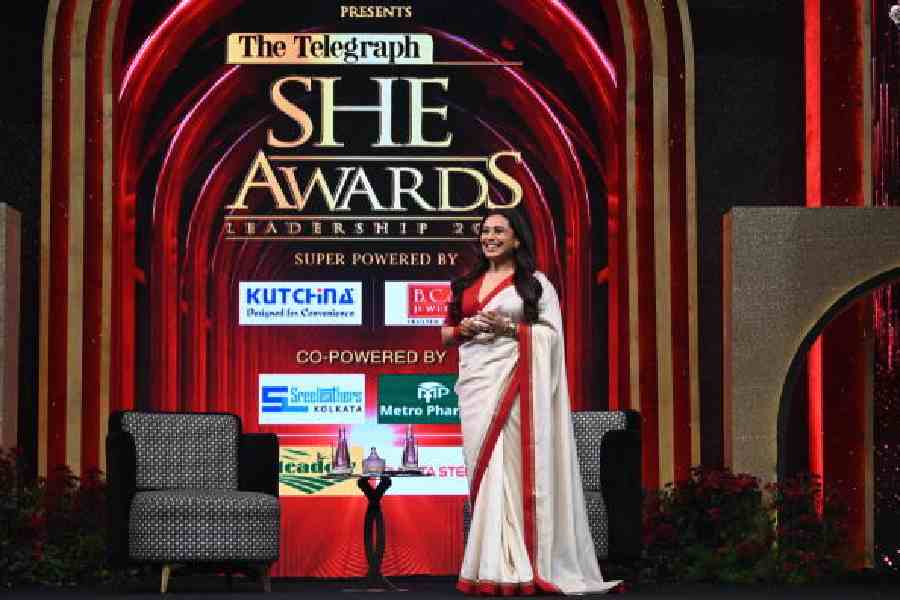
Ten years of excellence. Ten years of crowning the uncrowned. Ten years of recognising the unsung sheroes who have not only contributed richly to Bengal but have also made us proud outside it. The 10th edition of The Telegraph She Awards, presented by Secret Temptation and The Bhawanipur Education Society College, super-powered by Kutchina and B.C. Sen Jewellers and co-powered by Sreeleathers, Metro Pharma, Meadowkart, and Rungta Steel, held on February 11 at JW Marriott Kolkata, unfolded not only as an evening that celebrated the recipients of the last decade, but also honoured a true achiever with a Bengal connect who has been known as the undisputable ‘queen’ of Bollywood for three decades.
Dressed in a laal paar shada sari custom-made by designer Sabyasachi Mukherjee, a luminous Rani Mukerji was presented the She Power award. Warm and witty, gracious and graceful, Rani was presented the award by superstar and icon Prosenjit Chatterjee. Also doing the honours were Sharmila Sen of B.C. Sen Jewellers, Shipra Dey of Sreeleathers, Namit Bajoria of Kutchina and Vinit Daga of McNROE Consumer Products.
After a warm hug with Prosenjit, who later joined her on stage to share some Rani-Bumba anecdotes, Rani — fresh from the success of her latest film Mardaani 3 and on a high after her National Award win for Mrs Chatterjee vs Norway — took to the podium to deliver a heartfelt speech that spoke about her love for Calcutta, about the strong childhood roots that gave her wings to fly, and what has made her power on for three successful decades as an actor.
“Kemon achho, Calcutta,” was how a smiling Rani began her speech, going on to talk about her “first-ever shot in front of the camera”. “It was for a film called Debanjali, produced by my mashi, Debasree Roy. My Dida insisted that I take the mahurat shot for the film here in Calcutta, for which Aparna Sen gave the clap, and Bumbada (Prosenjit) started the camera! I was dressed as Maa Kali for that particular shot,” she recalled.
Summing up the experience of returning to her roots to accept The Telegraph She Awards, Rani continued: “It feels truly surreal that today I visited Kalighat with mashi, and Calcutta is now honouring me with an award for my work in cinema. For me, this moment will be etched in my heart forever. West Bengal and all the Bengalis living across the world have always supported me and I am indebted for this unconditional love. You showered the same love for Mardaani 3 and made it a hit! From the bottom of my heart, thank you for your warmth and your generosity,” she said.
Rani also expressed her happiness about receiving the award from Prosenjit. “Bumbada has always been like family to me — someone I have known since my childhood. It is extremely emotional for me to receive this award from Bumbada, who was also my first hero, in the Bengali film Biyer Phool, and someone who has been a towering force in Bengali cinema.”
She also spoke about her long association with The Telegraph. “The Telegraph and I go back a long way. The group has been an incredible support system in my journey in cinema and it is a great honour to receive the She Power Award from a media house that I deeply respect for its transparency and accountability in journalism. This award feels like a beautiful validation of my celluloid journey that began over 30 years ago... rooted in passion, courage and belief.”
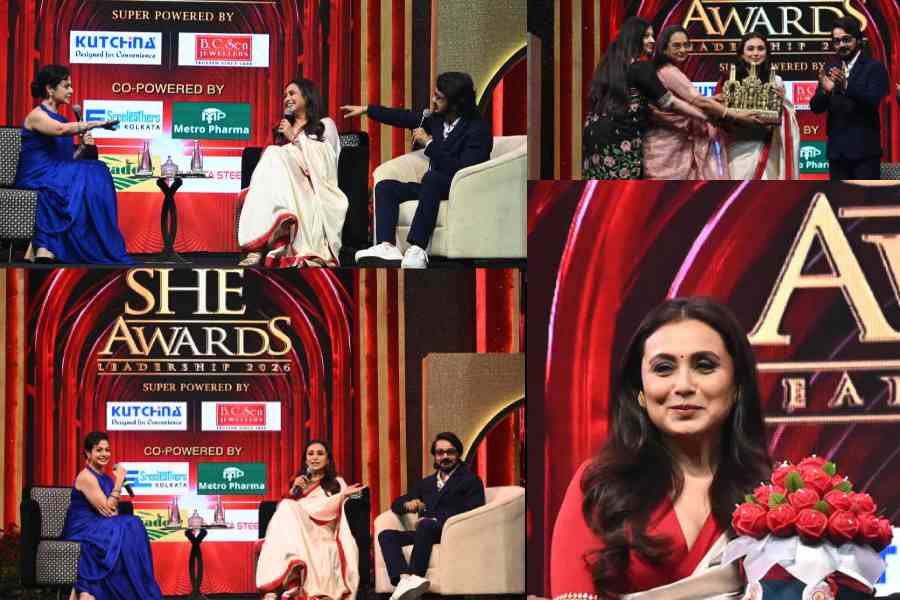
Sweet and cherishing moments
Lastly, Rani said that she would continue working hard for all the women out there. “As an actor, I constantly strive to entertain, tell meaningful stories and push boundaries that inspire women to dream big and follow their passion. I promise you all that I will keep staying on course to represent women in the way they should be on screen. We are tireless fighters, nation builders and society shapers and I dedicate this award to all of you.”
Post receiving The Telegraph She Power award, Rani was joined on stage by a previous She Awards winner — Tollywood actor Koel Mallick. Dazzling in blue, Koel sat down with Rani — with Prosenjit joining the duo midway — for a hearty interaction that proved to be the scintillating crown jewel on an already sparkling evening. Excerpts.
Koel Mallick: Rani, Mardaani 3 is a box-office success. What do you think it is about Mardaani that appeals so much and when you made the first film, did you think it would become such a big franchise?
Rani Mukerji: Actually, not. As we all remember, the Nirbhaya case that happened in 2012 completely shook the entire country. We were all very angry, frustrated and terrified by the horror and the audacity of the crime. Mardaani was born out of the collective anger that I felt as an artiste, Adi (Aditya Chopra, producer and husband) felt as a producer, Pradeepda (Pradeep Sarkar) felt as a director and Gopi Puthran as the writer.
Mardaani was our way of expressing our grief and anger towards such a crime. It was also a way for Shivani (Shivaji Roy) to be a woman in uniform — a character that empowers women and instils power in women. We felt that enough is enough!
But the sad part is, we sit here today in 2026, and we still talk about women’s safety. We still talk about crimes, the quantity of which has only increased. Mardaani reminds us as women that we are Shakti, and we have to keep believing that we have the power to fight these things.
The more conversations we have towards women’s safety, the judiciary will finally come out with stricter punishments that will probably never allow a person to even think of committing a crime like that. The film has created awareness.
After Mardaani, I never thought Mardaani 2 would happen. And after Mardaani 2, I didn’t think Mardaani 3 would happen. But we make these films because it is important to make people aware... we tend to be in our own bubble and think that everything is hunky-dory. But the truth is, these kind of crimes are happening right below our noses, next to us. It is important to make women realise that we need to talk about safety... not only outside, but also within our homes.
Koel: You, of course, hail from the famous Mukerji family that has contributed richly to Indian cinema and continues to do so. At what point in your life did you realise that several members of your family make films for a living as well as for passion and that you also wanted to do the same?
Rani: I never thought of becoming an actress. My mashi (Debasree Roy) is a very, very big icon. Every summer, during my childhood, my mother would put us in the Gitanjali Express and bring us to Calcutta. Bumbada (Prosenjit) would spoil us rotten! Bumbada would take us for pastries. My brother used to love eating, so they used to all catch Bumbada... he was the go-to person. He loves kids... at least he would love us a lot! (Laughs)
(Cue for Rani to call out to Bumbada aka Prosenjit in the audience and request him to join her, which the Tollywood superstar did in a heartbeat)
My mother was married in Bombay and she would miss her home in Calcutta, my naani-bari, so to speak. So summer vacations were only in Calcutta for us. I used to call Debasree Roy Chumki mashi, and she would never be at home... she was always shooting. So if I had to meet her, I had to go to the set. There were different sets like NT1, Technician’s Studio…. So, I used to go to all these places to meet mashi.
Koel: What do you remember most about being on those sets as a child?
Rani: When I used to enter the make-up room, because that used to be the only place where there was AC, I would see a big mirror with lights. As a kid, the make-up room, the mirror, the bulbs and the smell… the smell of powder, the pancake smell... that was a big associative memory. I would insist on sitting in the make-up room. I would say nothing, just observe and, of course, meet mashi.
Calcutta also means Didar haath-er ranna! Though the kitchen had gas, she used to cook on a small unoon (clay oven), and I used to love her haather ranna. She is no longer with us. But I always feel I have come to Maa’s house when I come to Calcutta.
Koel: What would you count as the milestones of your career so far?
Rani: I became an actor by chance because my mother was very keen. My family was not really going through a great time and my mother insisted I become an actor. She probably thought that me being an actor would probably improve the financial situation at home. I was hardly 16 then and wasn’t aware of many things. But slowly, I started seeing the difference that me being an actor started making in my home. From childhood, my dream was to give my parents a beautiful life, a comfortable life, a happy life.... And seeing them thrive and happy made me want to go to work even more. So that was my beginning.
My milestones have always been associated with audience acceptance. These 30 years wouldn’t have been possible without them. The audience is responsible for pulling me through. Being a married woman or being the mother of a baby girl has never come in the way of my audience accepting me. They have helped me smash the glass ceiling, as they say. If they hadn’t accepted me, I would not have been able to sit here today and have this conversation.
Koel: What would you cite as your most creatively satisfying experience as an actor so far?
Rani: All my films, in some way, have been very creatively fulfilling because very early on in my career, I accepted roles that pulled me towards them as a woman. I have always wanted to portray strong Indian women and showcase them to the world. How resilient we are, how fearless we are.... Indian women are super women. I have always tried to do roles that have inspired me as a person. Whether it was Meera Gaity, the journalist from No One Killed Jessica, Debika from Mrs. Chatterjee vs Norway... whether it was Shivani from Mardaani or Naina Mathur from Hichki... Shashi from Yuva or Riya Prakash from Hum Tum.... all these characters have been instrumental in talking about varied Indian women and their voices.
Koel: What would you say is the most pressing issue that women, in India in particular, face at the moment?
Rani: It is time we don’t address women, we address men. They are the ones who have to change their mindset, they are the ones who have to think, they are the ones who have to understand that women don’t need a character certificate from men. We don’t need men to tell us what we need to do, what we don’t need to do. We need them to treat us as equals, as just us. Whether it is our fathers, brothers, husbands, sons... they don’t need to dictate how we need to run our lives.
Honestly, we are the ones running theirs! It is time that even workplaces understand the power of a woman. They need to understand that women are, in many ways, Shakti. Shiv and Shakti have to go together. Only then is there a balance in the universe. If anyone tries to tip it one way or the other, there will be no balance. So, for true balance in the world, in the universe, in our homes, and in every aspect of life, equality needs to be maintained.
Koel: The Telegraph She Awards honours women with grit and gumption, who have stood their ground with a lot of strength, no matter what the circumstances in life. What, for you, is a shero?
Rani: I will always take my mother’s example. Bumbada would agree with me, because he has seen my mum up close and personal. For me, my mum stands for women’s power. My naani stood for that too. My naani was a dynamic lady. She produced four wonderful daughters.
Thanks to my mother’s family, I have had this fierce feminine energy around me since childhood. We didn’t grow up in riches, we didn’t grow up with everything that is given to many children or served on a platter to them. I saw my mum and dad struggle through every bit of life, but always with such a vibrant smile. I always saw them smiling, I always saw them spirited.
My dad and my mum always had this loud laughter. There was always happiness in my house. Even if there was one pot of rice in my house, that rice would be made with so much love that it would never get over. I watched my mum pull through, she was a fighter. So was my dad. I am blessed to have my mum, Krishna, and my dad, Ram, in my life. They are my Ram-Krishna. My mum says that when they got married, their friends watched Hare Rama Hare Krishna outside their room all night! (Laughs)
Koel: Bumbada, do you want to ask Rani something?
Prosenjit: I don’t want to tell my age (smiles), but I remember seeing her as a little doll with curly hair, walking towards me. I was already a hero by then. As a kid, she would tell my mother that she wanted to marry me! One day, my mum took out all the old albums and she told her: “Bumbada has got married.” My dad (Biswajit) and I looked similar, so she showed her his pictures. She also told her that by the time she grew up, my hair would turn grey. Rani thought about it for sometime and said: “Toh kya?! Godrej laga lega!” As in hair dye laga lega!
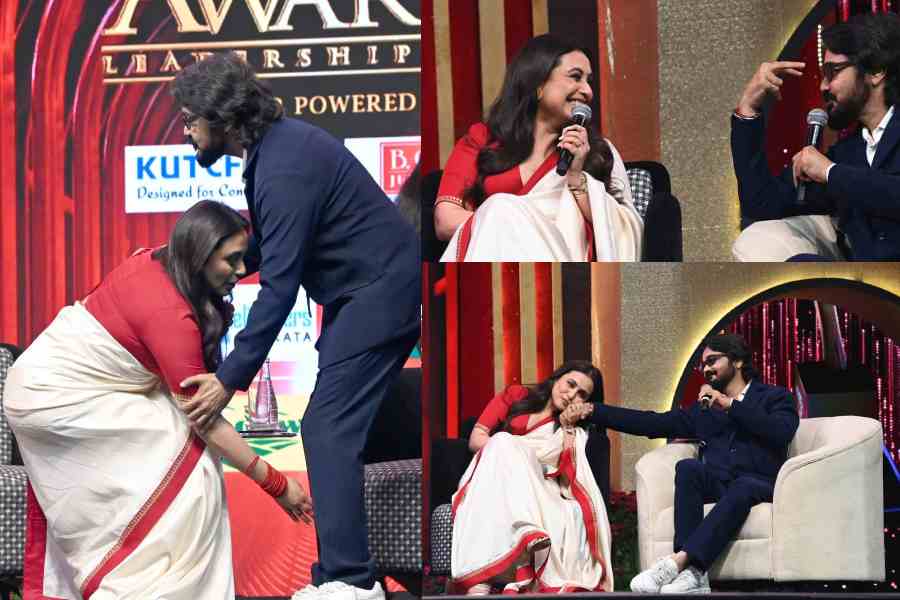
Rani shared anecdotes from her childhood with Prosenjit, with the vibe between the two bringing on nostalgia and smiles
I must also say that apart from her remarkable career of 30 years, she is a remarkable person. She is a person who keeps her entire family together. I have seen the kind of commitment she has towards her family. I am saying this from my heart. I must bless her because she is a wonderful human being. She is the ‘Rani’ of the entire family, whether it is the Mukerji family or the Roy family. She never forgets to call anybody when it is a family get-together. It is something people should learn from her. My sincere blessings and my love to her. She has been an inspiration to so many of us.
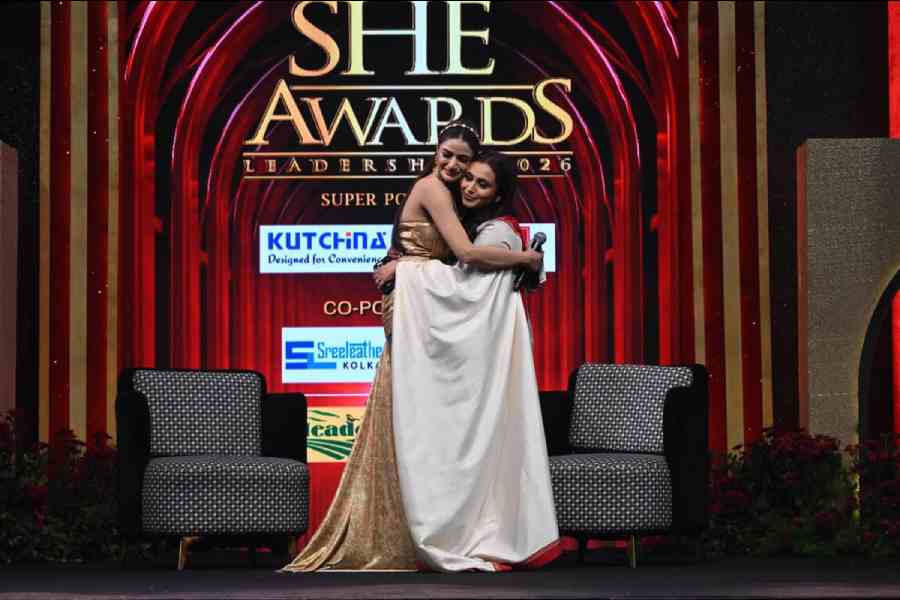
Rani and Sauraseni Maitra, the host for the evening, share a hug
The evening ended on a celebratory note, with a cake being brought out to celebrate Rani’s National Award and Prosenjit being recently conferred with the Padma Shri. It was made even more special by the presence of the cream of Team Tolly — Rituparna Sengupta, Raima Sen, Abir Chatterjee, Aniruddha Roy Chowdhury, Sudipta Chakraborty, Iman Chakraborty, along with Koel, who joined in for a slice of their success.