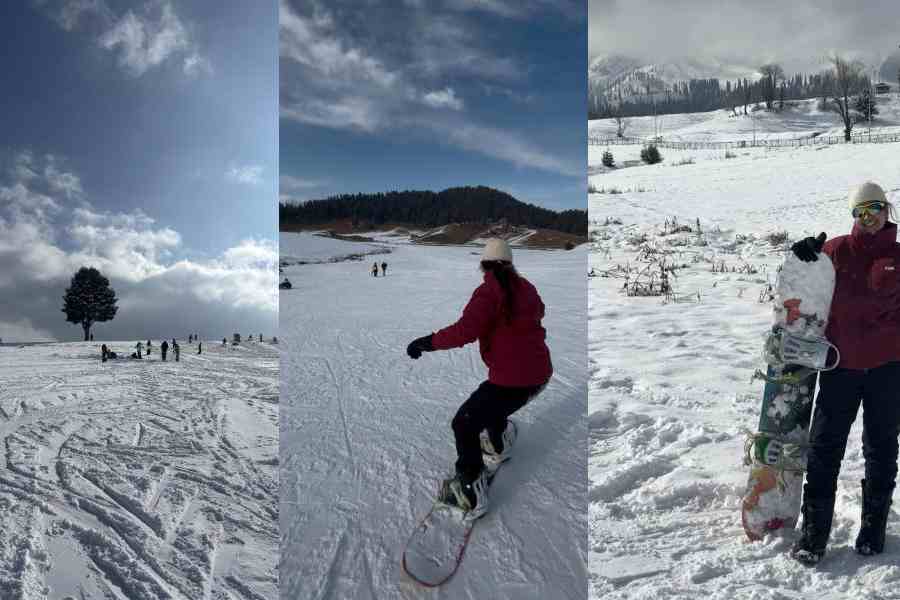
Why am I doing this? I kept asking myself the same question as I trudged uphill, snow crunching under my boots, lungs burning, my snowboard already a kilometre ahead of me, slung casually over my instructor’s shoulder.
Why am I doing this? Why had I taken 10 days off, travelled to Kashmir alone, chosen a sport I had never tried? Some people say you’re supposed to learn young. At 31, I couldn’t decide whether this was adventurous or simply foolish.
The questions followed me up the slope. And for once, I couldn’t call my sisters to help me make sense of them. This was a puzzle I had to sit with on my own.
I landed in Srinagar on January 4. The air felt sharp, closed in on itself, as though the mountains were holding their breath. Fifteen minutes into the drive to Gulmarg, it began to drizzle. Then, slowly, it turned to snow, the first snowfall of the year. Forecasts had said it would snow later. Nature disagreed. The snow fell without urgency, each flake choosing its own pace. Soft enough to feel forgiving. Heavy enough to remind you who is really in control.
That was my welcome.
Not everyone who comes to the mountains is looking for rest. Some of us come to be shaken. This wasn’t a holiday. It felt more like a decision.
I had come to Gulmarg in January to learn snowboarding alone — late, inexperienced, and acutely aware of my body’s limits. What began as a personal challenge quickly became an education in fear, terrain, and discipline, shaped as much by the mountain as by the realities of being a woman navigating a sport still designed around men.
As Kashmir quietly emerges as one of India’s most serious winter-sport destinations, Gulmarg offers more than powder; it demands patience, respect, and a willingness to begin again. Here, skill is learned, not admired from a distance.
By the time January came around, I knew I didn’t want a holiday built around doing nothing. I’ve never been good at stillness. Ten days in the mountains felt too intentional to waste on waiting around. Winter felt specific. Snow has a short window. Beaches don’t.
I had once written “skiing” in a journal years ago, without much thought, but in Gulmarg the decision shifted. My instructor told me skiing was easier to learn and harder to master; snowboarding harder to begin and gentler later. I listened, but that wasn’t what decided it. Snowboarding felt more exposed. There were no poles to lean on, nothing to hold. Just balance, fear, and control contained within the body. I think I wanted that.
The first day was less about learning and more about initiation. I was introduced to my board, handed layers of gear, and briefed on what the next few days would demand. My instructor told me what time to be ready the next morning.
The lesson began with a long trek of nearly 4km to what everyone casually referred to as the bunny slopes. The name was misleading. It had snowed the day before. Fresh, untouched snow stretched ahead of us, white to the point of being blinding. It felt so pristine that I became oddly aware of my boots pressing into it. I felt like my shoes were making it dirty. And yet, with every step, the snow seemed to clean more than it marked swallowing sound, softening the landscape, making everything quieter.
My instructor walked ahead, carrying my board with the ease of someone who belonged here. I followed slowly, breath visible, already wondering what I had signed up for.
At the top of the slope, I was surprised by how many people were already there, skiers, snowboarders, instructors, small groups, a few solo learners. There was comfort in it. Not the kind that dissolves fear, but the kind that steadies it.
Once strapped in, even standing felt like a task. There is a particular, undignified way you have to learn to get up when both feet are locked in: no poles, no leverage, just trial and error.
Before we began, I said a quiet prayer. Not for success, just for steadiness. We started with control or rather, the idea of it. How to slow down. How to stop. How to use your heels to create resistance in a sport with no brakes. I fell repeatedly: forward, backward, sideways. The snow caught me every time.
Going down the slope took seconds. Getting back up felt endless. No one had warned me that the hardest part wouldn’t be the descent, but the standing up again and again, breathless, cold, learning how to keep going.
The days settled into a rhythm: walking uphill, strapping in, sliding down, falling, unclipping frozen straps, lifting the weight of the board, and doing it all again. No one here was performing. Progress came slowly, almost imperceptibly, but it came.
The victories were private. Once, I stopped smoothly to avoid another snowboarder who had fallen in my path, no panic, just calm control. Another time, I completed a full run, moving left and right across the slope before falling at the end. I smiled anyway. For the first time, I recognised something unfamiliar: composure under pressure.
Being a woman on the slopes meant becoming aware of systems long before becoming comfortable on the board. The most immediate lesson came through the gear. Snowboarding is expensive, and in Gulmarg, access is uneven. Good boots are hard to come by. Many instructors have built their inventory slowly, asking international students to bring equipment from abroad. Rental gear exists, but it prioritises durability over fit. The boots are heavy, demanding strength before offering support. Clothing follows a similar logic. Sizes are limited. Function comes before comfort. You adjust, because you have to.
There were other women around, some alone, some in groups. We didn’t speak much, but the recognition itself was grounding. Solitude here didn’t feel unsafe. Just exposed.
Gulmarg reveals itself slowly. Many instructors are self-taught, part of a second generation that learned locally, season after season. One absence was noticeable. There were no female instructors, neither for skiing nor snowboarding. The reasons were practical rather than spoken aloud: the physical demands of carrying equipment uphill, daily, remain a barrier. It wasn’t framed as exclusion. Still, its absence lingered.
Higher up the mountain, experienced international riders arrive for weeks at a time. For them, Gulmarg isn’t a classroom but terrain. Instructors act as guides, not teachers.
On the learning slopes, there were no selfies. Falling was expected. Getting back up was yours to figure out. Gulmarg doesn’t reward spectacle. It rewards discipline.
By the end of it, I knew two things clearly: that I am still a beach person, and that discomfort, when chosen deliberately, teaches you something gentler than fear.
On my last afternoon, standing still at the edge of the slope, breath fogging the cold air, I watched my tracks disappear behind me as fresh snow settled over them quiet, unremarkable, and earned.