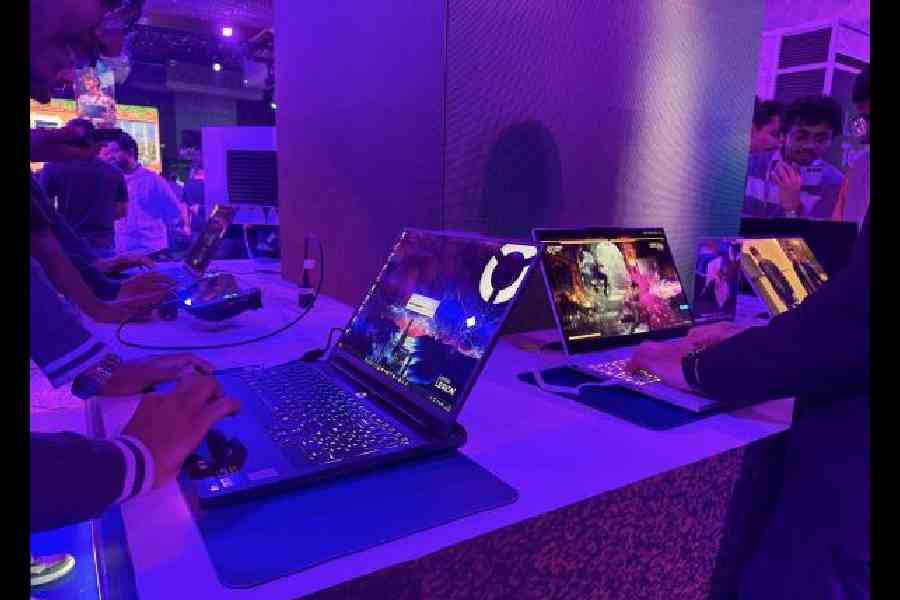
If you come across neon pink brain artworks splashed across a canvas or digital screen, you instantly recognise the signature style of Toosid — the creative alter ego of Sidhant Gandhi. His bold, pop-art-inspired aesthetic feels like a contemporary nod to the late Roy Lichtenstein and Claes Oldenburg, blending playfulness with cultural commentary. Yet beyond the striking visuals lies a deeper philosophy about creativity, storytelling and the evolving relationship between art and technology.
Speaking at Lenovo Tech World India in Delhi on Wednesday, Toosid returned repeatedly to one central idea: art and technology are not adversaries. In fact, he believes they thrive best when they coexist.
Over the years, Gandhi has built a multidisciplinary career — spanning art direction, film posters and virtually anything that can be designed. That versatility, he says, gives him confidence in an era where artificial intelligence is often seen as a threat to creative jobs.
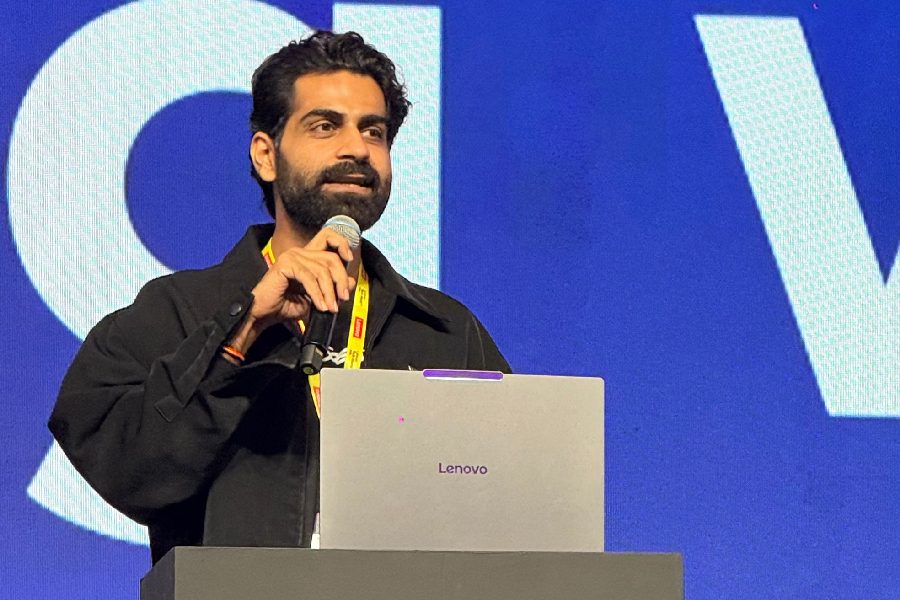
Toosid, aka Sidhant Gandhi, at Lenovo Tech World India. Picture: The Telegraph
“It puts me in a safe spot,” he explained. “I’ve always leaned towards technology, but I never really worry about AI taking away my job. I’ve always used technology as a means to express my thought process and tell my story.”
For him, technology has always been a tool... an enabler rather than a replacement.
His portfolio reflects that approach. Toosid has worked with leading brands, including Netflix, to bring AI-infused creativity into mainstream campaigns. He was closely involved with Ranbir Kapoor’s ARKS lifestyle brand, helping shape its visual identity, and contributed to MG Select’s The Select Art initiative. Across these collaborations, AI was not the originator of ideas but a supporting instrument that expanded possibilities.
However, he draws a firm boundary when it comes to storytelling.
“Storyline is the one part where you should not use AI at all,” he said. “Use AI for everything else — but not here.”
According to Toosid, storytelling rests on what he calls the three Cs: creator-driven vision, clarity and conviction.
“First, it must be creator-driven,” he explained. “You have to tap into your soul for creativity and offer something that genuinely reflects you. Second is clarity. Once you know what you’re making and who you’re making it for, you apply clarity to that idea. Then comes conviction. If someone challenges your idea, you should be able to stand by it.”
Without those three elements, he believes, no amount of technological enhancement can save a weak concept.
He emphasised that storyline remains the backbone of any meaningful creative output... whether it is a product campaign, a political campaign, a film, an advertisement or even a social media post. “You should know who you are and who you are creating for. Once you have that sense of identity and audience, you can begin using AI. AI can be your first collaborator.”
Toosid also highlighted tools such as Lenovo’s Creator Zone and Learning Zone as practical platforms for experimentation. He described AI as a sounding board — a system that can assist with research, uncover historical context, test ideas and identify blind spots.
“If you want to create something set in the 1950s involving your grandfather, and you have a photograph and know his story, AI can help you research the time period. It can help you build that world,” he said. “Once you receive a stereotypical answer, you understand what general perception looks like. AI can also show you potential flaws in your idea and what people might question.”
The Mumbai-based artist believes AI can also simplify archiving and documenting one’s creative journey. Yet he cautioned against superficial engagement with emerging tools.
“Many people talk about platforms like Midjourney or Gemini, but they never really sit down and practise,” he observed. Mastery, he implied, requires experimentation — not just name-dropping.
Ultimately, the debate, in his view, comes down to intent. Will creators treat AI as a collaborator or merely as a shortcut to commercial gain?
“AI is a tool. It is your collaborator,” he said. “Some people think they don’t need to think anymore — they can just use AI to write a script and make money. That approach will die. Only good stories survive.”
Drawing a parallel with cinema, he added: “Think of films from 1975. Many were released that year, but we only remember the good ones. A lot of films today use AI in ways you don’t even notice — for dubbing or language adaptation, for instance. They use AI for its strengths.”
In the end, Toosid’s message at Lenovo Tech World was not about resisting technology, but about redefining its role. AI may assist, enhance and accelerate but the soul of storytelling, he insists, must always remain human.