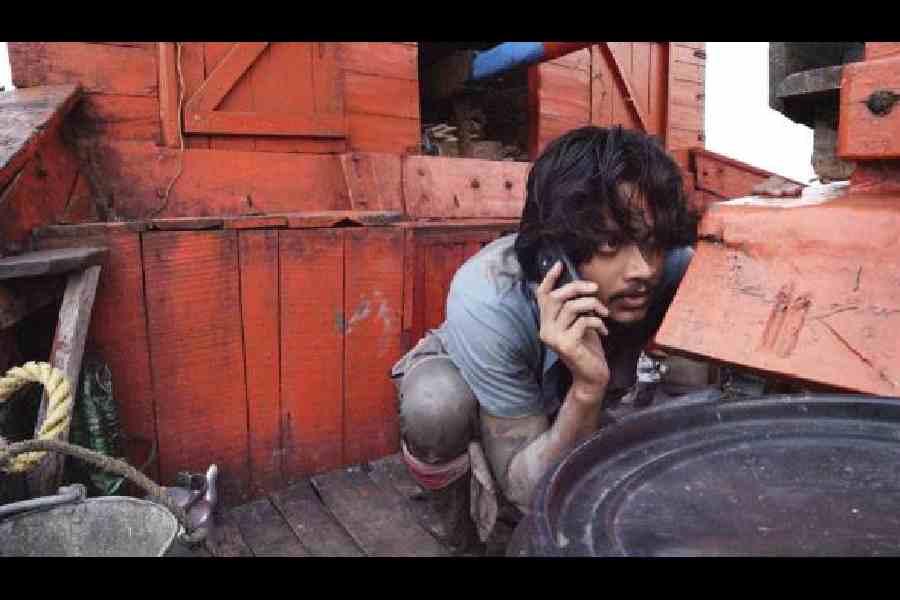
When a political assassination goes wrong, Palash, a 23-year-old hunter, becomes the hunted in Ranjan Ghosh’s film Adamya. As he flees from the system, the meaning of the collective and its movement undergoes several changes. A t2 chat with Ranjan Ghosh...
Why was it important for Adamya to be a single-character film?
When you pick out one matchstick from a box, it becomes the story of an individual. Every matchstick with fire on its tip is capable of gutting mansions of tyranny, palaces of greed. This aspect lent itself very easily to the concept of a single-character film. For me, Adamya needed to let audiences live inside Palash’s mind rather than just observe him. The most effective way was to centre the narrative around a single protagonist’s journey. That focus allowed us to strip away distraction and really interrogate how one individual responded when the system turned on him.
Did you ever consider softening the political sharpness of the film to make it more “viable”?
Not for a second. Because the moment you start thinking of “softening” something like this, you are already betraying the very reason the film exists. When a young man is branded an extremist, when resistance is automatically criminalised, when poverty and exploitation are normalised, when democracy becomes something fragile and manipulated — how do you “soften” that? I wanted to make Adamya unflinching. Because Palash’s world is unflinching. If that makes it less “viable” in an industry sense, then so be it. And if audiences are unwilling to see themselves in an urgent political story, then perhaps that’s the larger conversation cinema needs to have.
When producers hesitated, did you ever doubt your decision to go independent?
Of course, there were initial moments of doubt. Anyone who tells you otherwise is lying. But doubt and conviction often walk hand-in-hand. I quickly realised that if someone else’s risk threshold dictated the film’s shape, it would never be the film it’s meant to be. Going independent was a leap of faith I just could not avoid.
What does true independence mean to you — as a filmmaker and as a citizen?
True independence is not a funding model or a production category or a festival label. Independence is a state of refusal. The refusal to be trained into silence. Because let’s be honest — we live in a time where freedom is constantly being redefined for us. Where you are allowed to speak only as long as what you say is harmless. Where dissent is tolerated only until it becomes inconvenient. Where the moment you ask why, you are treated as dangerous. As a filmmaker, I will not make cinema as decoration or escape, which exists only to be consumed and forgotten. And as a citizen, independence is the right to look at the world around me, and not pretend it is normal. Some films cannot be made while constantly asking, “Will this offend someone powerful?”
How did working without infrastructure change your understanding of cinema itself?
Shooting without the luxury of lights, heavy gear, big crews — it refocused me on what cinema at its core really is: storytelling, human presence, and attention to truth. When you have fewer tools, you rely more on instinct, on the performative energy of your actor, on the natural rhythms of the setting. It taught me that cinematic richness doesn’t always require a massive infrastructure — it requires sincerity, observation, and a willingness to embrace what’s unpredictable.
The Sundarbans feels less like a backdrop and more like a living force in the film. Did the environment there ever dictate scenes or moments you hadn’t planned?
The Sundarbans have their own tempo — the light, the tides, the winds, the silence at dusk. There were moments when the world simply refused to cooperate with a scripted plan, and in hindsight, those were the moments that felt truer. The flesh of the film, the sensations, the quiet gestures, the silences, even some of the emotional pivots were discovered in the moment. Sometimes a scene would stretch longer than written because the wind carried a particular mood, or a moment of stillness would demand silence instead of dialogue. Those unscripted gifts became part of Adamya’s DNA.
What made you trust a team of mostly first-time collaborators with such a demanding film?
First-time collaborators bring fresh ears, open hearts, and a willingness to experiment. They ask bold questions because they haven’t yet been taught to self-censor. That energy was vital — and looking back, it’s one of the reasons the film has the pulse it does. Passion often outweighs experience when the aim is truth. I was lucky I had Aryuun, Arka, Sourya, Arjo, and Shubham. Also, later, Pushpak.
How did casting Aryuun as the sole protagonist influence the film’s emotional texture?
In a single-character film, you don’t have the usual safety nets like multiple arcs, supporting characters. Everything — the tension, the silence, the political weight, the vulnerability — has to pass through one body, one face. Aryuun brought something very rare: a kind of rawness that doesn’t feel performed. He carries an innocence, but it’s not softness. With a more seasoned, familiar face, the audience might have arrived with expectations — they might have watched him as a “character.” But with Aryuun, you watch him as a person. You feel like you’re witnessing something unfold rather than something being enacted. His intensity also has a generational truth to it, embodying the restlessness of youth today — the anger, the confusion, the longing for justice, the fear of being crushed by forces too large to name. Casting him was the most crucial decision.
What did the villagers give to the film that no production budget ever could?
They gave us belonging, accepted us with open arms. Whenever we needed something, they came together to help. When we needed a trawler, the entire community arranged it. They would often gather to watch us shoot, but more than curiosity, out of care. They were constantly concerned about our safety in that landscape, checking in on us, ensuring we had what we needed…
Shooting without lights, tripods, or schedules — did constraint liberate or burden you creatively?
Liberate, undoubtedly. Constraints were strewn all along our paths, but they were liberating since we embraced them as invitations to invent. When you don’t want to rely on artificial lighting, big units, or rigid scheduling, you start listening differently; seeing differently. Constraints became a kind of creative problem-solving that kept the process alive and unpredictable in the best possible way.
Do you believe cinema still has the power to provoke ideological discomfort?
I do. We live in a time where discomfort is constantly avoided, where everything is curated to keep us inside our own bubbles. Cinema is one of the last collective spaces where you sit with strangers in the dark and are forced to inhabit someone else’s reality – fear, hunger, anger, longing. Cinema cannot change the world, of course. But it can disturb complacency. It can make people question the narratives they have been handed. And that discomfort is cinema’s responsibility.
What did Aparna Sen’s response to the film mean to you at that moment?
Her very first words, “Well done!” as she patted my back, shall remain one of my most treasured moments. It carried the weight of a lifetime. She has been a guiding presence. She responded to Adamya with such warmth… And for her to lend her name to the film as its presenter — especially when she has never done that before — was not just support, it was faith. It confirmed that its voice, its urgency, its questions mattered. For me, that remains one of the most treasured affirmations of my journey as a filmmaker.
Do you see Adamya as part of a lineage of political cinema in Bengal?
Yes, but not as a mimicry of the past. Bengal has a rich history of cinema that interrogates society and power, and Adamya belongs to that tradition in spirit. But it’s also a distinctly contemporary story, rooted in the lived anxieties of youth, ecology, and democracy today. It’s in conversation with the lineage, not a repetition of it.
Finally, if Adamya speaks to just one viewer deeply, what do you hope it awakens in them?
I hope it awakens reflection — not agreement or agreement with any specific idea, but the capacity to question, to feel empathy for someone whose choices are messy and complicated, and to recognise that no human turning point is ever simple. If just one viewer carries that after the credits roll, then the film has fulfilled its purpose.