When Prosenjit speaks about Kakababu today, there is a noticeable difference from the way he discussed the character a decade ago. The excitement remains, but it is now layered with reflection, responsibility, and an acute awareness of legacy. It carries naturally into his thoughts on returning, once again, as Kakababu — a character that has long outgrown the boundaries of age and era.
“This is our fourth film in the franchise, and what amazes me is the kind of response we’re getting now.” He pauses, choosing his words carefully, as if weighing the enormity of what the character has come to represent. “We’re not just talking about kids anymore. We’re talking about a generation — people in their 20s, 30s, families coming together. Children are coming with their parents, aunts and uncles. That’s when you realise Kakababu is no longer just a character. It’s a shared memory.”
One moment, in particular, has stayed with him. A student played the saxophone while thousands of students sang one of his memorable songs in unison. “I was cheering, honestly. I had tears in my eyes,” he admits. “Seeing so many students cheering… that’s not just nostalgia. That’s the present. That’s today.” Prosenjit genuinely believes that Vijaynagar’er Hirey is a film that families should watch together. He talks about children discovering Kakababu for the first time, just as earlier generations did through books. This intergenerational bridge seems important to him. He is aware that for many young viewers, this film may be their first encounter with the character. His performance, therefore, must function as both introduction and invitation — encouraging curiosity about literature, history, and exploration beyond the screen.
The Mentor Dynamic
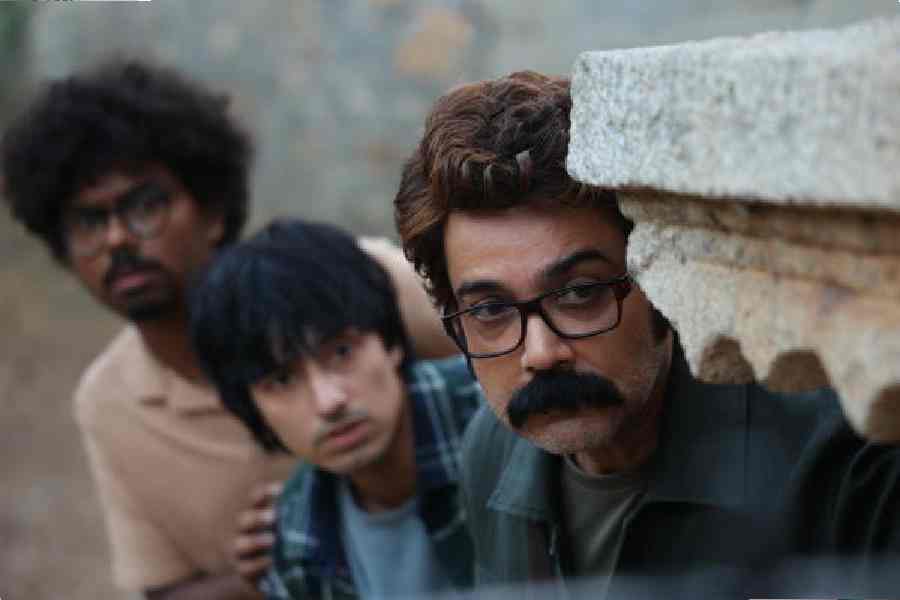
In discussing the film, Prosenjit frequently returns to Kakababu’s relationship with Santu. He highlights that Kakababu is never alone; he is always teaching, guiding, and learning in return. Prosenjit seems to enjoy this mentor-figure aspect of the role, perhaps because it mirrors his own position within the industry today. He speaks warmly about working with younger actors and about the energy they bring to the set. According to him, the presence of youth keeps the adventure alive and prevents the story from becoming solemn or heavy. This balance — between authority and warmth — is something he consciously tries to maintain in his portrayal.
"I see Kakababu as someone who enables others to grow, ask questions, and face fear."
Yet, despite the joy and emotional resonance, the journey of making Kakababu films has never been smooth. Prosenjit laughs when reminded of the challenges. “Nothing has ever gone smoothly,” he says, matter-of-factly. “In the past, we’ve shot in blackout zones with military personnel all around. During snow shoots, helicopters were kept on standby in case we needed rescue. To shoot in Hampi, every single camera angle needed separate permission.” Still, he insists that this chaos is part of the charm. “We enjoy the tension. Every moment connects us. That’s why, even under pressure, the journey feels fresh.”
Meeting danger with composure
Prosenjit has spent decades in the public eye carrying pressure with remarkable ease. Fame, expectation, and constant reinvention have been part of his life for so long that they no longer announce themselves on his face. When confronted with professional risk, he rarely allows tension to surface. Instead, he responds with warmth, humour, and a familiar, reassuring smile. It is not that the weight is absent — it is that he chooses not to display it.
This quality finds a natural echo in Kakababu, one of Sunil Gangopadhyay’s most enduring creations. Kakababu’s world is filled with danger — hostile terrain, collapsing ruins, ruthless adversaries, and moral dilemmas where a single misstep can prove fatal. Yet even at his most vulnerable moments, he rarely reveals anxiety.
The tension may be immense, but Kakababu refuses to let it dominate his expression. He meets danger with composure and, often, a gentle smile. That smile is not casual or careless. It is purposeful. It steadies those around him, especially the younger and less experienced. By masking his own unease, Kakababu prevents fear from spreading. He absorbs the anxiety of the moment so that others can think clearly and move forward.
In this sense, the connection between Prosenjit and Kakababu feels instinctive rather than constructed. Prosenjit does not have to perform this aspect of the character; he recognises it. This shared emotional language may explain why Prosenjit’s portrayal of Kakababu feels so authentic. Audiences sense that the actor is not borrowing a trait but sharing one. “The smile in the face of danger becomes more than a narrative device — it becomes a philosophy. A way of facing uncertainty without surrendering composure, and of carrying responsibility without transferring its weight to others,” said Prosenjit.
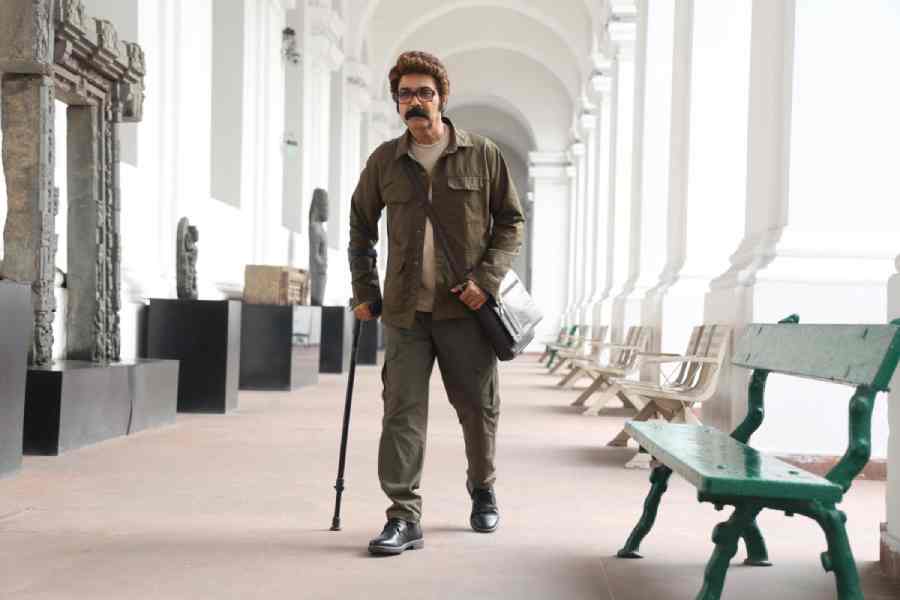
Prosenjit in 'Vijaynagar’er Hirey'
Carrying a Legacy on Screen
This alignment between actor and character deepens Kakababu’s resonance. He is not merely an adventurer navigating perilous landscapes, but a figure who teaches emotional courage. According to him, Kakababu is not someone who chases adventure for thrill alone; his journeys are guided by ethics, curiosity, and respect for history. He describes the story as layered — part mystery, part exploration, part adventure. In his words, the adventure is about understanding what the treasure represents.
As Kakababu has evolved, so has the storytelling around him. “From the very beginning, we wanted him to feel contemporary without losing his roots,” Prosenjit explains. The new film embraces adventure. “This time, it’s more about pace and danger, but the emotional core remains intact.” One of the most talked-about moments in the trailer is Prosenjit’s reunion with Chiranjeet. The nostalgia is unmistakable. “We worked together so much in the past — blockbuster films that people still remember. Coming together after so many years was emotional. Back then, life on set was different. We shared make-up rooms and meals. Even today, we remain deeply connected.”
When asked if he would ever act in a film directed by Chiranjeet, Prosenjit doesn’t hesitate. “Of course. In fact, I’ve been saying this for years — there should be a film with Ranjit Mallick, Chiranjeet and me together. It would be pure swag.”
His admiration for director Chandrasish Ray is equally heartfelt. “Honesty is everything in this profession,” he says firmly. “And Chandrasish has that honesty — as a human being and as a filmmaker. You can see it in his craft.” He also praises the film’s music, noting how the songs have struck a chord, especially Jatra shubho hok. “It connects instantly — with kids, with adults, with everyone.”
Behind the scenes, the work was painstaking and deliberate. “We worked on the script for almost a year,” Prosenjit reveals. Toward the end of the conversation, he speaks about Kakababu’s smile — calm, ironic, unshaken, even in the face of death. “That smile defines him,” he says softly. “He jokes in front of danger. That contrast — that humanity — is powerful. This film is the result of teamwork, patience, and love for storytelling,” he says. With Prosenjit, it has never been just about staying relevant. It has always been about staying connected — across generations, across memories, and across time.
What quality of Kakababu do you admire most — courage, calmness, intelligence, or compassion? Tell t2@abp.in