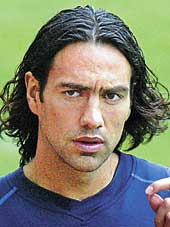
Best Italian bets
 |
| Nesta |
Tall, charismatic and handsome, Alessandro Nesta is one of the world’s most high-profile defenders with a full range of skills that includes vision and pin-point passing. He joined Lazio in 1992, enjoying as captain the fruits of their success between 1998-2001.
During this spell, Lazio won the Cup Winners’ Cup, reached the Uefa Cup final, won a Super Cup, two Italian Cups and the dramatic Italian championship in 2000 when Lazio pipped Juventus by gaining ten points over them in the last eight games.
In 2002 the then 26-year-old moved north to AC Milan for a fee of 30.2 million euros on a five-year deal. That season AC Milan were simply irresistible in Europe and after a penalty shoot-out win over Juventus at Old Trafford in May 2003, Nesta picked up a Champions League winners medal.
He earned his first national cap in October 1996 against Moldova and since that day has skipped past 50 international matches and looks set to clear 100.
He can reflect with satisfaction on a period in which he has taken over the role of defensive watchtower much as the great Franco Baresi did before him.
“He is the most complete player in the world in his position,” Baresi has said of him.
By the time Euro 2000 came along he was a trusted rock in the brilliant Italian defence that so resiliently held on against the rampaging Dutch in the semi-final only to be unlocked by a devastating late show by France in the final.
Out in Japan-Korea, Nesta was knocked out of contention by a foot injury in a group match loss against Croatia, who scored twice while he was off the pitch. He was unable to play in the controversial defeat against South Korea. Italy eventually stormed to Euro 2004 after a nervous start.
Nesta has been a crucial part of that effort and will be fundamental to any national success out in Portugal.
 |
| Buffon |
Gianluigi Buffon was a Serie A regular at 18, an international at 20. The late Juventus president Gianni Agnelli forked out 40 million euros to take the then 23-year-old to Turin in July 2001 and credited Buffon’s performances as key to their championship trophy in his first season.
His celebrated reflexes helped Juventus to a second consecutive title a year later, but despite two penalty shoot-out saves in the Champions League final, he was unable to prevent AC Milan winning Europe’s most prestigious prize in 2003.
He is a colourful and outspoken man who claims to have taken to goalkeeping due to his distaste for running. Born in 1978 he is the nephew of one-time Italy and AC Milan ’keeper Lorenzo Buffon and made his full Italian League debut for Parma in November 1995. By the following season he had displaced Italy international Luca Bucci in the Parma goal, where he was to make some 168 league appearances. With Parma he won the Uefa Cup and Italian Cup in 1999, but his ambitions dictated a move to a larger club in the form of Juventus.
He established himself as Italy No. 1 under the great Dino Zoff during Euro 2000 qualifying, but missed the finals with a broken thumb that left the door open for Francesco Toldo of Inter Milan to shine as they made the final. Nevertheless, he was back in goal for the 2002 World Cup and coach Giovanni Trapattoni still prefers him to Toldo, perhaps because of his brilliant one-on-one ability, penalty stops and lightening reflexes.
He is also known for his social work and was voted the Champions League’s Most Valuable Player in 2002-2003 at the European Awards in Monaco.
He has had his fair share of trouble. After requesting the No. 88 shirt at Parma, anti-racists said it was in reference to the eighth letter of the alphabet and stood for ‘Heil Hitler’. Buffon claimed to merely like the number. He also claims to have been beaten by police after being mistaken for a hooligan on the way home from an Italian Cup final.
Bulgaria
 |
| Berbatov |
With five goals in eight Euro 2004 qualifying matches Dimitar Berbatov played a major role in Bulgaria’s successful run toward the finals in Portugal as winners of Group 8.
This followed a rollercoaster ride in 2002 with Bayer Leverkusen when his German club suffered an agonising campaign that saw victory snatched from their grasp on three fronts.
After losing the Champions League final 1-2 to Real Madrid and a piece of Zinedine Zidane magic, they then threw the German title away as Borussia Dortmund pipped them on the last day and finally added to their horrors by losing the domestic Cup final.
An exodus of players meant Leverkusen just avoided relegation the following season but it was a year that Berbatov proved his own colossal worth. He was born in Blagoevgrad near the border with Yugoslavia where his father was a professional footballer with local outfit Pirin Blagoevgrad.
He made his own debut as an 18-year-old with the same club, but had a rough time to begin with and was whistled by fans for his hesitant inconsistency. But there has been no inconsistency at international level since his call up to the Bulgarian side in November 1999.
Three months later he scored his first international goal in a 2-3 defeat to Chile and has been on prolific form since. In January 2001 he joined Leverkusen where he suffered a knee injury that messed up his first season before he established himself as first choice striker. His own idol is the Dutch master Marco van Basten and in Marvov’s Bulgaria side he is on track to do justice to the memory of the legend who made headlines for AC Milan and on the international stage.
He is equally shaping up to add his name to the all-time great list of Bulgarian stars such as Stoichkov, Kostadinov and Letchkov.
Denmark
 |
| Tomasson |
Striker Jon Dahl Tomasson proved at the 2002 World Cup he can do business at the highest level and is already among the elite in the game when it comes to scoring goals. His four out of four at the tournament in Asia took Denmark into the second round where they lost to England.
Now AC Milan have brought him to the San Siro. Although he has struggled to get a start in Milan in a crack strike force featuring Andriy Shevchenko and Filippo Inzaghi, he is still crucial to Denmark’s Euro 2004 aspirations and scores at a rate of nearly a goal every two games.
His recent rise is in sharp contrast to a disastrous spell in his career in the mid-90s when he was nearly considered a washout. Born in Copenhagen, a steady start to his career took him to the Dutch league in 1994 as an 18-year-old where he became one of the top-scorers playing for SC Heerenveen. A big money move to the Premiership and Newcastle in 1997 was a complete disaster and after two miserable years in the north of England, he returned to Holland in an attempt to rejuvenate his career at Feyenoord.
Although he made his international debut in 1997, the goals had dried up at club level and he failed to make the Denmark team that reached the World Cup quarter finals in 1998. In 1999, he returned to his best form with Feyenoord becoming their top-scorer and was also decisive for Denmark scoring six goals in five qualifiers to help his country make it to Euro 2000.
Although Denmark were disappointing at the tournament in Holland and Belgium, he put the setback behind him helping Feyenoord to the Uefa Cup in 2002. Then came his brilliant World Cup campaign followed by a much-publicised move to Milan and although he has made only a handful of first team appearances, he was part of the squad that won the Champions League title in 2003.
Sweden
 |
| Berbatov |
The honour of slipping on the celebrated No. 9 shirt at Ajax Amsterdam, formerly graced by Marco Van Basten and Patrick Kluivert, is one that would weigh heavily on many a striker’s shoulders. Zlatan Ibrahimovic has been responding brilliantly to the pressure of that heritage.
Growing up in the rough and tumble suburb of Rosengord, Malmo, where he was born from Bosnian roots in 1981, he began to play for local side FK Balkan before Malmo FF signed him at 14.
With his slender frame Zlatan is a technically gifted striker with great sense of vision and a nose for goal.
The national coaching duo of Tommy Soederberg and Lars Lagerbaeck were swift on the uptake and gave him his Sweden debut in January 2001 against the Faroe Islands. He has since established himself at the head of the attack alongside Marcus Allback and Henrick Larsson. His first international goal came against Azerbaïjan in October 2001, shortly after joining Ajax in July that year.
After a tough first season in Amsterdam Ibrahimovic won the double with Ajax before going on to take part in his first World Cup, where he made two appearances. But it was not until his five goals in the Champions League 2002-2003 campaign, where a youthful and multi-talented Ajax missed a semi-final spot by a whisker, that European football stood up and took notice of his talents.
In January 2004 the striker decided to undergo a groin operation to resolve a nagging injury so as to fully resolve the problem well ahead of the Euro and was scheduled to be sidelined for two months. He would seem to have the world at his feet and only needs now to iron out his temper and fine tune his sense of positioning to become one of the stars of the Euro 2004 finals.
 |
| Allback |
Marcus Allback scored five goals in seven games during Sweden’s run to direct qualification for Euro 2004, and along with Zlatan Ibrahimovic is putting up pretty impressive performances.
Allback’s double against Hungary in Budapest gave Sweden a crucial 2-1 win in their third match to steady the ship after draws with Latvia away and Hungary at home.The professed wine lover will be 30-year-old in the week following the Euro 2004 final and his rise to the top has been slow but sure.
He played in all four matches in Sweden’s run to the 2002 World Cup second round after squeezing into the squad (he was the last man named) after a purple patch in the spring of that year that had seen him move to Aston Villa in the English Premiership in May. He started out with four seasons at Orgryte before a switch to Denmark’s Lyngby in 1996. Then came a miserable time in Italy where he failed to score in 16 starts for Bari during the 1997-98 season, that sent him scurrying back to Orgryte to lick his wounds. A move to Heerenveen in the Netherlands re-launched his career and he scored 25 goals in 48 starts for the Dutch team between 2000-02. He now plays for Aston Villa.
He made his international debut in November 1999 and made it into Sweden’s Euro 2000 squad, but will have felt frustrated to have never been called from the subs bench.Euro 2004 should be somewhat different for Allback, Sweden’s top active marksman.
Note: Denmark’s Jesper Gronkjaer would have featured among the stars, but has been omitted since his participation in the tournament is in doubt due to an illness in his family.
(AFP)