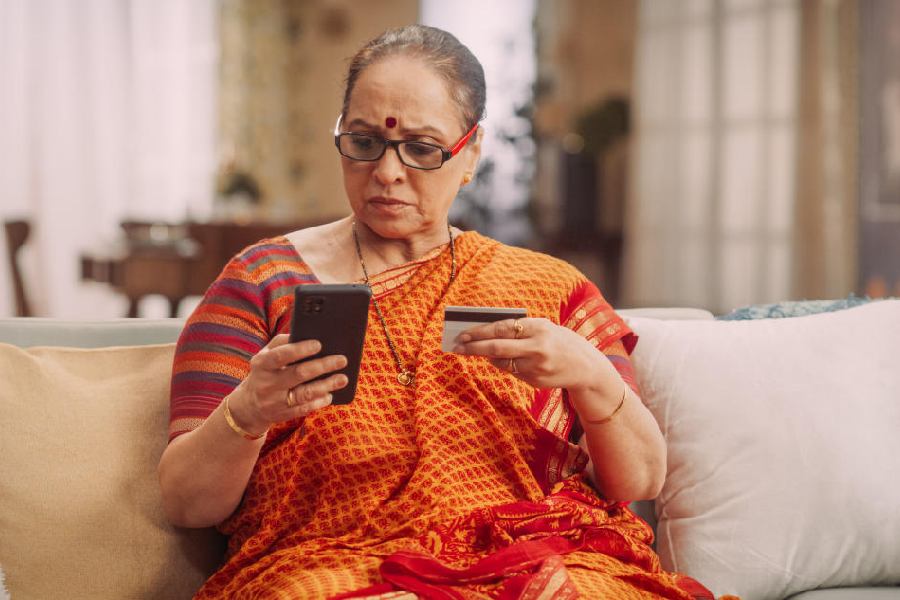
A 73-year-old woman studied two photographs of the Taj Mahal and only after 10-odd seconds identified the one generated by artificial intelligence.
Sumita Ghosh is representative of millions of women who have lived through successive leaps in technology — the arrival of computers, the Internet and the smartphone. She has no idea how generative AI works, yet she spends most of her time scrolling through social media feeds now packed with AI slop. At a glance, many posts appear real. For someone who hasn’t seen the ghats near the Howrah Bridge in over two decades, she finds comfort in videos showing a clean-up of the area — though it is AI doing the sweeping.
“There is a significant gender gap among senior citizens in India when it comes to accessing digital technology, and that is bound to have a subsequent impact on exposure to AI-enabled scams. Our research shows huge gender disparity in digital literacy, access to technology and confidence in using digital tools,” Sonali Sharma, head of communications at HelpAge India, told The Telegraph.
According to HelpAge India’s 2025 report, Understanding Intergenerational Dynamics and Perceptions on Ageing, 71 per cent of elders uses basic mobile phones, only 41 per cent owns smartphones and just 13 per cent uses computers, the Internet or social media.
“Among older women, engagement is significantly lower. Approximately 59-60 per cent lacks familiarity with smartphones or social media, and 60 per cent has never used a digital device. Participation of older women in our digital literacy workshops remains low at 20 per cent, and we are working to encourage greater inclusion,” said Sharma.
She notes these factors make older women “even more vulnerable to AI scams”. Limited digital familiarity leaves them disproportionately susceptible to fraudulent calls, fake links and so-called digital arrests — a menace that seniors are increasingly falling victim to.
“In an AI-first world, senior citizens should follow a simple rule — verify first, act later,” said Prabhu Ram, VP of industry research, CyberMedia Research. “Any unexpected request for personal information or money — especially via voice or video on messaging platforms like WhatsApp — should never be acted upon without independent verification. AI companies, meanwhile, should embed persistent watermarking in synthetic media and make authenticity-verification tools widely accessible. They should also deploy senior-focused safety defaults and proactive misuse-detection systems, rather than relying solely on regulatory intervention.”
Reports of senior citizens falling prey to fraud calls and suspicious links continue to multiply. Asim Datta, 78, moved to Cleveland in the US from Calcutta in 1982. There, he eventually built a business in the travel industry. His ties to Calcutta remained strong — he had placed a substantial sum in a fixed deposit, the interest from which supports his extended family.
When the deposit was due to mature last April, Datta visited his bank to explore better investment options. He was advised to close the fixed deposit and start a new fixed deposit for a longer term without incurring a foreclosure penalty. He agreed — and hesitantly handed his smartphone to a bank representative who offered to set up the new investment. “In hindsight, I shouldn’t have handed over my phone. It also helped establish the alibi that I had opened the new account, not the representative,” he said.
In the weeks that followed, the expected interest did not arrive, and he lost money. He wrote to the branch head, copying nodal and circle officers, besides the bank’s MD. “Seven to 10 days later, I received an email from someone claiming to be a representative of the MD’s desk, saying the bank had followed all rules, but that I could contact an RBI ombudsman and/or any of the three phone numbers included in the email if I wished.” So far, he had only lost some interest money and nothing more.
When he eventually reached someone purportedly in a position to help on one of those numbers, he was asked to continue the conversation on a personal VoIP number rather than an official line — and then to share his screen, during which multiple OTPs were delivered.
Datta lost all the funds in that particular account, and though he has recovered some of it through the intervention of an RBI ombudsman, his message is clear — never hand your phone to anyone, even a bank official and do not to share your screen with strangers.
Technology, and now AI, is creating an intimidating new frontier for older adults — even those who were once tech-savvy.