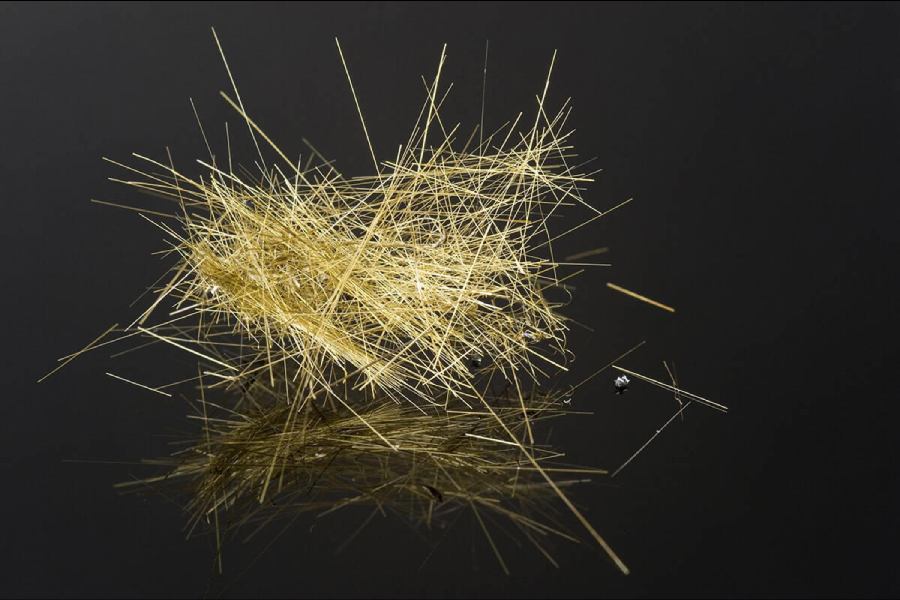
Most people associate ash and churning lava with volcanic activity, but volcanoes also produce formations that look unnervingly like human ponytails.
Known as Pele’s hair, these extremely thin strands of volcanic glass are named after Pele, a female figure in Hawaiian mythology associated with volcanism. They’ve been reported raining down on yards and filling up rain gutters near volcanic regions in places like Hawaii and Iceland.
According to new research by a team of scientists and glass artists, the delicate-looking structures may form when bubbly magma is stretched. The results of the study were published in Geology.
Unlike the glossy black of obsidian, another volcanic glass, Pele’s hair is typically light brown or yellow and can rival human locks in length. The strands can travel long distances on a breeze. Recently, activity on Kilauea volcano in Hawaii produced Pele’s hair that landed in the town of Pahala, about 30 kilometres away.
Pele’s hair can form when bits of lava are tossed up in the air and then stretched by jets of volcanic gases. “They can get spun out by the wind,” said Janina Gillies, a geologist at the University of Canterbury in New Zealand.
But that process, which creates strands of Pele’s hair of different lengths, did not explain why it was sometimes found in bundles of hundreds, or even thousands, of aligned strands. Ed Llewellin, a volcanologist at Durham University in the UK, remembers finding one such on the Big Island of Hawaii. “I was 100 per cent convinced it was a woman’s ponytail lying on the lava,” Llewellin said. “It was quite shocking.”
A team led by Gillies and Llewellin investigated how such a “ponytail” might form. Maybe, they hypothesised, the stretching of lava without the help of a gas jet could produce it. Maybe, Llewellin said, “you can start with a foamy, molten glass material and stretch it”.
The idea came from experiments the team did with a sugary, air-filled dessert known as hokey pokey. That early work showed the presence of air bubbles seemed crucial to producing long, sugary strands.
Still, more realistic experiments were necessary, and the collaboration grew to include the group of people perhaps most accustomed to working with lava-like material — glass artists. One was Colin Rennie, whose work is often inspired by science.
Rennie helped the research team prepare hockey-puck-size pieces of glass containing varying amounts of powdered calcium carbonate. When they were heated in a furnace to roughly 2,000°Fahrenheit, the calcium carbonate decomposed and produced carbon dioxide gas. That created air bubbles in the pucks. “It looked like bread inside,” Llewellin said.
Wearing a suit designed to reflect heat, Rennie retrieved the pucks from the furnace and slipped them into a steel device he had designed and named the Pullificator. The device stretched the pucks using a weight-and-pulley system. Everything had to happen within about a minute.
When air bubbles filled three-quarters of the space, the pucks readily formed Pele’s hair-like threads when stretched. But pucks that had far fewer air bubbles formed one wide ribbon of glass. “The more bubbles there are, the more hairs that form,” Gillies said. That made sense, because it was the glass between the bubbles that had stretched to form the hairs.
Ken Hon, a volcanologist who was not involved in the research, said the study involved a simplification of nature. He noted that in real life a blob of lava is not being pulled straight down with a weight. “Their mechanism isn’t quite right,” he added.
The researchers suggested that in the real world, several processes might stand in for the Pullificator. For example, lava is always being stretched because it’s constantly churning, Llewellin said, adding, “Bits are rising at different rates, and that leads to parts of it stretching.”