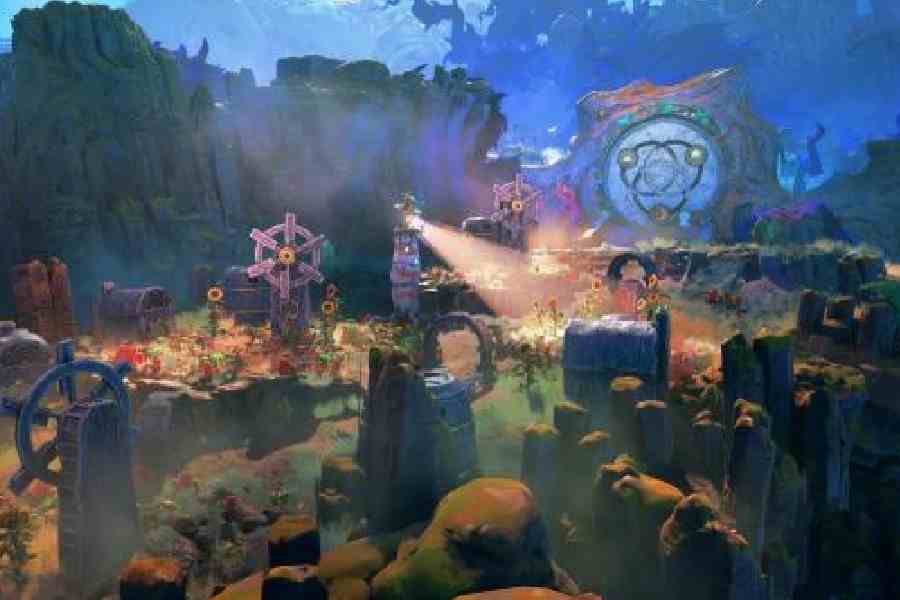
Early into Keeper, an electric feeling crept over me that I recognised as the shock of the new. The studio Double Fine specialises in offbeat video games whose gallery of characters includes psychic explorers, working ghosts and a jet-propelled head. But none of its past creations left me so happily unmoored, struggling at times to digest what I saw happening onscreen — the bizarre creatures, botanical puzzles, whimsical painterly shapes and riotous colours.
All of which is to say, Keeper blew my mind.
The game opens with a flock of birds streaking through an autumnally coloured sky. Hot on their feathers is an alien purplish mass that sends one bird off course and then pursues it. Full of panic, the bird, Twig, alights on a decommissioned lighthouse standing on a bluff. Twig lets out a cry as the purplish mass closes in, causing the lighthouse to project a beam that repels the adversary.
The game then hands over control to the player, who must shake the lighthouse from its foundation. Falling to the ground, the lighthouse grows a set of legs, gets up and then stumbles before it begins to walk. Things get much weirder from there.
Casting the lighthouse’s beam causes the world’s flora and fauna to behave differently. Plants flower, vines retract, creatures cower. The lamp can also cause light-activated contraptions to alter time; some devices physically change Twig, who plays a key puzzle-solving role by turning gears and transforming into an egg and a spectre.
There are no game over screens, and the tests of dexterity that come later are low pressure. For the most part, pleasure comes from moving through the beautiful areas and grappling with intuitive but incredibly strange puzzles. One of my favourites involves escorting a plant-eating critter with a big round shell on its head from snack to snack until it is sucked up by the tendrils of a plant and rolls inside its tubular body like a pinball. The shell eventually transforms into a tool that helps clear away an organic obstacle.
The initial spark for Keeper came to Lee Petty, the game’s creative lead, in mid-2020 while hiking in a county park south of San Jose, California, US. The area once housed a mercury mine, he said, and the rotting remains of equipment can be seen on the sides of the trails.
His solitary walks during the coronavirus pandemic made him think about what paths evolution might take after humanity has left the scene. Petty’s thoughts were also guided by the documentary Fantastic Fungi, which describes the life of mycelium networks, and how trees can piggyback on those networks to share nutrients. It rekindled his admiration for the surrealists, including the fantastical landscapes of Max Ernst, who tried to probe outside the confines of rational spaces.
“Everything felt like a weird fever dream,” said Petty, who decided he wanted to make something wordless to capture the moment. Petty said his team referred to the mysterious purple mass that serves as an antagonist as the Wither, which he thought about as an ecosystem. But he was reluctant to say much more about Keeper’s lore. He wanted to leave it open to interpretation.
The idea of a game centred on a lighthouse grew out of a thought experiment Petty shared with Gabe Cinquepalmi, the lead designer on Keeper — a video game mission based on a lighthouse wandering onto a farm. The goal was to get into the building, go to the top and guide it back to the sea where it belonged.
From there, Petty zeroed in on the idea of a lighthouse that sets out to find a new purpose for itself, in part through finding connection with a green bird.
What is most astonishing about Keeper is how its anthropomorphic conceit becomes more (artfully) alienating as it goes along. Its charming posthuman world gives way to something more menacing and inhospitable. The final stretch plays out in a way that is so different from its opening that you will inevitably reflect on your original emotions.
Christopher Byrd/NYTNS