In 1953, Ray Bradbury, an American writer, published a book titled Fahrenheit 451. It is a novel about an American fireman in a not-too-distant future who realised that he was doing his job all wrong — because his job was to burn books which were banned in that future America.
The book got a lot of attention and won some major prizes because it was the time of the second Red Scare in the United States of America: anti-communist witch-hunts, Senator McCarthy’s Congressional hearings and, of course, book bans. But Bradbury’s ‘fireman’ hero secretly reads the books, learns the truth, and ends up working to preserve knowledge. That is just what we need right now. And the ideal hero for our redemptive tale is Russell Vought, Donald Trump’s director of the office of management and budget. He was a lead author of the ‘Project 2025’ plan for transforming the US government into a tool of the hard Right, and he urgently needs to be redeemed.
Vought’s current project is to destroy American climate science, which he regularly refers to as “climate alarmism” or “climate fanaticism”. He is currently taking the lead in an official drive to break up or close down all the climate-linked scientific institutes that receive federal government money. (If the facts don’t suit your politics, just erase them.)
His primary target is the NSF National Center for Atmospheric Research, the ‘jewel in the crown’ of American climate science: 830 climate scientists and engineers in a purpose-built building in Boulder, Colorado. Since its creation in 1960, it has certainly fulfilled its promise of doing research projects bigger than any single university could handle. March 16 was the deadline for proposals for the disposal of various parts of this institute, whose personnel, equipment, and possibly even records will be scattered to the winds. All other government-backed climate research institutes in the US are also facing destruction. The National Oceanic and Atmospheric Administration, the Geophysical Fluid Dynamics Laboratory at Princeton, and NASA’s Goddard Institute for Space Studies: they are all on the hit list.
It doesn’t mean that a couple of thousand American climate scientists will be begging on the streets. The best ones will be snapped up by universities and institutes abroad, especially in Germany, Scandinavia, the United Kingdom and Australia (where you are already tripping over emigré American scientists in the better universities).
The younger and more adventurous ones may go farther afield, to big countries like Brazil, India, Indonesia, and China where governments are scrambling to build up their climate science communities as the threat of catastrophic climate damage comes ever closer (for there is where it will hit first and the hardest).
Of course, there are still many hundreds of climate scientists in American universities but their prominence in the global community is fading fast. Only 46 US-based scientists were chosen as authors for the key Intergovernmental Panel on Climate Change report this time, down from 210 in the previous cycle. The greater loss is NCAR, the single biggest node for climate research in the world. Only the Potsdam Institute for Climate Impact Research in Germany, the Met Office Hadley Centre for Climate Science and Services in England, and the Climate Change Research Center of the Institute of Atmospheric Physics in Beijing even come close.
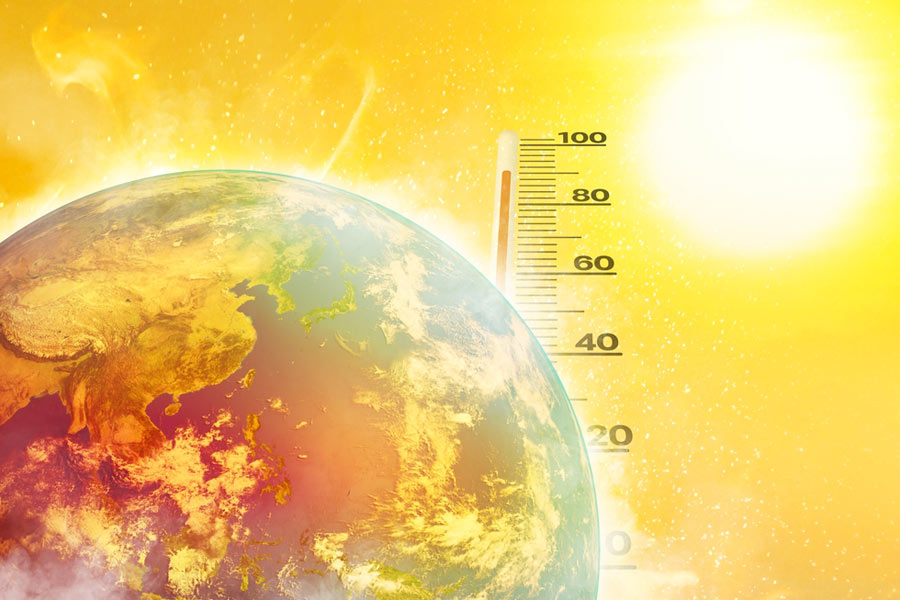
Numbers matter. Critical mass matters too. It’s already clear that making it through the next half-century without a climate calamity that radically changes the living conditions on this planet will be a near-run. The rest of us cannot afford to lose the Americans. In the meantime, somebody give Russell Vought a book that isn’t the Bible. He might learn something, even though he is a self-avowed ‘Christian nationalist’.