On Saturday, May 9, Péter Magyar officially took office as Hungary’s new prime minister, formally ending the sixteen-year-rule of Viktor Orbán and closing one of the longest uninterrupted political eras in post-Cold War Europe. For much of the past decade, Orbán appeared politically immovable. He was a leader who had not only won elections but also reshaped the Hungarian State itself around his party, Fidesz, through constitutional changes, media consolidation, loyal business networks, and an increasingly confrontational relationship with the European Union. Yet, one month after Hungary’s historic April election, Magyar now enters office with something equally remarkable: a two-thirds parliamentary majority of his own.
At dinner with a Hungarian activist friend on the eve of the election, I was told that although all signs pointed to Magyar winning, it felt unimaginable to think of Orbán simply losing, conceding, and walking away from the authoritarian grip he held on Hungarian life for the better half of two decades. Dozens of Hungarians I spoke to felt the same way. Months of aggressive and misleading campaigning by the Orbán government and well-sourced evidence of Russian interference, including a proposed plan to stage an assassination attempt on Orbán in the lead-up to the election, made the chances that Orbán would simply walk away seem limited. But by 9:30 pm on election night, that was exactly what happened. Orbán conceded. Magyar had won.
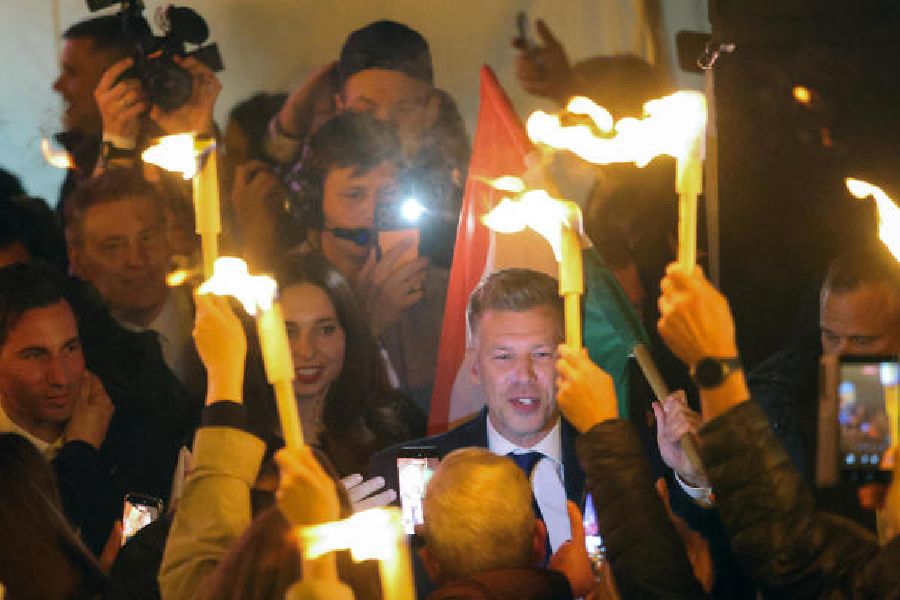
On election night, thousands gathered in Batthyány tér on the Buda side of the Danube, staring across the river at the illuminated dome of the Hungarian Parliament building. The mood moved in stages: anxious anticipation, disbelief, then outright euphoria as precinct results rolled in. The square filled steadily through the evening with students, pensioners, families carrying Hungarian and EU flags, and older voters who remembered both the optimism and the trauma of Hungary’s post-Soviet transition.
Before the final results came in, Ilona Szabó, 48, who grew up near Lake Balaton and has lived in Budapest since 2000, described the election less as a normal democratic contest than as an attempt to escape a political climate she believed had become suffocating. “Everything has gotten worse,” she said. “More expensive, meaner, darker. It feels incredible just to have hope again. Hope for something that isn’t Orbán. Hope for someone who isn’t corrupt. It is so insane to me that we do not remember what it was like under Russian control here. I remember, and I don’t want to go back to that.”
Yet even among Magyar’s supporters, enthusiasm often came with caveats. Szabó emphasized that she did not fully share Magyar’s politics. “He is conservative, yes,” she said. “But when you are in a house that is on fire, you don’t ask where the water comes from that can save you.”
Magyar himself started as a comfortable Hungarian MEP in Brussels and an insider within the inner circles of Fidesz, Orbán’s political party. His former wife, Judit Varga, far outranked him and ultimately became Orbán’s minister of justice. After a political scandal that quietly pardoned several people accused of paedophilia, the political blame of which fell mostly on several high ranking Fidesz women, Magyar took to social media to chide the men who “hid behind womens skirts” and accused the party of widespread corruption. Unlike previous fragmented Opposition figures, Magyar was not a liberal outsider attacking Orbán from the political margins. He emerged from within the system itself: a former Fidesz insider, conservative lawyer, and one-time loyalist whose public break with the government transformed him into the most serious challenger Orbán had faced since taking power largely unchallenged in 2010.
For younger voters, however, the election was less about ideological realignment than generational exhaustion. Emma, an 18-year-old first-time voter from a town roughly an hour outside Budapest, stood in the square rolling cigarettes with friends. “I have lived my whole life where Hungary means Orbán,” she said. “I want something different. I want something to change.” Her friend, István, also 18, echoed the sentiment. “I want my country to be a democracy,” he said. “And I want us to be part of Europe.”
The desire for normalcy, democratic legitimacy, and reintegration into Europe has shaped Magyar’s first month. Even before formally taking office on Saturday, Magyar had moved quickly. Armed with a rare parliamentary supermajority, he possesses powers broad enough to dismantle many of the constitutional and institutional mechanisms Orbán spent years constructing.
Within weeks of the election, Magyar’s transition team signalled plans to overhaul State media leadership, reopen investigations into corruption allegations involving Orbán-era oligarchs, and renegotiate Hungary’s relationship with the EU. His government has also promised reforms to reintroduce judicial independence and procurement transparency, two issues that repeatedly brought Budapest into conflict with Brussels during Orbán’s leadership.
Symbolism has mattered almost as much as policy. Magyar is handsome, young and coiffed. He ran as a Hungarian everyman. To make his campaign image even more on the nose, his name literally translates to ‘Peter Hungarian’. He has carefully presented himself not as a revolutionary but as a national restorer, as someone reclaiming Hungary rather than remaking it. His rhetoric has emphasised patriotism, legality, and civic repair over ideological transformation.
That balancing act is deliberate. Magyar appears acutely aware that his coalition is less a coherent political movement than a temporary democratic alliance united primarily by opposition to Orbánism. His voters include liberals desperate to restore institutional checks and balances, centrists exhausted by corruption scandals, conservatives alienated by Orbán’s increasingly Russia-friendly posture, and younger Hungarians who see emigration as the only viable future if the country remains politically stagnant. The challenge now is whether governing can sustain the emotional momentum that powered Magyar’s victory.
Orbán leaves behind not only a polarised country but a deeply-embedded political infrastructure. Over sixteen years, Fidesz extended influence through the courts, universities, media ecosystems, cultural institutions, and business networks. Even with a parliamentary supermajority, undoing that system will prove extraordinarily difficult. Many key appointments and institutional structures were specifically designed to survive electoral defeat.
There is also the question of expectations. The atmosphere on election night bordered on euphoric precisely because so many Hungarians had ceased believing political change was possible. But democratic restoration is often administratively slow and emotionally anticlimactic. Dismantling patronage networks does not immediately lower grocery prices or housing costs. Rebuilding public trust in institutions can take years.
And Magyar himself remains, in some ways, an ambiguous figure. Critics note that he still reflects many conservative instincts common within Hungary’s political culture. Some liberal supporters privately worry that the movement around him remains too centred on personality rather than on institutional ideology. Others fear that Hungary’s desperation for change may have obscured unanswered questions about what exactly Magyarism will become once the unifying goal of defeating Orbán fades into history. Yet for now, those anxieties remain secondary to the sheer fact of transition itself.
In much of Europe, elections change governments. In Hungary this spring, many voters felt they were trying to change the direction of history itself.
Carol Schaeffer is a journalist based in Berlin, Germany, and is a senior fellow at the Atlantic Council in Washington D.C.