
The 150th birth anniversary of William Butler Yeats (1865-1939) has been noted across the continents. India, so given to anniversaries and commemorations, could have been expected to do more than it has to mark the date. Yeats's admiration of India, of the Upanishads, of the Gita and then, through Gitanjali, of Tagore has long been known to us. But so inward-looking has India become, so preoccupied with its own 'greats', whether of literature, philosophy or politics, that a larger pulse of feeling seems today alien to its cardiologic or cerebral potential.
I do not doubt - this being more the presumption of hope than of information - that Visva-Bharati would have placed the anniversary on its calendar. But a West Bengal assembly resolution in tribute to an ardent friend of Tagore, a lodestar to Sarojini Naidu and Manmohan Ghose, would have been handsome. Likewise, the Parliament of India noting the anniversary of one who, as early as September 1912, said "a new renaissance has been born in your country" would have been a felicity. But then, the ministry of external affairs and the ministry of culture are busy ministries, the Sahitya Akademi is beset with the weight of returned awards and Parliament's primary concern today is the GST bill. In the larger analysis, India's memory deficit is India's loss, not Yeats's.
The Irish poet has been part of the world's literary, philosophic and political imagination for so long now that readers of various nationalities feel an equation with him. One might call it a mystic equation. They do not understand Yeats completely and certainly not identically. But the sound of his words, the deep-drawn breath one feels and hears in them, have touched the mystic chord in every one who has read him. The mystic chord, I said, implying that everyone possesses such a chord. Who can confirm that? No one. And yet, who can deny, having read Yeats or Blake, that such a thing exists?
Literal meaning and the search for it seem a triviality, an irritation, almost, when it comes to responding to this line from "When You Are Old": "how love fled/And paced upon the mountains overhead,/And hid his face amid a crowd of stars."
As with William Blake, who was an influence on Yeats, there is a gloomy greyness that befogs and, ironically, also enlightens his words. The cloud creeps up in the middle of a stanza that has been making perfect 'sense' - that 'rational' despot - until then and engulfs you in its overpowering haze. Where, one asks bewildered, are we now? The very next moment, the density begins to thin and turns to light, the tyrant-king of sighted humanity. If, like Blake, our poet had also been an engraver, we would have had some very perplexing and disturbing artwork illustrating his poetry. The plates would have doubtless mystified his verse even more, bewitched the reader's imagination. Just think of this line from "The Rose Tree" done into a sketch: "O plain as plain can be/There's nothing but our own red blood/Can make a right Rose Tree. "
In this, he shares something with Tagore as well, whose late-life paintings are unrelievedly sombre."I have carried the manuscript of these translations about with me for days," Yeats writes in his much-quoted introduction to Gitanjali, first published in 1912, "reading it in railway trains, or on the top of omnibuses and in restaurants, and I have often had to close it lest some stranger would see how much it moved me." Ever since Gitanjali appeared in English, India has thought of Yeats and Tagore together. The more industrious of his 'followers' have also known, of course, of Yeats's other Indian 'draws', which pre-dated his encounter with Tagore and which, today, seem surprising.
Was it the Irish contrarian in him that admired what he came across of a British colony? Or was it just his 'pilgrim spirit'? As with so much about Yeats, a cloud hangs over this question and one may never know the answer to it - but that matters little. Yeats had discovered India in the high noon of Empire. His three complicated and visually tangled poems around India appeared in 1889, exactly mid-point between the formation of the Indian National Congress (1885) and Vivekananda's historic journey to the world parliament of religions in Chicago (1893). That was a renascent point when a great strophic turn was taking place in the subcontinent's consciousness. That was also when a young Indian who was to change Indian history was then in London. Mohandas Gandhi met Annie Besant in London and could well, through the Theosophic link, have come across Yeats. But he did not. The ascetic, not the mystic, was the young Gandhi's ideal. Yeats's lyrical poem, "Anushuya and Vijaya", would have left him cold.
Whatever be the naïvety or complexity of those three poems, they show that his nascent involvement with India ran deep. And it was to last a lifetime. From 1889 to when he died, in 1939, lay half a century of a lonely, and at times laughing, fascination with India, a land he never visited but which visited him in a steady stream of variegated callers, books and manuscripts. During this half century, India saw, through Governor General Lansdowne's Indian Councils Act (1889), the first Indian member enter the all-British Council to Indians forming governments in the provinces (1937), taking the country to the very threshold of self-government. And it was during that time that Yeats not only introduced Gitanjali to the English-speaking world, but also worked to have the Nobel prize for literature reach, in 1913, Rabindranath Tagore. Indians have, over the decades, looked up to Yeats not just because of the politically inspirational Ireland link but because of his mystic passion, which for all its unfathomable imagery, strikes a chord. And never more forcefully than in "The Second Coming", of which the concluding lines are among the most haunting ever written: "And what rough beast, its hour come round at last/Slouches towards Bethlehem to be born?"
The poem was written in the wake of World War I. Reading it now during what seems, in many ways, to be the beginning of World War III is a duty we owe not to Yeats but to ourselves. Other phrases in the poem like "Things fall apart" and "The blood-dimmed tide is loosed, and everywhere/The ceremony of innocence is drowned" lead up to a "shape" that "is moving its slow thighs" as it slouches, almost despite itself, towards a dreaded birth.
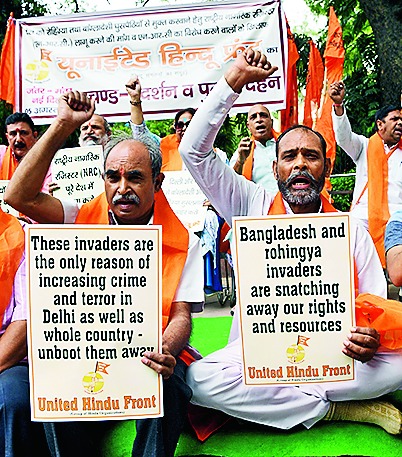
Why does this image seem, despite its deliberate ambiguity, so hideously real? As real as Shakespeare's "huge leviathans" in The Two Gentlemen of Verona, that "forsake unsounded deeps to dance on sands"? For the only reason that we are witnessing the lurch forward of the rough beast of hate-driven violence. The technological claws of this "shape" make it both primeval and postmodern. It emerges both from the ancient slime of human hates and a 21st-century cauldron of human craftiness. For us in India, the "rough beast" has two heads, two faces. The first is that of global terror, the second is that of domestic bigotry.
Yeats, who spoke in 1912 of an Indian renaissance, warns India today, in "The Second Coming", of a recoil to the barbarism of sectarian hatred. Even as India joins the global drive against global terror it must also ensure a local vigil against local barbarisms in which the blood-dimmed tide can threaten innocents. The civilization of India, which Yeats invoked in his introduction to Gitanjali, wears no sacred thread, no holy mark. It is in its extraordinary blends that its spirit resides. And it is from there alone that it can repulse the slouching shape.