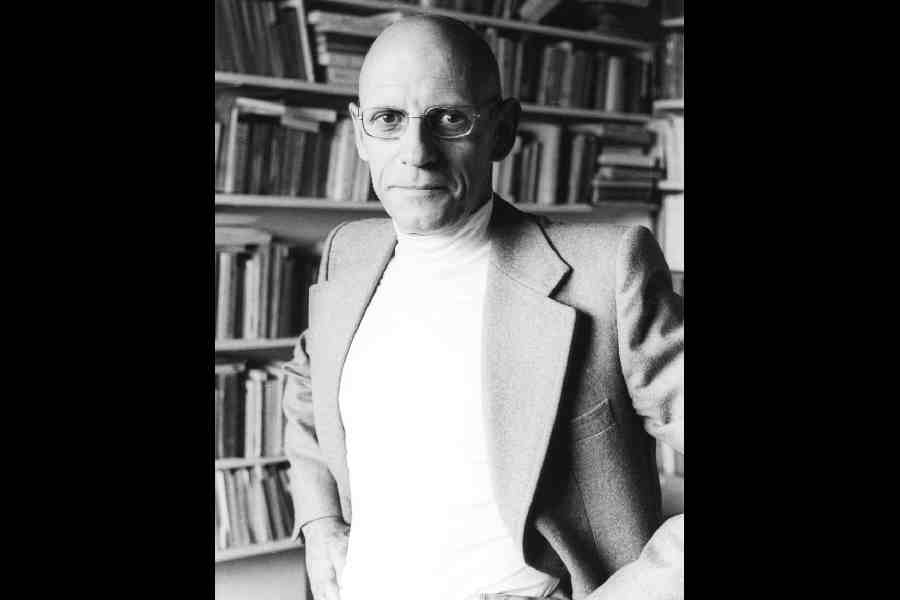
On the centenary year of Michel Foucault’s birth, Artificial Intelligence has not merely vindicated his most famous provocation but it has also exposed its limits. The ‘death of the author’ now coincides with a deeper historical rupture: the exhaustion of postmodernism itself in an age where discourse is automated, owned, and scaled beyond human intention.
The age of AI has transformed what once read as philosophical provocation into technical fact. Texts now circulate without writers. Arguments appear without intention. Style persists without experience. Meaning reproduces itself without belief.
This is often taken as proof of Foucault’s prescience. But to stop there would be to miss the more unsettling implication. AI does not simply confirm the ‘death of the author’; it marks the point at which that death ceases to be critical and becomes infrastructural. The author has not vanished into freedom; authorship has been absorbed into systems of production, ownership, and control. What dies alongside the author, in this moment, is postmodernism’s historical role as a language of critique.
When Foucault delivered “What is an Author?” in 1969, he was intervening in a specific intellectual and political conjuncture. The Romantic figure of the author — sovereign, expressive, originary — had become an ideological anchor for authority, property, and truth. To dismantle that figure was to weaken inherited hierarchies of meaning.
Foucault’s move was surgical. The author, he argued, was not a natural origin of texts but a regulatory function — the way societies classify, police, and distribute discourse. Writing did not flow from interior genius but from historically structured fields of knowledge, from what he called the episteme. Language preceded intention. Discourse spoke through subjects, not the other way around.
In the late twentieth century, this was emancipatory. It cracked the foundations of cultural authority. It allowed feminism, postcolonial theory, and critical historiography to flourish. Postmodernism became the philosophical mood of this dismantling. But postmodernism was always parasitic on a specific condition: the persistence of human authorship even as it was being critiqued.
AI changes the terrain entirely. Large language models generate text without consciousness, memory, or intention. They do not mean; they correlate. They do not argue; they approximate. They operate by metabolising the accumulated archive of human discourse and predicting the statistically plausible next word. This is not creativity in the human sense. It is the automation of discursivity. What appears uncanny is not that machines ‘sound human’, but that they reveal how much of human writing already functioned as pattern, convention, and repetition. In this sense, AI literalises Foucault’s claim: discourse does not require a sovereign subject.
Yet this literalisation drains the claim of its critical force. What was once a challenge to authority becomes a mechanism for its expansion. The author-function no longer organises discourse for interpretation; it is replaced by platforms that organise discourse for optimisation.
Postmodernism thrived on destabilisation — of truth, of identity, of meaning. Its intellectual power lay in revealing contingency where certainty had been assumed. But AI has shown that contingency alone is politically inert. When discourse becomes endlessly reproducible, ambiguity ceases to threaten power. It feeds it. AI systems do not resolve meaning; they scale it. Irony becomes a style. Dissent becomes content. Critique becomes data. The very tools postmodernism developed to unmask authority are now absorbed into the machinery that governs communication.
This is the historical irony of Foucault’s centenary: the disappearance of the author no longer liberates discourse from power. It liberates power from accountability.
One of the most striking features of the AI moment is the inversion of authority. Texts generated without identifiable authors often appear more objective, more neutral, more trustworthy. Their lack of biography becomes a form of credibility. Their impersonality reads as expertise.
This is a profound political shift. Authority migrates from persons to processes, from responsibility to systems. When no one speaks, no one can be held to account. The disappearance of the author no longer disperses power; it concentrates it in opaque technical and corporate structures.
Foucault’s analyses of power were incisive but incomplete. He traced how institutions discipline bodies and how knowledge produces subjects. But he underestimated how deeply capital would come to organise discourse itself.
AI is not merely a philosophical problem. It is a political-economic one. Language models are trained on collective human expression and enclosed as proprietary assets. The cultural commons becomes raw material. Meaning becomes extractable value.
Postmodernism, suspicious of grand narratives, struggled to articulate systemic economic critique. It excelled at deconstruction but faltered at reconstruction. In the age of AI, this limitation becomes fatal. Without political economy, critique dissolves into style.
What, then, dies with postmodernism? Not its insights, but its historical function. The refusal of foundations, once radical, now mirrors the logic of platforms that thrive on endless circulation without commitment. Relativism, once subversive, now lubricates systems that profit from confusion and overload.
In this environment, postmodern irony reads less like resistance than resignation. The world no longer needs to be persuaded that truth is unstable; it needs to be governed amid instability.
What then remains after the author?
The task is not to resurrect the Romantic author or to deny the insights of Foucault. It is to move beyond a theory of discourse that ends where responsibility begins. The present demands a renewed account of agency — distributed but not dissolved, collective but not anonymous.
The central question is no longer epistemological but political: who owns the infrastructures through which meaning is produced, circulated, and enforced?
Foucault remains indispensable for understanding how power works through knowledge. But the age of AI reveals what his framework left under-theorised: the fusion of discourse, technology, and capital at planetary scale.
The death of the author was once a philosophical shock. Today, it is an operational reality. The death of postmodernism follows — not because it was wrong, but because it was historically bounded.
AI marks a transition from critique to condition. It forces intellectuals, policymakers, and movements to confront a world where language itself has become infrastructure,
and where meaning circulates faster than judgment. In that world, the question is no longer whether authors exist, but whether responsibility can survive without them. Foucault’s centenary, arriving in the age of machines that speak without knowing, demands not celebration but reckoning.
Debashis Chakrabarti is a political commentator and Commonwealth Fellow (UK)