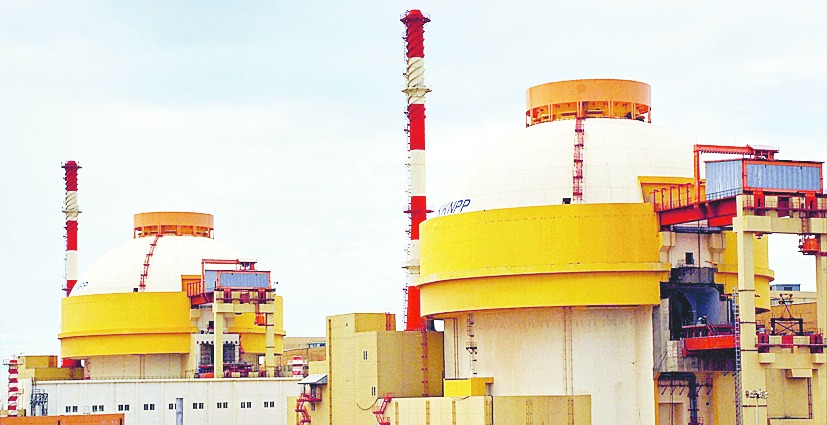

The prolonged media hype and the views of the high and mighty brought this author to explore the Nuclear Suppliers Group and the Indian connection with it. What transpired is that, in spite of the recognition of the importance of technology for economic and strategic autonomy, India has been away from the global forum of high technology for a long time. This glaring Indian absence from the nuclear power technology club, which comprises the rule-making body in the form of the NSG and the Missile Technology Control Regime, understandably made Indian keenness during the last two years somewhat more conspicuous than before. India rightly understood the additional urgency in this owing to New Delhi's commitment to Paris, which stipulates that 40 per cent of its installed power capacity should come from non-fossil sources.
So 2016 suddenly saw Indian diplomacy shifting to overdrive as New Delhi's application for participation in the NSG meet was submitted on May 12, thereby setting a precedent. For the first time, the NSG received a membership application from a non-nuclear proliferation treaty country. In spite of this, the Indian application found some takers as substantial discussions followed, although Beijing objected on technical grounds.
What followed further was sizeable support for India's membership. Two-thirds of the NSG members supported India. But China stood its ground on formalities and technicalities. Although the remaining one-third of the NSG members were not opposed to India's entry on principle, they wanted a clearer elaboration and classification of India's bid for membership. This is not unusual in multilateral diplomatic forums.
A silver lining emerged nevertheless. In contrast to India's application, there was virtually no support for Pakistan's application. Quite the opposite happened when the current Chair of the NSG, pointedly raised A.Q. Khan's proliferation activities in his opening remarks.
But as the Seoul plenary of the NSG ended without decision on India's membership, New Delhi's disappointment is understandable. Perhaps New Delhi had an over-expectation of its short-notice overdrive, although it had not fulfilled the gestation period requirements with the endeavour of engaging NSG members on the basis of India's record as a responsible State regarding non-proliferation as well as with the energy needs of the nation of 1.2 billion.
The flip side of the failed post-Seoul mission, however, is that India certainly does have some positive results to show in the form of its entry into MTCR, which has not allowed China membership yet. This regime, too, counts the NPT as a criterion. Thus if 34 members of the MTCR, all of which are also NSG members, can agree that India's credentials do qualify it to be a member in spite of its non-NPT status, surely the 48 member NSG has to take the call. And it is likely to be sooner than later.
Another visible fallout of the Seoul plenary is the high decibel and widespread internal political criticism and external media bantering from China. Even after conceding failure in Seoul, India needs to take the criticism in its stride by answering it bravely. India must let members know what the scenario is now, and why India did what it did.
Questions must be dispassionately dealt with. If it is asked what benefits, if any, would be accrued with India joining the NSG, there has to be some explanation that participation is essential to be a rule-maker, otherwise India is left at the receiving end.
That would suggest that NSG membership is likely to facilitate access to technology as well as finance for India's civil nuclear programme. The waiver received in 2008 shows that there exist in nuclear supply multiple chains, thereby giving a head start to whosoever is a member of the NSG club.
Critics point out that India allowed itself to be hyphenated with Pakistan in this entire fiasco. A closer scrutiny of facts and figures, however, points in the opposite direction. Countries which were not favourably disposed towards New Delhi in the past appear to have changed tack, and, if not changed, at least have softened their stand. This certainly has been an exceptional development for India, unmatched by other countries aspiring for NSG membership.
That China is perceived to have 'outsmarted' India by creating a 'procedural hurdle' along with some others perhaps cannot be denied; what appears favourable is the reduced, near-unanimous collective voice of opposition of the past. Thus the 'demand' for 'clarity' by a few countries regarding the process of India's entry into the NSG is understandable, and also not unjustified, as India's case would be a precedent, it being the first from a non-NPT nation to do so. Critics, perhaps not without some apprehension, have felt that the NPT being the cornerstone of the NSG, India would find it difficult to enter the latter without first signing the NPT. This indeed appears somewhat complicated. However, it may be recalled that the NPT was dealt with on September 6, 2008 with the NSG's "Statement on Civil Nuclear Co-operation with India", which clearly showed that the decision on India contributes to the "widest possible implementation of the provisions and objectives" of the NPT. To that extent, India's credibility and its international commitment have always been praiseworthy, the different colours of ruling political parties of India notwithstanding. The chaotic democracy of India certainly deserves some credit on this issue.
The moot point, however, is that the NSG was fully conscious that legally India could not be part of the NSG; a situation akin to France's in 1975, when, in spite of being outside the NPT, Paris became one of the founder members of the NSG. Critics may say that it was a different era altogether. Yet India, too, in spite of being outside the NPT, virtually meets all criteria: commitment to non-proliferation, International Atomic Energy Agency safeguards, and commitment to nuclear disarmament. The image, credentials and credibility of New Delhi far outstrip those of some nuclear nations whose every action deserves scrutiny owing to the fact that they only export hatred, terror and often resort to black marketing of nuclear raw material.
A serious point raised by a section of Indians is that the government should not have had hyped the NSG issue, knowing well that there was no quick-fix solution regarding New Delhi's entry into the NSG. It lay in the domain of impossibility. The counter-argument was, when will India wake up? Thus far the charge against India was that New Delhi rarely shows ambition, initiative and diplomatic courage of conviction owing to fear of failure. Perhaps true. Or not. At the end of the day, however, the 2016 NSG push did not succeed. But the silver lining appears to be the fact that an earnest push for the mission to be included has begun.