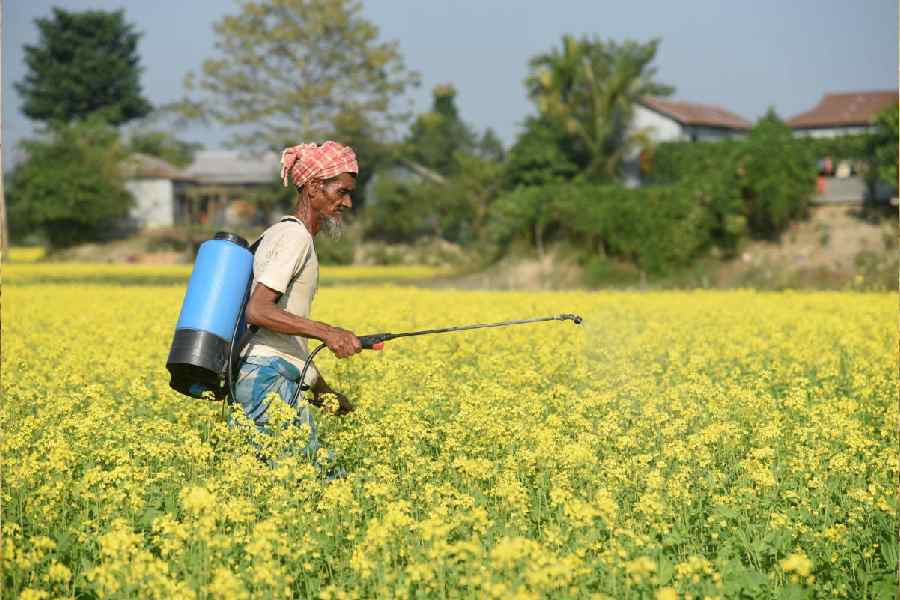
It may not yet be a substitute for chemical fertilisers, but domestic wet waste — those rotten food leftovers we dump in bin bags — could become a carbon-rich compost supplement for farms.
The capacities are in place, a study by the NITI Aayog and the Centre for Science and Environment claims. Cities are increasingly converting domestic waste into compost and, as this writer has found in multiple locations, farmers think it works wonders. “Soil becomes lighter,” one farmer near Indore said, “and holds moisture longer.” The circuit — food grown on farms; food waste in cities processed into compost; compost going back to farms — is called the Urban Rural Nutrient and Carbon Cycle, a system that helps municipalities with waste management while providing farmers with cheap, carbon-rich compost. This idea is no longer theoretical. It has acquired urgency.
The Iran war has disrupted the oil and gas supply through the Strait of Hormuz. India is among the countries severely impacted. One of the consequences is the looming fertiliser shortage ahead of the kharif season. Government data show fertiliser stocks at roughly 18 million tonnes against a requirement of about 39 million tonnes. India depends significantly on imports and energy-intensive production chains for key inputs like urea, leaving it vulnerable to geopolitical disruptions.
And yet, within the country, a parallel system has been quietly built.
The ministry of housing and urban affairs says that India generates over 1.62 lakh tonnes of municipal solid waste per day, 80% of which is now being processed. More importantly, India now has over 2,800 compost plants with a combined capacity of 1.14 lakh tonnes per day. But this is only half the story. The problem lies with distribution, leaving much of this underutilised.
To turn compost into a fertiliser supplement, the Centre, states, and municipalities must join hands for a systemic intervention: a regulatory mechanism, strict quality control, and a functional distribution network. Without this, the URNCC remains incomplete.
Some practices show what’s possible.
Take Vellore, Indore, Mysuru, Ambikapur, or Karad. These cities have built composting systems where farmers regularly procure compost. In some cases, farmers have reduced their dependence on chemical fertilisers. But their numbers remain small. In other cities, compost lies piled up — unused — because there is no reliable system to move it to farms, and no assurance of quality.
Where the system works, it is almost elemental. Waste does not end its journey at the edge of the city. At the municipal compost yards, trucks arrive carrying market waste, kitchen scraps, temple flowers browning in the heat. Workers spread the waste into long windrows, turning the heaps every few days. As the rot settles, it transforms into dark, crumbly compost.
For farmers at Vellore’s outskirts, this compost has become part of the soil’s everyday arithmetic. What urea can’t achieve, the wet waste does. It restores soil structure and holds moisture.
The compost won’t replace chemical fertilisers entirely. Indian agriculture remains too deeply structured around chemical fertilisers. But compost definitely reduces dependence on fertilisers, protecting farmers from the volatility of distant supply chains.
Vellore is not an outlier. In Ambikapur in Madhya Pradesh, waste is processed through decentralised centres run by women’s self-help groups. Similar models are emerging in Kerala. In Indore, the system scales up. Segregated waste feeds large composting plants where manure is processed, packaged, and sold. In Vellore and elsewhere, the evidence lies in those long rows of compost pits, quietly returning organic carbon to farms. In times of uncertainty, that quiet return will be an insurance.