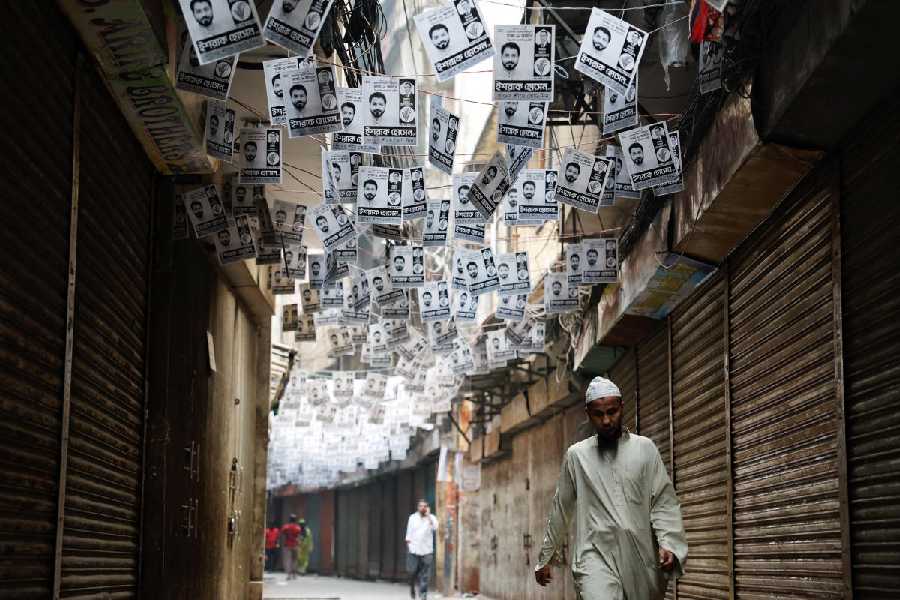
Bangladesh has voted. By the weekend, the final arithmetic will reveal whether the Bangladesh Nationalist Party secures a majority of its own or whether the Jamaat-e-Islami, allied with the National Citizen Party, a Gen-Z formation born of the 2024 student uprising, denies it that outcome. This election, held alongside a constitutional referendum, unfolded in the shadow of the ban on the Awami League, Sheikh Hasina’s exile, and the contested interim phase associated with Muhammad Yunus. It was never merely about seats. It was about the direction of a republic forged in 1971 and repeatedly tested by the concentration of power.
Bangladesh is neither collapsing nor securely consolidated. It is a nation arguing with itself — about authority, identity, accountability and the meaning of its founding promise. Five features define this moment.
First, there is the unmaking of a duopoly. For three decades, politics in Bangladesh revolved around the rivalry between the Awami League and the BNP. Today, the BNP is led by Tarique Rahman, the son and the political inheritor of Begum Khaleda Zia, symbolising continuity as well as transition within that tradition. The BNP’s politics has long combined Bengali nationalism with scepticism towards perceived Indian influence and a harder edge on questions of identity.
These formations shaped not only electoral competition but also the grammar of public life. The Awami League’s removal from the electoral field has, for now, ended that bipolar stability. Disruption can renew — but it can also fragment. The erosion of two-party dominance opens up space for pluralism; it may also sharpen ideological divides once moderated by parity. In any case, Hasina may be in exile in South Delhi, yet the Awami League remains woven into Bangladesh’s political fabric and cannot be wished away. The true test is whether competitive intensity matures into institutional responsibility. Victory cannot mean vindication; defeat cannot mean delegitimation. Institutions must outlast personalities.
Second, the generational surge. Young voters, digitally fluent and impatient with patronage, have refused to inherit the quarrels of their elders. The protests that unsettled the old order reflected fatigue with corruption, opacity and exclusion. This generation is less tethered to liberation war memory and more animated by opportunity, dignity and global connectivity. Youthful energy is democracy’s oxygen — and its accelerant. Institutions must absorb this force without being overwhelmed. If politics closes ranks, turbulence will return. If it opens itself to reform, resilience may follow. The movement from street mobilisation to institutional accountability will determine whether generational assertion strengthens the republic or strains it.
Third, constitutional recalibration. By pairing parliamentary elections with a referendum, Bangladesh acknowledged that electoral ritual without institutional trust is fragile. Amendments recalibrating executive authority or strengthening oversight are not technical adjustments; they are safeguards against majoritarian excess. Yet reform carries its own risks. Temporary majorities can weaken protections for vulnerable communities or blur the line between mandate and monopoly. Constitutional change must deepen pluralism, not narrow it. Legitimacy rests not only on ballots counted but on rules respected.
Fourth, the contest over identity. Bangladesh’s founding was an act of cultural defiance. Its secular ethos was forged in struggle, not imported from theory. But identity evolves. The rising visibility of the Jamaat-e-Islami signals a continuing debate about religion’s place in public life. This debate need not be existential. Bangladesh remains devout yet plural, rooted in Islamic heritage yet shaped by linguistic nationalism and cultural pride.
Still, minorities observe these shifts with apprehension. Recent reports of Hindus killed, Hindu homes vandalised, temples attacked, and families intimidated are a stark reminder of how quickly reassurance can give way to fear. Their security is not merely a minority question; it is a test of republican confidence. Memory of 1971 exerts moral pressure — but memory alone cannot guarantee rights. Vigilance must accompany memory.
Fifth, the economic undertow. Bangladesh’s ascent was built on export dynamism, remittance flows and the steady incorporation of women into the workforce. Its development trajectory has often been cited as one of South Asia’s quiet transformations. Yet growth has slowed, global headwinds have strengthened and domestic expectations have hardened. Inflation and employment anxieties shape the lived experience of politics more powerfully than constitutional theory. The ballot was also an audit. Jobs, stability and credible governance — more than rhetoric — will determine the durability of any mandate. Democratic legitimacy ultimately rests on delivery.
Bangladesh’s verdict is not a distant democratic episode for India. It touches India’s borders, rivers, trade corridors and internal security. What unfolds in Dhaka will shape stability in eastern India and the balance of power in the Bay of Bengal. New Delhi cannot afford either sentimentality or detachment.
First, India must move beyond nostalgia. The liberation war forged an enduring bond, but relations cannot rest permanently on memory. A post-Gen Z Bangladesh is animated less by historical gratitude and more by sovereignty, opportunity and strategic autonomy. Engagement must extend beyond governments to institutions, businesses, universities and youth networks. The future of India-Bangladesh ties will be built as much in classrooms, boardrooms and border districts as in diplomatic exchanges. Strategic depth now depends on societal breadth.
Second, India cannot be indifferent to instability across its eastern frontier. Migration pressures, river waters and border management are lived realities in West Bengal, Assam and the Northeast. Nor can India ignore reports of Hindu communities living in fear. Respect for Bangladesh’s sovereignty must coexist with legitimate concern for regional stability and minority protection. Quiet diplomacy may often be wiser than public admonition — but silence cannot be a substitute for principle. Friendship is strengthened by candour, not evasion.
Third, strategic realism is an imperative. Bangladesh occupies a pivotal space in the Indo-Pacific and is actively courted by China. But China is not the only external variable. Pakistan and elements of its security establishment, including the Inter-Services Intelligence, have historically viewed Bangladesh as strategic terrain — a reality India cannot ignore. Ports, infrastructure corridors, digital networks and defence cooperation shape the maritime geometry of the Bay of Bengal. Strategic competition now intersects with economic engagement. Complacency would be a mistake. India’s response must be purposeful and sustained — investing economically, integrating regionally, enhancing connectivity and engaging politically with steadiness. Influence is earned, not inherited. Confidence must replace both anxiety and nostalgia.
Bangladesh’s democratic evolution will ultimately be decided by Bangladeshis. Yet India’s security and prosperity are intertwined with that evolution. Strategic patience must be matched by strategic clarity. The region’s future will be determined not by historical sentiment but by institutional maturity, economic inclusion and mutual respect.
In 1971, dignity was asserted. In 2026, accountability is demanded. Between those moments lies a democracy still unfinished, yet resilient in its capacity for renewal. Bangladesh stands at a hinge moment in its political evolution. The passing of the liberation generation, the assertion of Gen Z, and the recalibration of institutional power are converging in ways that will shape the republic for decades. Democracies are not defined by the absence of tension but by their capacity to channel it constructively. Whether this moment becomes a cycle of polarisation or a renewal of pluralism will depend less on electoral arithmetic and more on the restraint, imagination and courage of those who now hold power. As Kazi Nazrul Islam wrote, “I sing the song of equality — there is nothing greater than the human being.” That remains the republic’s truest compass.
Amitabh Mattoo is Dean and Professor, School of International Studies, JNU