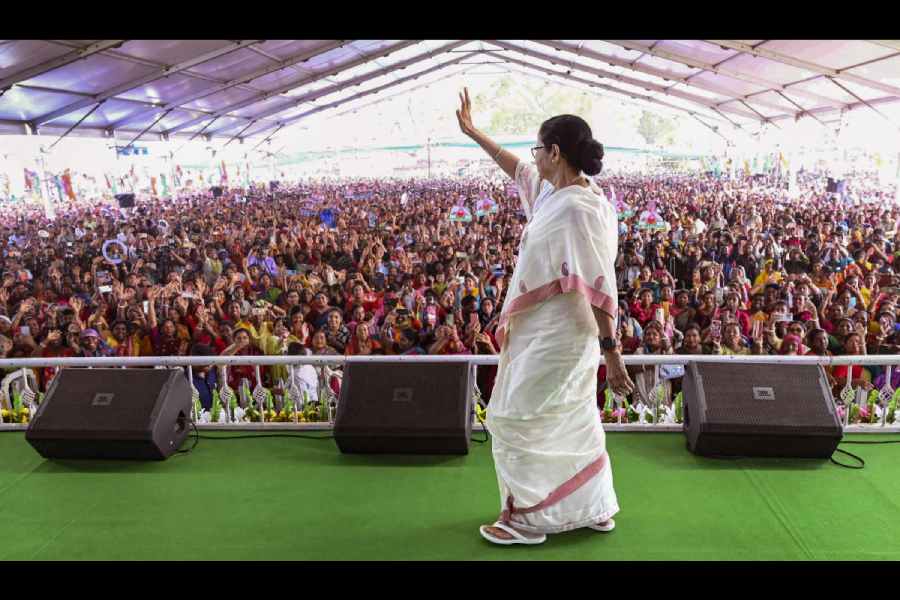
In recent years, the return to office of no other incumbent chief minister would have been regarded as more consequential for national politics than the potential return of Mamata Banerjee as chief minister of West Bengal. There was a moment during the 2024 Lok Sabha elections when state-level political leaders like Nitish Kumar in Bihar and N. Chandrababu Naidu in Andhra Pradesh may have entertained hopes of playing a larger role in national politics. Despite his loss of majority in the Lok Sabha, Prime Minister Narendra Modi not only managed to retain power but also ensured the marginalisation of such regional aspirants with national ambitions.
Ms Banerjee is different. As the only woman to presently head both a political party and a government, Ms Banerjee stands apart from all the current generation of leaders of national and regional political parties. She is a totally self-made, first-generation leader who has her feet firmly on the ground. She can communicate in three languages — something that cannot be said of most North Indian politicians.
Living in a small apartment in an unglamorous neighbourhood, sporting a white cotton saree and hawai chappals, Ms Banerjee has branded her popular image as a no-nonsense person of the people; the country’s most rooted and most important woman political leader. Her recent appearance in the Supreme Court underlined, once again, the self-confidence that has always defined her persona.
While there have been many political leaders who led simple lives and commanded popular support and respect — such as a Karpoori Thakur in Bihar and an E.K. Nayanar in Kerala — more recently, one can think of very few. By the time a politician rises to become a chief minister or a Union minister, he or she has acquired adequate personal wealth and, once in office, their wealth rapidly multiplies. In this regard, Ms Banerjee remains an exception.
More importantly, Ms Banerjee has crafted her political career almost entirely on her own, setting up her own party, leading it into office, and securing a wholesome endorsement the third time round. This, too, is an exception when one compares her to chief ministers across party lines around the country.
Given the uniqueness of Ms Banerjee, it is surprising that she has taken a long time to acquire a national persona befitting her political career and achievements. Perhaps it speaks to Bengal’s long-term marginalisation in national politics and business. Time has come for Bengal to leave its imprint, once again, on the country.
Bengal has long nursed the grievance that despite its role and importance in the nation’s political, social and cultural awakening, no Bengali has been able to become the prime minister of India. Several Bengalis have been national leaders across many professions: from Swami Vivekananda to Rabindranath Tagore, from Subhas Chandra Bose to Jyoti Basu, from Satyajit Ray to Amartya Sen and from J.C. Bose to P.C. Mahalanobis. Yet, few Bengali politicians have left their mark on national politics and governance.
At least two Bengali politicians have nursed a grievance that their respective political parties denied them the opportunity to become prime minister. The late Jyoti Basu articulated his grievance publicly, while the late Pranab Mukherjee rarely spoke about it. Both deserved a chance. After all, Jyotibabu may have well been a better manager of a coalition in the mid-1990s than H.D. Deve Gowda or I.K. Gujral.
Mr Mukherjee was the only Bengali to become president of the republic but the prime minister’s post eluded him. Of course, he was not a popular political leader in Bengal in the manner in which Jyotibabu was or Ms Banerjee now is. But then, neither P.V. Narasimha Rao nor Manmohan Singh was a popular political leader and, yet, the politics of New Delhi enabled them to occupy the high office of prime minister.
So Bengal has a legitimate grievance that national politics has not so far favoured its leaders. Remember it was Netaji Subhas Chandra Bose who gave the slogan, “Dilli chalo”, to his rank and file. Supporters of Ms Banerjee would not be off the mark if they believe that it is time for another Bengali to echo Netaji’s call — ‘Dilli chalo’!
Three years back, when the INDIA platform was formed, I took the view that Ms Banerjee ought to have been made its chairperson. Repeating the Sonia Gandhi-Manmohan Singh model with Rahul Gandhi-Mallikarjun Kharge has not helped.
A fiery Mamata bolstered by nationwide political support through INDIA would have helped the parties battling the Bharatiya Janata Party to acquire coherence and popular appeal.
Even now, if INDIA facilitates Ms Banerjee’s electoral victory, it would be in a better position to take on the BJP. I have long argued that the Congress Party would have immensely benefited by inviting her to return to the fold and made her the party president.
Considering the fact that the BJP is a male-dominated party, an Opposition alliance led by a woman political leader, that too one who symbolises independent womanhood, can make a dent into the BJP’s more recently acquired women’s vote base. It has been suggested that in Bihar, the BJP owed its return to power to a swing in its favour of women voters. If it is indeed the case that women, especially younger women, are seeking a voice in governance, then they cannot find a better mascot than Ms Banerjee.
Ms Banerjee’s only deficit is that her governance record at the state level has not been very impressive. But then, there are few chief ministers who can legitimately claim a creditable record of governance. Consider the case of Nitish Kumar who has repeatedly returned to office without much to show for it. Ms Banerjee has a reasonably good record of governance, especially the turnaround in Calcutta’s urban development.
Governments in states like erstwhile Andhra Pradesh, Karnataka and Tamil Nadu are credited with good work, but politicians in these states have become millionaires in office, pointing to high levels of corruption. Perhaps efficient corruption delivers development but not good governance. Maharashtra has had a run of bad governance for two decades. So the charge that Ms Banerjee cannot be credited with good governance gets diluted by the comparative record of her peers across the country.
In any case, it is a long time since we have had a woman prime minister. Given the excessive male domination of national and regional politics at a time when women have come to play a larger role across all professions, it is time the country had a second woman prime minister and no one fits the bill better than Ms Banerjee.
Sanjaya Baru was Editor, Business Standard. His most recent book is Secession of the Successful: The Flight Out of New India