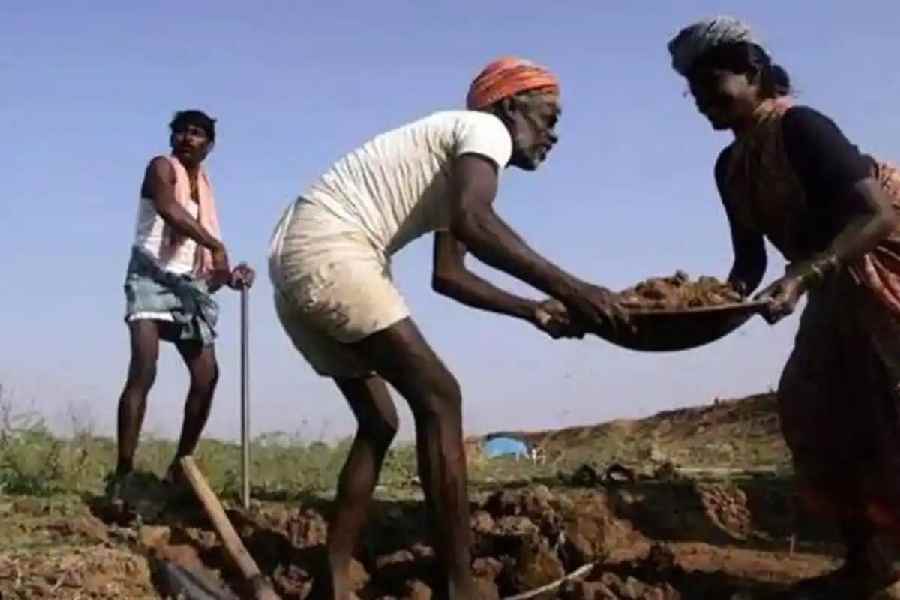
This year closes with the restructuring of the flagship rural employment guarantee programme, the Mahatma Gandhi National Rural Employment Guarantee Act. This month, a new legislation renamed it Viksit Bharat-Guarantee for Rozgar and Ajeevika Mission (Gramin), with substantial modifications that have invoked significant concerns. Many are unconvinced about the underlying reason — a transformed rural economy — that prompted the adjustments. Disquiet ranges from its renaming to its recharacterisation as a Centrally-sponsored scheme with higher financial obligation for the states, swing to a top-down from a bottoms-up architecture, and reoriented objectives that transform the MGNREGA’s essence — an open-ended, unconditional employment guarantee — to a growth and infrastructure creation strategy aligned to Viksit Bharat@2047, with normative state allocations and structured planning. What are the apprehensions and their economic significance?
A preview of the critical changes is essential for understanding the concerns. One, the statutory guarantee remains, raising unskilled manual work provision from 100 to 125 days per household a year. Two, work can be stayed up to 60 days in peak seasons against no statutory bar before. Three is a distinctive shift in funding structure with proportionate Centre-states financing (60:40) as a Centrally-sponsored scheme from 90:10 before. Four, while rights-based, the work demand is linked to rules-based financial allocation with planned design and aggregation. Five, the governance architecture adds a layer of Central and state level steering committees to the existing employment guarantee councils for recommending funding distributions, oversight, inter-ministerial coordination and so on. Six, the framework reconfigures from gram sabhas’ suggested public works to planned anchoring in Viksit Gram Panchayat Plans, grouped into the VB-National Rural Infrastructure Stack, integrated with PM Gati Shakti and geospatial systems. Seven, the type and the purpose of work refocus from labour-intensive works to defined areas — water security, core rural and livelihood infrastructure, and climate/extreme weather mitigation. Seven, technology is statutory with biometric authentication, geo-tagging, GPS-based monitoring, AI-enabled planning and audit instead of social audits and evolving technology use before.
A brief backdrop shows that in the last five years (FY21-25), an average of 50.3 employment days per household were demanded/provided nationwide against an average of 46.6 workdays over FY14-20. During these intervals, the Central government’s actual financial liability relative to the total labour budget rose to an average 106.6% from 95% before. In the last two years, Central fund releases slowed to about 80% of the total expenditure under the MGNREGA from more than 90% in FY21-FY22. In fact, after accounting for inflation, Central government fund releases grew 0.5% a year on an average during 2021-25.
This period includes the exceptional jump during the pandemic when
the MGNREGA, with its administrative simplicity and flexible responsiveness, proved invaluable in delivering universal demand support to those in need, the self-selection feature enabling outreach to the most vulnerable or distressed. Indeed, there was then considerable discourse on the need for an urban counterpart for a similar outreach. The deeper point is that with its large informality, no meaningful safety net, and low personal income tax base, India is not particularly well-positioned to deliver timely support in times of economic distress, unlike many other countries. The MGNREGA, as also its founding base of Maharashtra’s Employment Guarantee Scheme, ably served the function. Research evaluations have consistently held that an adjustable employment guarantee through public works could combat droughts and major economic shocks, alleviate distress and poverty, while being fiscally manageable, notwithstanding imperfect implementation, leakages, among other limitations.
We can briefly consider the implications thus. The new changes indicate conversion of these safety net qualities to a State-led growth, infrastructure- and climate resilience-focused scheme. Possibly, this serves less countercyclical and insurance functions and is more growth-driven even as job provision remains the delivery mechanism. Then, the work suspension mandate is interpretable as rebalancing equity and efficiency because the MGNREGA’s unconditional, unlimited access to work at wages adequate to relieve distress (this set a floor, sometimes inviting criticism for pushing up labour costs in busy times) transforms to a managed labour re-allocation across seasons and sectors. The shift from a grass-roots, decentralised structure to a centralised and digitised one appears to make it more discretionary; the probability of excluding households with connectivity/authentication constraints, typically the marginal ones, could increase.
By far, the most profound implications arise from rule-bound funding distribution across the states, which will also face higher financial burden due to increased contribution as a Centrally-sponsored scheme. It is well known that following the pandemic, which extracted a heavy fiscal toll, all state governments are challenged with elevated debt, interest payments, and the burden of reduction. The likelihood of their forking out more to fulfil a statutory financial obligation appears doubtful. Historically, legal invocation of employment guarantee in case of non-provision has not been heard of. History also shows that because of low spending flexibility under Central-sponsored schemes, states have typically not fully utilised funds with disappointing or sub-optimal outcomes. This could possibly undermine the very stated objective of the VB-G RAM G — strengthening implementation.
It remains to be seen how the MGNREGA’s rights-based sensitivity via demand channels operationally and evolves under the public investment-cum-labour market combination model with the rules-bound funding model of the VB-G RAM G. Although the latter permits administrative relaxation during economic shocks, the short-run employment response observed in agricultural downturns and major shocks could be diluted with harder fiscal and planning constraints.
Finally, the restructuring and the metamorphosis of public work-based employment guarantee must also be seen in the context of the emerging preferences at both levels of government towards ‘unconditional’ cash handouts to specific population segments (for example, women). These are growingly electorally-timed, dissociated from economic ups and downs, fiscally taxing and unsustainable, but pay off handsomely in terms of outcomes. As a matter of public policy choice in spending allocations, the merits are worth pondering.
Renu Kohli is Senior Fellow, Centre for Social and Economic Progress, New Delhi. Views are personal