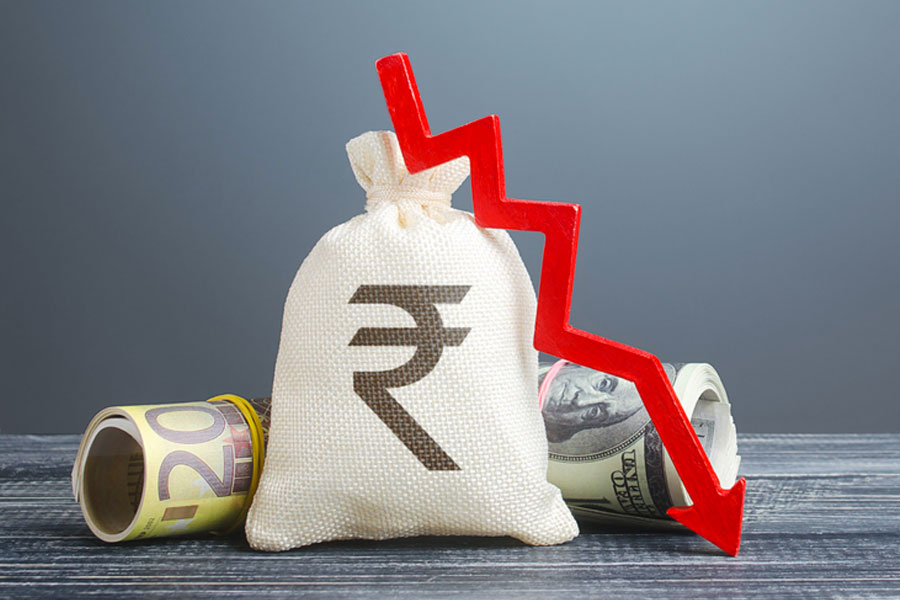
The rapid depreciation of the Indian rupee against the US dollar and its breaching of the 90-per-dollar mark have set off many questions. Those involved in government or the monetary system have, quite expectedly, taken the stance that this development is nothing to be worried about and that there are advantages to be gained from the falling value of the rupee. Many of these arguments are partially true but they constitute the implications, and not the causes, of the decline. At a time when the dollar is weakening against almost all major currencies of the world, the Indian rupee’s performance goes against this trend. Yet, India’s macroeconomic indicators, such as a high growth rate and low inflation rate, point to economic strength. The reasons for the weakening of the rupee thus merit reflection.
One plausible cause of the rupee’s slide is the indefinite delay in the finalisation of the trade deal with the United States of America. This delay has triggered adverse expectations about reductions in US tariffs in the near future. The second reason is the significant net outflow of foreign portfolio investments and an unprecedented decline in inward foreign direct investments. These have led to a reduction in India’s foreign exchange reserves. Some analysts have maintained that the exit of foreign investment is only a temporary phenomenon and that it does not reflect a fundamental change in attitude towards the Indian economy. Rather, the outward flow may be attributed to investments gravitating to the US where there is a massive price bubble building up, led by stocks of high-tech companies.
There are important implications for the depreciating rupee. If economic agents expect further depreciation, they would hold on to export shipments to take advantage of a better exchange rate in the near future. By the same expectations, importers would try to maximise current imports in anticipation of future depreciation, aggravating the trade deficit. In short, the root causes indicate a loss of confidence in the Indian economy’s ability to withstand the full effects of the tariff war. That might be the reason why Vladimir Putin visited India: new trade deals with Russia appear to be on the cards.
Significantly, the Reserve Bank of India, has, since the liberalisation years, not been averse to the rupee’s weakening: a weak rupee facilitates exports competitiveness. The RBI intervenes only when too much volatility is discerned. This is when it sells US dollars and soaks up domestic liquidity. But this outcome may not be the best for ordinary citizens since with globalisation, their consumption basket includes a lot of imported goods. Through the latest repo-rate cut of 25 basis points last Friday, the RBI has indicated that it is not fully convinced in the strength of the economy indicated by the current growth and the inflation rates. They are not sufficient to withstand international headwinds. Hence, a policy stimulus through a rate cut is warranted. Unless India can extract a favourable trade deal with the US, the rupee’s slide is likely to continue. That, whatever government officials might claim, may not augur well for the Indian economy and its citizens.