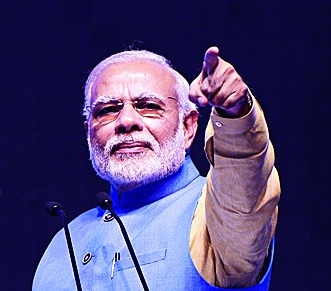

The year, 2016, will be remembered in India for the dramatic decision by the prime minister, Narendra Modi, to nullify 500 and 1000 rupee banknotes, the most common currency denominations in the country, and then eventually replace them with newly-designed, more secure 500 and 2000 rupee notes. The demonetization scheme is perhaps one of the most far-reaching policy decisions taken by any Indian government in recent times. It will have significant long-term implications for India's economic growth trajectory.
In many ways, 2016 was the year when Modi, the economic reformer, got his groove back. His government managed to pass the landmark goods and services tax bill in Parliament. By levying one indirect tax for the nation, it will make India a unified common market. It is the biggest reform in India's indirect tax structure since the economy started opening up over 25 years ago and is likely to be implemented in 2017.
India remained one of the few fast growing major economies in the world in 2016. Modi, too, was one of the most dynamic leaders on the foreign policy front, putting his imprimatur on global politics. He remained rather unpredictable and unconventional in his outreach to the world. In a move of great symbolism, Modi did not attend the 17th non-alignment summit despite repeated attempts by the host nation, Venezuela, to woo him. Modi was the second prime minister, after Charan Singh in 1979, to miss the summit.
Modi's shift away from Jawaharlal Nehru's legacy is a significant departure from the traditional foreign policy approach of New Delhi. Indian policymakers' fixation with non-alignment has remained a central component of Indian identity in global politics. Although India has had to accept help of the two global powers throughout the Cold War - notably from the United States of America in 1962 against China and from the Soviet Union in 1971 against Pakistan - the country has preserved a façade of non-alignment, at least in rhetoric. The dominance of the Congress in Indian polity and intellectual life meant that as late as 2012 Indian strategic thinkers struggled to move beyond this approach with the release of Non-alignment 2.0, a policy report that pulled the post-Cold War threads of strategic autonomy into a full revival of Nehru's non-alignment for modern times.
But New Delhi faces a new set of challenges, particularly the rise of China. Indian policymakers confront a conundrum in calculating the benefits and risks of an increasingly assertive neighbour and a network of alliances with like-minded countries. Modi, with his centre-right political inclinations, does not share an ideological attachment to Nehru's ideas. He has gradually, but decisively, shifted Indian foreign policy in directions which few would have dared to try before. While sections of the Indian intellectual establishment retain reflexive anti-Americanism, Modi has used his decisive mandate to carve a new partnership with the US to harness its capital and technology for his domestic development agenda. He is not ambivalent about positioning India as a challenger to China's growing regional might. With this in mind, he signed the bilateral Logistics Exchange Memorandum of Agreement with the US.
Modi is also busy pursuing strong partnerships with US allies in the region, including Japan, Australia and Vietnam. He has taken a strong position on the South China Sea dispute in favour of such nations as Vietnam and the Philippines as well as expanded the Indo-US bilateral naval exercises to include Japan.
The astute politician also recognizes the domestic challenges as he pivots India closer to the US. So he continues to invest in non-Western platforms such as BRICS. Economically the grouping is less attractive, given the economic troubles in Russia, Brazil and South Africa. Still, India hosted the eighth annual BRICS summit in Goa if only to assuage domestic critics that New Delhi does not intend to put all its eggs in one (US) basket.
The other dramatic change in South Asia came when the Indian army's special forces took out several suspected terror camps across the volatile Line of Control in Kashmir in response to an attack on an army post by Pakistan-based terrorists that killed 18 soldiers. The Indian response came almost 11 days after the initial attack and reflected an attempt by the Modi government to pressurize Pakistan on multiple fronts.
Even as it deliberated on its options after the initial terror attack, India launched a diplomatic blitzkrieg against Pakistan. Modi himself reached out directly to the people of Pakistan, wondering if they could find solutions to developmental issues faster than India could and to ponder 'why India exports software while Pakistan exports terrorists'. Sushma Swaraj, the external affairs minister, used her speech at the United Nations general assembly to deliver a stinging rebuttal to Pakistan's prime minister, Nawaz Sharif, who had paid tribute to Burhan Wani, the militant whose killing had triggered massive protests in Kashmir.
At the regional level, the Modi government succeeded in ensuring the postponement of the South Asian Association for Regional Cooperation summit after several member states took India's lead and decided to boycott the meeting in Islamabad. This was one of the rare occasions when regional nation states spoke in one voice against Pakistan's use of terror as an instrument of State policy. Even as Pakistan was reeling under these pressures, the Modi government decided to use military power, a tool which New Delhi had avoided for long. What was new was not cross-border raids taking place, but that India decided to publicize them. The Modi government's Pakistan policy has not been predictable. Keeping Pakistan on tenterhooks is part of the larger strategy.
Equally significant was the Modi government's decision to call the world's attention to the plight of the Baloch people who have resisted Pakistan's military establishment. New Delhi warned that if Pakistan continued to meddle in Kashmir, India would expose the atrocities it committed in restive Balochistan.
While New Delhi sought to isolate Pakistan in 2016, it proactively reached out to other neighbours. India's ties with Bangladesh and Afghanistan, in particular, deepened with New Delhi deciding to step up military cooperation with Kabul and resolve the boundary dispute with Dhaka.
But Pakistan continues to be strongly backed by China. The Sino-Pakistan relationship is blossoming, with China poised to deploy its naval ships along with Pakistan's navy to safeguard the strategic Gwadar port and trade routes under the China-Pakistan Economic Corridor. If this move goes ahead as planned, it will be the logical culmination of a long-drawn Chinese involvement in Pakistan, giving the Chinese navy a foothold in the Indian Ocean and the Arabia Sea.
Other equations in South Asia are also changing with the US getting impatient with Pakistan and Russia moving closer to Islamabad. The South Asian strategic milieu is in a flux and old rules no longer apply. The year, 2016, has been a year of dramatic changes that are likely to gain further momentum in the coming years.
The author is professor of International Relations,
Department of Defence Studies, King's College, London