|
|

In cricket, they talk of a two-paced wicket. Our economic state, it seems, reflects a similar kind of double reality. Inflation has reached the highest level since the beginning of the new century, foodlessness pervades the countryside despite the illiteracy of George W. Bush and his ilk, the public distribution system is in a mess, jobs are hard to come by, three-quarters of the nation, already in dire poverty, find nothing cheerful at the end of the tunnel. While most of the down-and-outs are reconciled to accept such a state of being as their indelible destiny, some of them explode in fury from time to time. The angry ones are, however, still a negligible minority, or are too disorganized to cause much worry to the powers that be.
Now, the other parallel reality. Those at the helm of the country’s affairs are in rompingly good cheer. The media too go along with this mood. It is carnival time for the creamy layer and others who have experienced bouts of extra earnings in the course of the past decade by clinging on to the coat-tails of the creamy layer. They never had it so good; no-holds-barred consumerism is their current avocation. More often than not, consumerism is spilling over to hedonism.
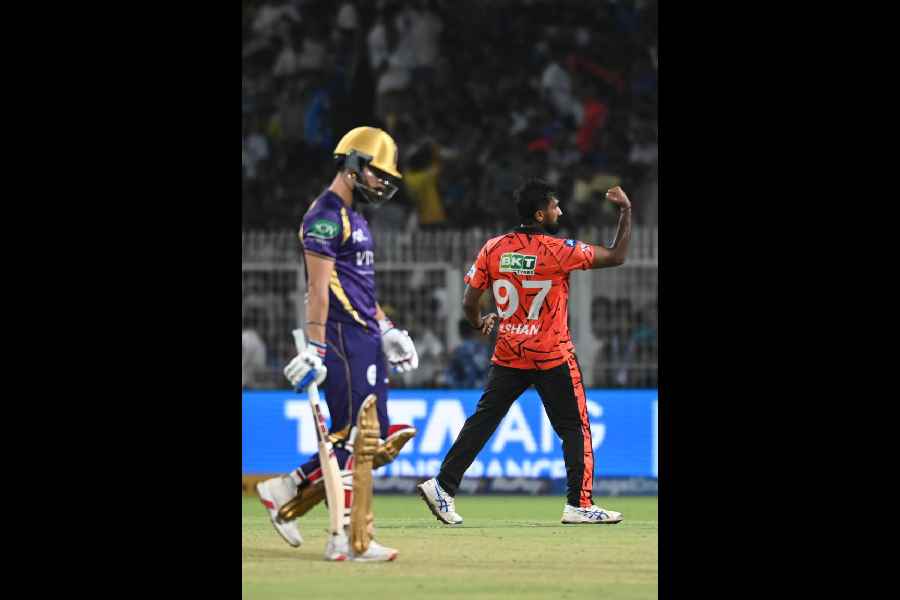
Consider the — let it be said — obscenity the game of cricket has been reduced to. It is, at the moment, the focal point of frenzied excitement for society’s luckier ones, who, have embarked on a proselytizing mission: if you do not have food, never mind, you can still watch the evening’s double-header of the Twenty20 fixtures, your hunger is guaranteed to dissolve.
Indulgence — coupled with insensitivity — of this nature was an integral aspect of the Middle Ages and of the feudal era. Medievalism obviously has managed to stage a comeback in India after an interval of quite a few centuries. In those days of yore, the main entertainment of the nobility was blood sports; that has been substituted now by the dubious stuff going on in the name of cricket. The return to medieval times is also heralded by the pattern of nomenclatures for the teams participating in the ribaldry: kings, super-kings, royals, knights, riders, challengers et al. The names are meant to evoke the memory of those days when the poor and the underprivileged knew their place, the universe revolved only round the feudal lords. Even the apparel the different teams have chosen for themselves are intended to recreate the old world where pageantry and chivalry went hand-in-hand with mindless jollification even as the commoners starved; some of the commoners were occasionally thrown to the wolves as part of the fun and games.
The medieval ritual has to be fitted into a global mould though. After all, the export-led gross domestic product growth is a foreign gift. The opening up of the economy has contributed to the fantastic prosperity India’s upper stratum has come to enjoy. The demand for software from overseas, particularly from the United States of America, has transformed the life and living of a thin segment of the nation. The rapid accretion of larger and larger income by this segment is also on account of foreign involvement in such areas as banking, insurance, tourism and entertainment. Those whose fortunes have been thus transformed are not ingrates; they are demonstrating their gratitude by opening up a new frontier of entertainment, a globalized cricket, which they are inviting foreigners to partake of along with the comfortably-off over here.
Necessity is the mother of invention. Cricket has been packaged, abbreviated, Americanized. It has been rendered into a version of baseball, India’s homage to the American epoch. Since time is the essence of money and event management is at the core of money-making, cricket has been compressed, à la baseball, to within a space of three to three-and-a-half hours, and each contending team has to complete an ‘inning’, not ‘innings’. As in baseball, there is a dug-out for each team, and a coach. The cheerleaders too have arrived, the hot dog stands cannot be far behind. The pinch-hitters are already playing a big role and hitting sixes galore, like home runs in baseball. Give or take a couple of seasons, the wicketkeepers will begin to be called catchers and the bowlers re-designated as pitchers. The franchise for the teams is being decided in the free market and players too are being bought and sold as in North America; film stars, who are immensely wealthier than the run-of-the-mill of cricketers, have taken a fancy to such free-market operations. There is even a commissioner to oversee the conduct of the matches in imitation of the baseball commissioner in the US; the incumbent commissioner actually speaks with a flawless Yankee accent. Once the Board for Control of Cricket in India comes to a live-and-let-live arrangement with its not-necessary-to-name-adversaries, we might even have two parallel series of Twenty20 contests, and the winners in the two groups could then meet, as in the US, in a World Series.
The story does not quite end here, the baseballization of cricket has other ramifications. The purchase and sale of players have begun to take place on a world scale. From one point of view, this is only fair. The overwhelming proportion of the money currently spent on cricket in India is made up of accumulation in the services and manufacturing sectors as a consequence of the export boom. Render unto Caesar what belongs to Caesar. Since foreigners have greatly contributed to the fabulously high earnings of a section of Indians, why not allow them to be beneficiaries of the conspicuous consumption, via cricket, indulged in by this group of Indians?
But what about the flip side of it? The outstanding contemporary phenomenon in the country is uneven economic growth, growth concentrated within a thin periphery, from where the bulk of the nation has been kept away. If the income generated in the sectors enjoying the export boom could be spent on the purchase of goods and services produced within the country, the present reality of exclusive growth, theory says, could then be coaxed into, at least partially, a process of inclusive growth; many millions would have found work in the wake of the generation of activities following the splurge in demand for domestically produced goods. Consider, however, the case of cricket, neo-baseball, that is. Very little of the money being spent on cricket is percolating down into the domestic economic system. Go through the roster of names constituting the eight teams in the Indian Premier League. A large majority of them are foreigners, and they are claiming the lion’s hare of the fees and other reimbursements. The money they earn they will take out of the country in a scampering hurry. In other words, the import content of what is happening in the name of cricket is inordinately high. Once it is so, there can be little of what economists call the ‘multiplier’ effect of the carnival on domestic income and employment.
Maybe all this is according to a game plan, intended to combine consumerism, medieval pomp, globalization, sycophancy addressed to Americans, and a smattering of neo-colonial exploitation. An additional expectation could be at work too: the concoction will act as opium of the people. Will it? One never knows. Even a people steeped in medieval beliefs can, once the pitch is queered, behave in a mighty strange manner. Take Nepal for instance.