Global icon
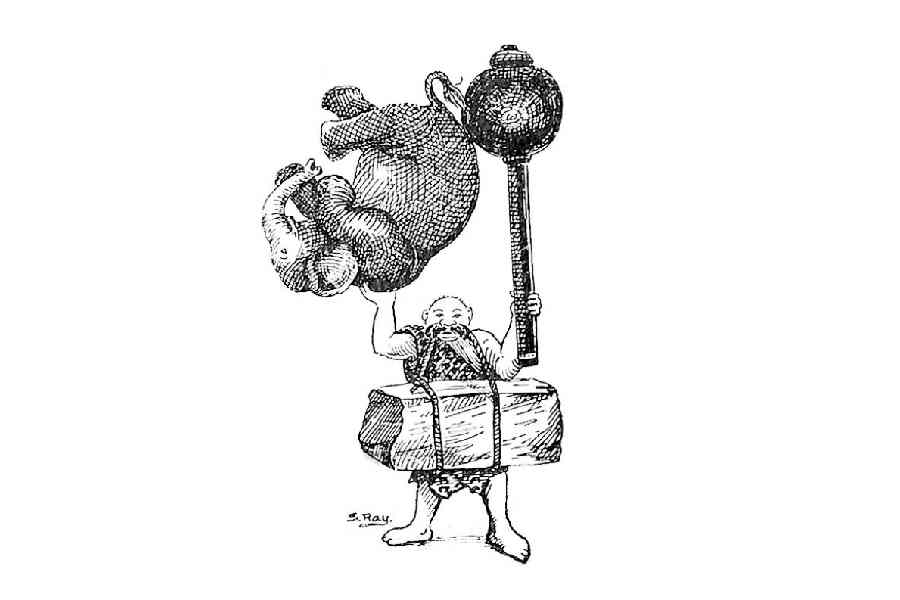
Sir — One does not usually associate an athletic diet with carbohydrates and fats. Many people will thus be surprised to learn that in the two weeks of the Winter Olympics, athletes ate about 60 kilogrammes of grana padano cheese a day along with 365 kg of pasta, 10,000 eggs, 12,000 pizza slices and 8,000 cups of coffee. However, this is not as shocking for Bengalis. Several years ago, Sukumar Ray introduced them to Shashticharan, a fictional palowan from Beniatola, who is strong enough to juggle elephants. Shashthicharan consumes massive amounts of food throughout the day, including pesta, mewa, malai, mounds of luchi, bowls of rice and monda mithai, none of which fits the generic idea of an ‘athletic diet’. Perhaps Shashticharan is the icon of athletes at the Winter Olympics.
Sourish Misra,
Calcutta
Reality check
Sir — South Africa snapped India’s 12-match unbeaten streak at the ICC Men’s T20 World Cup, handing the defending champions a 76-run defeat (“Proteas punch flattens India”, Feb 23). This exposes a recurring problem that selectors keep refusing to accept. Batting-order collapses, poor shot selection under pressure, and an over-reliance on Jaspreet Bumrah to rescue the team in crunch situations are repeated issues with a side that is, at present, coasting on reputation rather than adequate skill and preparation. India must urgently rethink its middle-order, cultivate aggressive Powerplay partnerships, and stop treating every defeat as a mere blip.
K. Chidanand Kumar,
Bengaluru
Sir — The Indian team should have played Kuldeep Yadav more. The absence of players like Shreyas Iyer was felt in the match against South Africa. This defeat is a wake-up call for the Indian team players as well as the selectors. The next matches with Zimbabwe and West Indies must not see the same mistakes being repeated. It must also be mentioned that the South African team played exceptionally well in the match.
N.R. Ramachandran,
Chennai
Sir — The Indian team was given a reality check by the Proteas who handed the Men in Blue their biggest defeat in terms of runs in a T20 World Cup. India have now been backed into a corner where they have to win their remaining two games against Zimbabwe and the West Indies to have a chance of qualifying for the semi-finals. For South Africa, the win reinforces their status as serious contenders for the title. Their ability to recover from the loss of early wickets and dominate the Indian bowlers showcased the team as a balanced and tactically sharp unit.
Ranganathan Sivakumar,
Chennai
Sir — The two host teams of the T20 World Cup, Sri Lanka and India, had to face defeat against England and South Africa, respectively. It seems that both teams were overconfident and took their opponents lightly. None of the Indian batsmen could save their wickets for long. At the same time, due credit should be given to South Africa, which had clearly analysed the patterns and the weaknesses of each Indian player. It is now going to be a difficult task for both the host teams to book their places in the semi-finals as their remaining opponents will not make it easy for them.
N. Viswanathan,
Coimbatore
Sir — The successful knocks by the South African batsman, David Miller, in the T20 World Cup qualifiers have shown his ability to overcome challenges and seize control of a difficult match. The composure that he displayed under pressure was evidence of his growth as a cricketer. His score of 63 runs of 35 balls highlights a mental toughness that many seasoned batsmen lack. On the other hand, India’s batting performance was underwhelming. This was one of the primary reasons behind the decisive loss against South Africa.
Jayanta Datta,
Hooghly
Forgotten values
Sir — A teacher in Latur, Maharashtra, was arrested for allegedly assaulting 32 students over suspected damage to his motorcycle. School teachers are expected to adhere to strict standards of conduct. Historically, teachers commanded respect owing to their clear commitment to their students’ well-being. While many educators continue to uphold these values, a few instances tarnish teachers’ reputation.
Ganapathi Bhat,
Akola, Maharashtra
Fatal catch
Sir — The Sundarbans have now become more infamous for tiger attacks than for tigers (“Two brothers back from the jaws of tigers”, Feb 19). Local fishermen
risk their lives to lay baits to catch crabs and often get attacked by tigers. As long as people keep going out to catch crabs, the man-animal conflict will continue. In order to ensure the safety of locals, alongside securing Sundarbans as a safe habitat for tigers, crab-catching should be banned altogether by state authorities. Crabs must be declared a protected species in the Sundarbans and their trade and consumption should be banned. People dependent on crab-catching should be assisted by the authorities to find alternative and acceptable avenues of livelihood.
Kunal Kanti Konar,
Calcutta
Clear guilt
Sir — It is shocking that paper restorers and bookbinders in the 1930s and the 1940s in Nazi Germany had helped the regime track down people’s Jewish ancestry. Their aim was to prove their allegiance to the Nazis. Beyond those who donned the Brownshirts, other Germans — the bookbinders and restorers are a case in point — were equally complicit in the Holocaust. The psychology and motivation of such people who catalysed the Holocaust must be studied.
Sukhendu Bhattacharjee,
Hooghly