Roman holiday
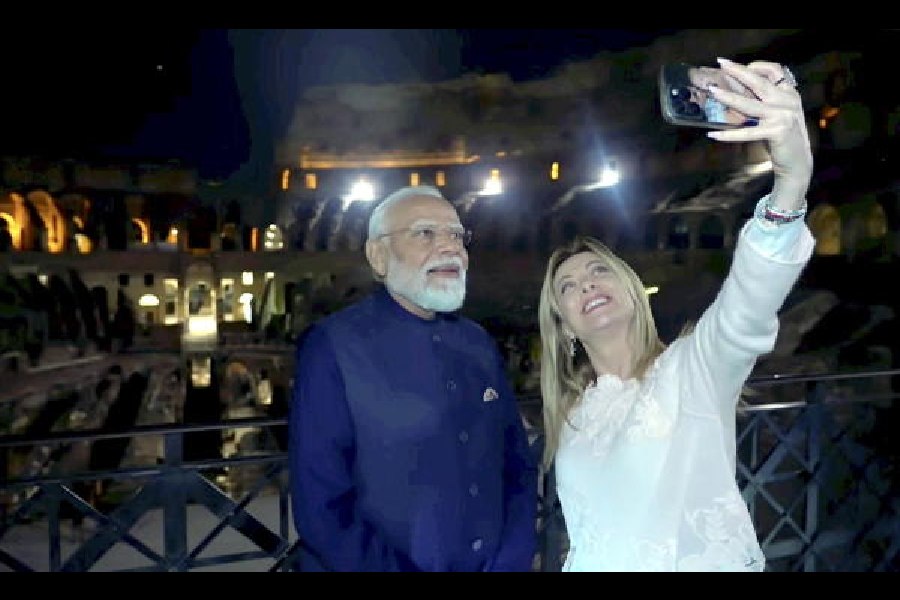
Sir — Prime Minister Narendra Modi recently prescribed certain austerity measures for Indian citizens to weather the economic slowdown which included limiting foreign travel. But, within days, he himself embarked on a five-nation foreign tour that culminated in Italy. There, Modi met his Italian counterpart, Giorgia Meloni, and gifted her a packet of Melody chocolates — a playful nod to the much-discussed ‘Melodi’ pairing — and toured the Colosseum with her. The irony was not lost on anyone: sacrifice and restraint for the ordinary citizens and dream-like, tourist-coded pictures in Europe for the leadership.
Swatilekha Biswas,
Calcutta
True face
Sir — No self-respecting Bengali should henceforward equate his or her community with secularism, justice, and open-mindedness — the cornerstones that Bengal has long prided itself on (“A false dawn”, May 19). By shedding the fig leaf of liberalism — the moral inheritance from Bengali icons like Rabindranath Tagore and Satyajit Ray — Bengalis have been successful in unmasking their true selves — orthodox kupmanduks — joining the likes of Gujarat, Uttar Pradesh, Bihar, Rajasthan, Haryana, Delhi, Maharashtra, Madhya Pradesh, Odisha, and Assam to become part of the homogenised national mainstream. What was once concealed beneath the veneer of intellectualism and progressivism now stands exposed. It is disturbing that fellow human beings can now be judged and vilified on the basis of narrow identities while the few voices still attempting reason and sanity are branded as ganashatrus.
Kajal Chatterjee,
Calcutta
Sir — In his article, “A false dawn”, Ruchir Joshi recalls the aspirations of the Bengal electorate during the 2011 elections which included governance free of political bias, zero tolerance for corruption, revival of education and healthcare and industrialisation.
However, the then newly-elected chief minister lacked the vision necessary to fulfil the enormous expectations attached to that mandate. Surrounded by sycophants, she chose expediency over reform, replicating many of the Left Front’s policies which contributed to the steady erosion of public trust. One hopes that, contrary to the author’s fears, the new Bharatiya Janata Party dispensation in Bengal will avoid polarisation.
Indranil Banerjee,
Calcutta
Past contested
Sir — Arghya Sengupta’s article, “Dehypheanted” (May 20), criticises the stance of the Madhya Pradesh High Court in its Bhojshala verdict while invoking the Places of Worship (Special Provisions) Act, 1991. The site had been protected since 1904 under colonial-era monument preservation law. Sengupta’s argument reflects a degree of bias that weakens the criticism directed at the courts.
The author’s argument against the Ganga judgment delivered by the Allahabad High Court is equally obtuse. Sengupta criticised the judgment for dwelling on Hindu sentiments and not on the environmental aspect of throwing non-vegetarian leftovers in the Ganga. However, Islamic dietary practices, too, have certain stipulations. Halal certification, for instance, is insisted upon because it is considered an essential religious practice in Islam, not because non-halal slaughter is environmentally harmful.
Ajay Tyagi,
Mumbai
Sir — There are dangers in turning history into a perpetual arena of contestation. India’s civilisation has evolved through countless layers of conquest, assimilation, and renewal. An endless excavation of historical grievances risks deepening social fractures, thereby trapping society within inherited resentments. Courts and political institutions must exercise restraint while dealing with matters involving civilisational sensitivities.
Harsh Pawaria,
Rohtak, Haryana
Sir — The Bhojshala verdict raises deeper questions about the intersection of history, faith and law in India (“Many claims”, May 19). When archaeology becomes a battleground for belief, truth risks being shaped more by sentiment than by evidence. The refusal to carbon‑date artefacts and the omission of the discovery of a figurine of the Buddha from the site weakened the credibility of the process. Places of Worship (Special Provisions) Act, 1991 was meant to preserve peace by freezing religious identities of sites, yet each new dispute chips away at that intent. Instead of reopening old wounds, the emphasis should remain on protecting historical integrity.
K. Chidanand Kumar,
Bengaluru
Welcome reform
Sir — The newly-formed Bharatiya Janata Party government in West Bengal deserves appreciation for announcing free travel for women on all state-run buses from June 1. The scheme will provide significant financial relief to countless women, especially daily commuters, by reducing transportation expenses. I would like to request the chief minister, Suvendu Adhikari, to consider extending this benefit to students, many of whom struggle with rising travel costs.
Sourish Misra,
Calcutta