The latest Gulf war has manifold consequences. Amongst them is another shake-up in the world of professional golf, proving that one of the most geopolitical of sports is equally vulnerable to the vagaries of geopolitics. Golf is geopolitical if only because so many of the richest and the most influential congregate around it.
Late last month, the Saudi sovereign wealth fund — the Public Investment Fund — announced that it would cease funding for LIV Golf from the end of the current season. This decision had clearly to do with the deep crisis unleashed by the US-Israel-Iran conflict which dominates every aspect of life in the Gulf today.
This pulling of the plug marks the end — or perhaps the beginning of the end — of a saga that began in 2022 with the establishment of LIV Golf as a parallel professional golf league to the US Professional Golfers Association. At the time, this had the quality of a seismic event — a geopolitical-cum-financial-cum-sporting-event all rolled into one, pushing golf from the sports page to the financial and edit pages of most broadsheets. Golf may have begun in Scotland but its true home has long been the United States of America. Now the world leader — the global hegemon in the sport no less — was being challenged by an upstart league funded by a country that had no tradition of or real interest in the sport.
The Saudi initiative — fronted by the PIF — had deep pockets and it was able to attract a significant number of top golfers to join it. The PGA’s way of dealing with competition was to blacklist all LIV Golf players from joining its own tournaments. A war of words followed.
To many, this Saudi foray was no more than ‘sports washing’: using golf to bolster its poor human rights record. To others, this was something bigger: part of the initiative by Crown Prince Mohammed bin Salman to change Saudi Arabia from a conservative country entirely dependent on hydrocarbons to one in which tourism, culture, sports and education would also play a role; to become, in effect, a much larger version of the United Arab Emirates in short, complete with its hedonism.
Both views had merit. The sports washing theory appeared apposite given that the 2018 murder of the journalist, Jamal Khashoggi, by Saudi agents in Turkey still dominated the news. The PIF investment also appeared to fit in with the Crown Prince’s ‘Saudi Vision 2030’ plan that advocated rapid modernisation and diversification of the kingdom. Incidentally, ‘Saudi Vision 2030’ was unveiled in 2016, the year Donald Trump was first elected to the presidency. As president, Trump would also, in time, play a role in the LIV Golf saga.
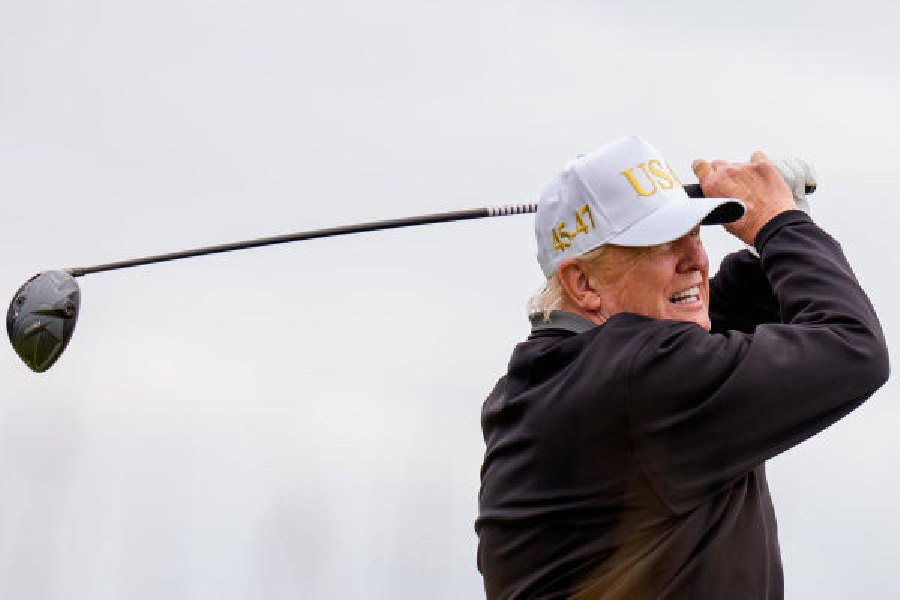
Many saw the emergence of LIV Golf in even wider geopolitical terms — as another sign of the world moving towards multipolarity with the global hegemon in the form of the US PGA having to accommodate a rival league. This view was further consolidated when the PGA and the LIV decided, after a year-long war of words, that this war of attrition was not in either’s interest. An agreement — more in the form of a ceasefire — was announced. The expectation was that this would be followed up by a durable arrangement — even a merger — but despite efforts, including those of President Trump, a passionate golfer, owner of multiple golf courses and, incidentally, one of LIV Golf’s prominent supporters, it did not happen. But with peace announced, the two tours continued as separate entities.
This arrangement could have continued indefinitely. Although LIV Golf was not making a lot of money, it had the backing of PIF — the CEO of PIF was also the head of LIV Golf’s board. To some, it promised to take golf to a new era and marketed itself as “Golf but Louder” in contrast to the PGA tour’s old fashioned, fuddy-duddy image. Unlike professional golf’s quiet tournament settings — LIV Golf was creating a high energy atmosphere with loud music, shorter formats, much larger prize money payouts and so on, similar to the contrast between Test cricket and the T20 tournament of the Indian Premier League. In any event, it was always more of a soft power and a geopolitical project than a business proposition.
The war in the Gulf has changed this. Saudi Arabia is reordering its priorities to focus more on its economy and domestic challenges. The realities of being in a region riven by conflict and geopolitical uncertainty are setting in. The Gulf sheikhdoms’ model of open and globally-connected economies, expatriate labour, ports and pipelines that export massive amounts of hydrocarbons now appear fragile with drone and missile attacks on urban centres and with the navigation channels in the Strait of Hormuz deeply vulnerable. The UAE may be the worst hit of all the Gulf states, but all of them are badly affected. This geopolitical uncertainty was never imagined.
There have been even wider changes. Human rights now appear as a significantly retreating Western concern. Multiple wars with manifold consequences have ensured that. The US, which looms larger than life over the Gulf states, has also changed — in policies and postures but also in narratives. Additionally, its security umbrella has revealed multiple chinks. Most significantly, it has exposed the fragility of a workable plan of how the Gulf countries can combine an adversarial relationship with regional stability with their local behemoth, Iran. Many Gulf citizens must be wondering whether their interests have been subordinated in this war to those of the Iran-US concert.
Responses to the LIV Golf’s crisis are accompanied by a quiet complacency amongst PGA supporters in the US. There is also a discernible schadenfreude that one of LIV Golf’s strongest supporters — President Trump — has unleashed this fate upon it by starting an unwinnable war against Iran. Has the traditional hegemon — the PGA — then won? Perhaps yes, in an immediate, tactical sense. It may have won the duel against LIV Golf but the wider ecosystem that sustains it in terms of US power and prestige could have suffered a major setback. The final verdict will be pronounced only when all the consequences of the latest Gulf war become clear.
T.C.A. Raghavan is a former High Commissioner to Pakistan and Singapore