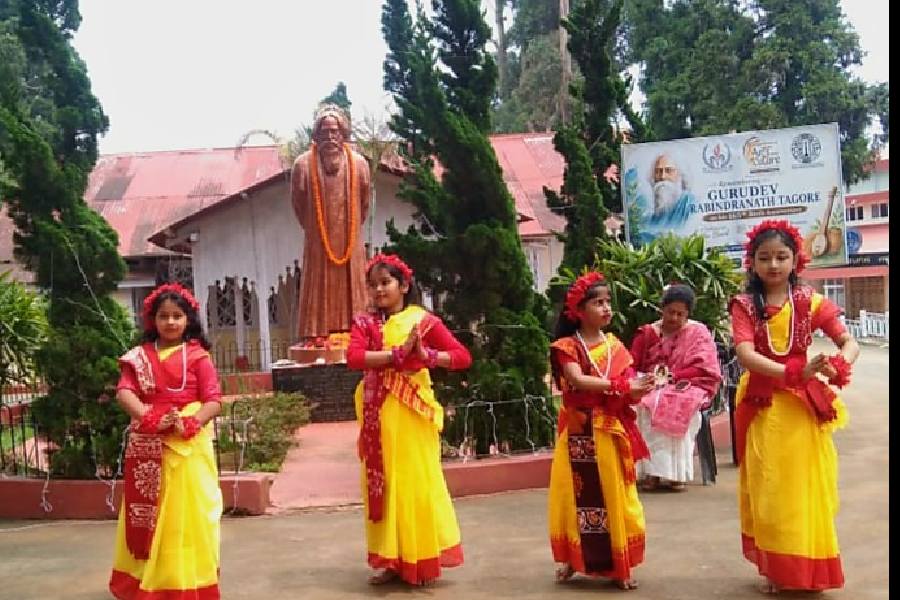
Every May, the aptly-named Zigzag Road in Shillong’s Rilbong locality preens in anticipation of Rabindranath Tagore’s birth anniversary. This year, his 165th, was no different, with cultural programmes organised to celebrate Asia’s first Nobel laureate and his affinity for the verdant hills of Meghalaya.
Indeed, the month of May appears to be inextricably woven into Tagore’s tryst with the Khasi hills. He spent considerable time in Shillong during his three visits — in 1919, 1923 and 1927. While the poet’s first visit was in autumn, his next two visits were in summer.
In fact, in May 1919, following the Jallianwala Bagh massacre, Tagore wrote to Viceroy Lord Chelmsford renouncing his knighthood as a protest against British repression in India. He subsequently planned his visit to Shillong that autumn, renting a colonial bungalow, Brookside, from the then assistant commissioner of Chittagong, Kiran Chandra Dey. The cottage and its surroundings left an indelible mark on Tagore’s mind and are amply documented in his works, particularly his novel, Shesher Kobita. Today, Brookside, with its towering copper-hued statue of Tagore, remains the focal point of commemorations.
During the May 1923 visit, Tagore stayed at Jitbhoomi, another cottage in Rilbong, not too far from Brookside. His final visit (May 1927) came at the invitation of his industrialist friend, Ambalal Sarabhai, who had rented two adjacent houses on Upland Road in Shillong’s Laitumkhrah locality. But Tagore missed the pastoral ambience he had savoured at Brookside. His growing fame, too, intruded upon the solitude he sought. He expressed these sentiments in one of the many letters addressed to Ranu Adhikari (later Lady Ranu Mookherjee), who had accompanied him to Shillong during the 1923 visit. He wrote: “There is always a congregation of people — the curiosity to see me — the way people go to the circus to see lions — where the lion feels depressed but the spectators are happy. I am thinking of charging five rupees as viewing fee! Sometimes there is rain, sometimes it is sunny — this is how the weather has been. When I sit down to write, I feel tired, I recline on the chair, a visitor arrives suddenly …”
In 1936, an ailing Tagore planned another journey to Shillong but the visit did not come to fruition. He wrote to Lady Ranu, “Considering the heat of Jaistha (May-June), I was contemplating several cool destinations. I was discussing with Dr Bidhan Roy the prospect of going to Shillong.” Roy had a house not far from Tagore’s beloved Brookside and the Meghalaya government’s bid to raze it is now being contested in court.
The activist who moved the public interest litigation over Roy’s house is also campaigning for heritage status for Brookside. Malabika Bisharad, a Tagore researcher, is now striving for the establishment of Rabindra Bhavan at the site. Last month, the deputy-secretary, arts and culture department, U. Kharkongor, wrote to the director of the same department, Iadashisha Majaw, to expedite action on Bisharad’s plea. When asked about the letter and her decision on the heritage status, Majaw declined to comment.
Across the world, from France to Fiji, memorials dedicated to Tagore are preserved with care and pride. Meghalaya’s reluctance to accord lasting protection to a site so deeply intertwined with Tagore’s creative and emotional landscape, despite repeated assurances from presidents, governors, ministers and bureaucrats, is ironic. If promises are to mean anything, this is the month to honour them. For it was in this abode of clouds, during his Shillong summers, that Tagore transformed impressions into literary treasures and Meghalaya into immortality. How long will the arts and culture department remain in hibernation?