Family feud
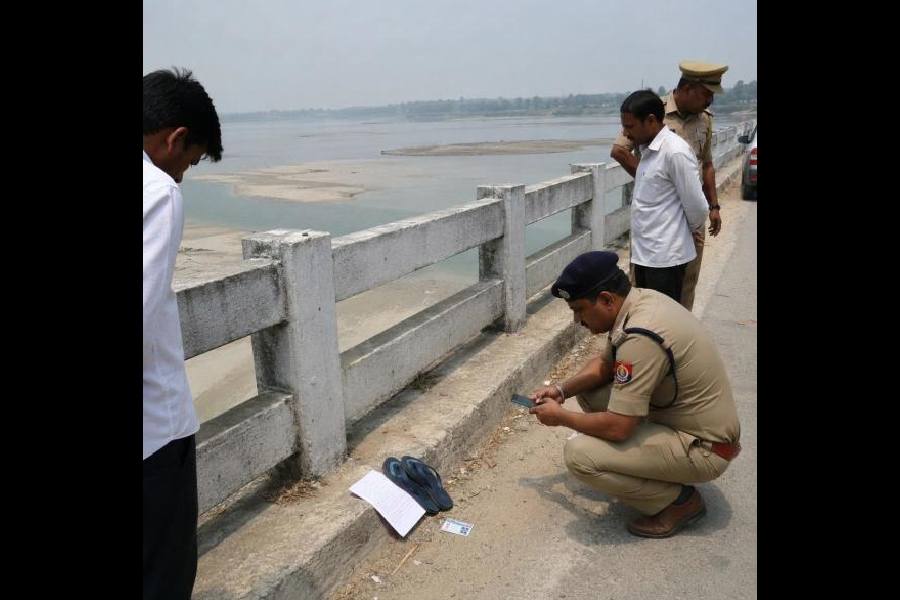
Sir — Truth can indeed be stranger than fiction. Just ask the villagers in Deoria, Uttar Pradesh, who spotted a handwritten suicide note, a pair of slippers, and an Aadhaar card on a bridge over the Saryu river. The police launched a massive six-hour search for a body, only to find the man completely fine. He admitted that he staged the whole dramatic exit just to escape family disputes and mental stress. While it sounds like a film plot, it highlights a sad reality: Indian families can sometimes create so much pressure that a person may feel forced to stage his own disappearance just to get some peace. This incident also serves as a reminder that families, instead of being the first port of call in distress, can often be the foremost stressor in a person’s life.
Nikhil Sen,
Hooghly
Tough questions
Sir — The four-nation European tour of the Indian prime minister, Narendra Modi, highlighted India’s effort to reposition itself in the global order as a trusted technological and manufacturing partner. As Europe seeks to reduce its dependence on China and build resilience with democratic nations, India has emerged as a critical partner. The broader European tour reinforced this shift. Modi’s visit deepened partnerships in advanced manufacturing, clean energy, and built resilient supply chains. While this strategic opening is significant, India must now sustain these ties through policy stability, faster execution, and industrial competitiveness.
Khokan Das,
Calcutta
Sir — Narendra Modi has a deliberate strategy of avoiding the media and dodging tough questions. This was evident in Norway where he completely ignored a journalist’s query at a press conference (“Why no answer: Norway scribe to Modi”, May 19). Despite frequently describing India as the “mother of democracy” and being the leader of the world’s largest democracy, the prime minister simply walked away
as if he had no obligation
to face the press. This interaction underlined the mysterious and unpredictable nature of both Indian
democracy and Modi’s leadership style.
Avinash Godboley,
Dewas, Madhya Pradesh
Sir — During Narendra Modi’s visit to the Netherlands, a member of the ministry of external affairs, Sibi George, staunchly rejected concerns raised by a Dutch journalist regarding press freedom and minority rights in India. The reporter cited remarks by the Dutch prime minister, Rob Jetten, who had expressed worries to the local media about the treatment of the Muslim community and other minorities in India. In his strategic response, George countered these criticisms by highlighting India’s 5,000-year-old civilisation, noting that the country’s minority population has grown from 11% at Independence to over 20% today. He further emphasised India’s deep-rooted religious pluralism as the birthplace of four major faiths and pointed to high voter turnout in massive democratic elections as concrete proof of an inherently free and vibrant society.
Bidyut Kumar Chatterjee,
Faridabad
Popular choice
Sir — The Congress finally naming a chief minister in Kerala after weeks of internal wrangling bared an ugly reality (“At last”, May 19). The party’s chronic factionalism nearly overshadowed its victory. Yet, the choice of V.D. Satheesan for the top role shows a rare moment of pragmatism. His appeal to the public and collective leadership mark a shift from personality‑driven politics to performance‑based accountability. Kerala’s electorate expects competence, not charisma, and the Congress must prove it can govern with unity and purpose. The real test begins now.
Babu Krishna,
Bengaluru
Sir — In choosing V.D. Satheesan to be the chief minister of Kerala, the Congress appears to have rewarded political performance over hierarchy. Over the past five years, he emerged as one of Kerala’s most prominent Opposition voices, consistently challenging the Left government on corruption and misgovernance. More importantly, he succeeded in projecting a younger and more assertive image of the party in the southern state which was essential for this electoral win.
S.S.Paul,
Nadia
Systemic failure
Sir — The alleged dowry death case of Twisha Sharma exposes the brutal harassment that many Indian brides face. Despite strict laws, fear of rejection by
both families forces many women to suffer silently. To prevent such tragedies, the government must ensure stringent surveillance. Moreover, informal networks must be activated as news of dowry harassment often spreads at the local level. The National Commission for Women should actively monitor such networks and ensure that the harassers
are apprehended.
R.S. Narula,
Patiala, Punjab
Make it easy
Sir — Since West Bengal introduced electronic ration cards, the physical issuance of ration cards has nearly halted, leaving many citizens without the newly-launched authentic PVC cards. Consequently, people must repeatedly download and print their digital cards via one-time password verification for various governmental and non-governmental purposes, causing financial strain on account of repeated visits to online service centres. While many laminate colour-printed copies for safekeeping, these lack the official weight and acceptance of an authentic, PVC card issued by the authorities concerned.
To modernise this system and make it user-friendly, the food department should allow cardholders to update their photographs online and then issue high-quality PVC ration cards similar to Unique Identification Authority of India’s Aadhaar cards and ensure that all those already registered get their cards.
M.D. Washim,
Birbhum