Trash talk
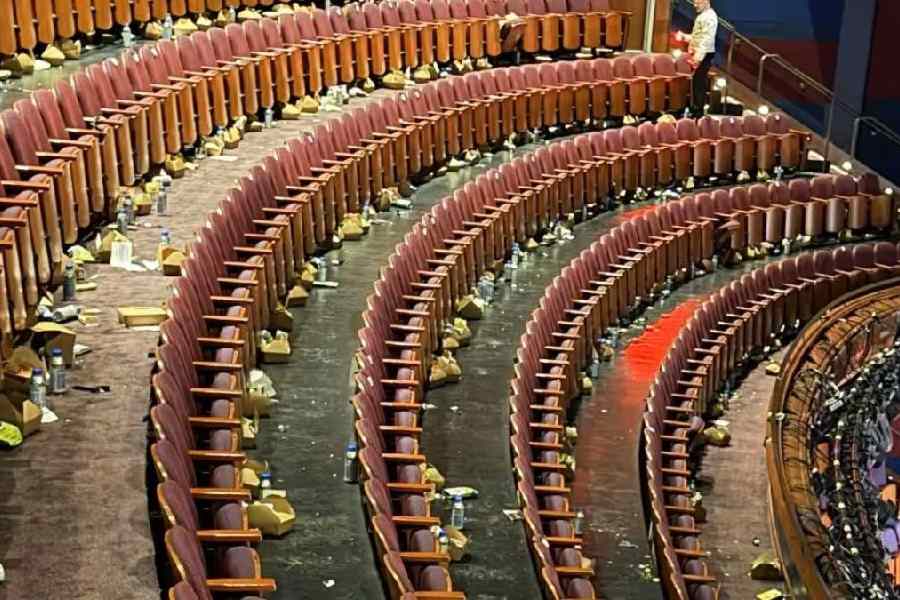
Sir — In recent years, the Oscars stage has echoed with acceptance speeches about saving the planet and ending wars. But a photograph of the Dolby Theatre hours after this year’s ceremony revealed a less-inspiring reality: empty water bottles and snack packets strewn across seats and floors. The irony is cinematic: calls for global accountability are delivered by people who cannot even manage local dustbins. Since humans respond best to competition and rewards, perhaps the Academy should take note. Alongside the usual honours, it might consider introducing a new category — Best Use of a Trash Can.
Archana Singh,
Calcutta
Grey outcome
Sir — Days after the killing of its Supreme Leader, Ayatollah Ali Khamenei, Iran finds itself navigating one of the most destabilising phases in its modern history (“‘Unrealistic’ tag on Bibi’s Iran uprising plan”, Mar 19). A fresh wave of assassinations has struck at the heart of Iran’s leadership, eliminating figures who once formed the backbone of its military and political Establishments. Among the prominent casualties are Ali Larijani, the top security official, Gholamreza Soleimani, the commander of Basij, and Esmail Khatib, the intelligence minister.
The latest development underscores the scale and the persistence of the offensive led by Israel and the United States of America. But the removal of its leadership has not weakened Iran; on the contrary, it has transformed its internal dynamics.
Khokan Das,
Calcutta
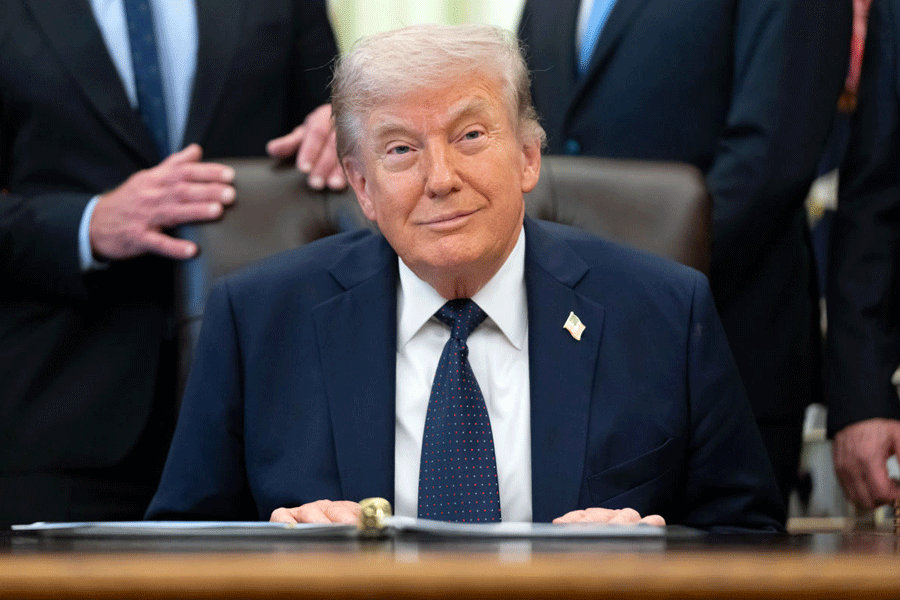
Sir — Questions about the wisdom of the decision to engage in a conflict with Iran have put the US president, Donald Trump, on the defensive. The enthusiasm he displayed in the early stages of the conflict has diminished considerably. Twenty-one days into the conflict, the US has failed to achieve its objective of regime change, despite a series of assassinations targeting Iran’s top leadership. The killing of a key Iranian security figure, Ali Larijani, has only added to what Iranians view as a growing list of martyrs. Instead of stoking an uprising, the killings have strengthened their resolve to defend their country. European leaders distancing themselves from the conflict in West Asia has left the US increasingly isolated. The ongoing exchange of attacks has produced no winner.
G. David Milton,
Maruthancode, Tamil Nadu
Sir — In the article,“Power gone rogue” (Mar 18), Arghya Sengupta highlights the tragic deaths of at least 175 children in an American attack on an Iranian school. However, the piece omits mentioning Iranian retaliatory strikes on civilian targets across West Asia. According to Human Rights Watch, these attacks have resulted in at least 11 civilian deaths and 268 injuries, with the majority of the victims being migrant workers.
It is also worth recalling that the October 2023 attack by Hamas on Israel killed 1,200 people. Empathy for victims is essential. But it must be even-handed. Condemning one set of actions while overlooking others risks weakening the moral force of such criticism.
Ajay Tyagi,
Mumbai
Sir — Democracy is a facade; the US is indeed a rogue State. Historical examples, such as the massacre of unarmed civilians during the Vietnam War and the atomic bombings of Hiroshima and Nagasaki, are testaments to this. Institutions like the United Nations, established to safeguard peace and prevent future wars, often seem ineffective in restraining powerful nations. The UN is a puppet in the hands of the big powers.
Aranya Sanyal,
Siliguri
Sir — The attempt by the US and Israel to decapitate Iran’s top leadership is unlikely to bring about the collapse of the Iranian State. The back-to-back assassinations are more likely to inflame a desire for vengeance than to weaken Iran’s resolve. The ongoing conflict has already pushed the global economy to the brink. Iran’s sustained retaliation poses serious challenges not only to the US leadership but also to its long-term prospects in the region. The Donald Trump-led administration’s objective of regime change in Tehran appears increasingly unrealistic.
Gregory Fernandes,
Mumbai
Parental excess
Sir —The editorial, “Heavy burden” (March 10), rightly raises concerns about childhood obesity. While genetic factors play a role, obesity is largely driven by lifestyle changes. In well-off families, children are often overindulged. Modern parenting often prioritises comfort and convenience. Physical activity has taken a backseat while malls, restaurants, and screen-based entertainment have become the spaces for recreation. The easy availability of sugary drinks and junk food adds to the woes.
Ardhendu Chatterjee,
Durgapur
Sir — The editorial, “Heavy burden”, was thought-provoking. India is witnessing a sharp rise in obesity. Although initiatives such as the Fit India Movement and Eat Right India campaign have been launched, their impact has been limited at the grassroots level.
Jayanta Datta,
Hooghly