Digital duel
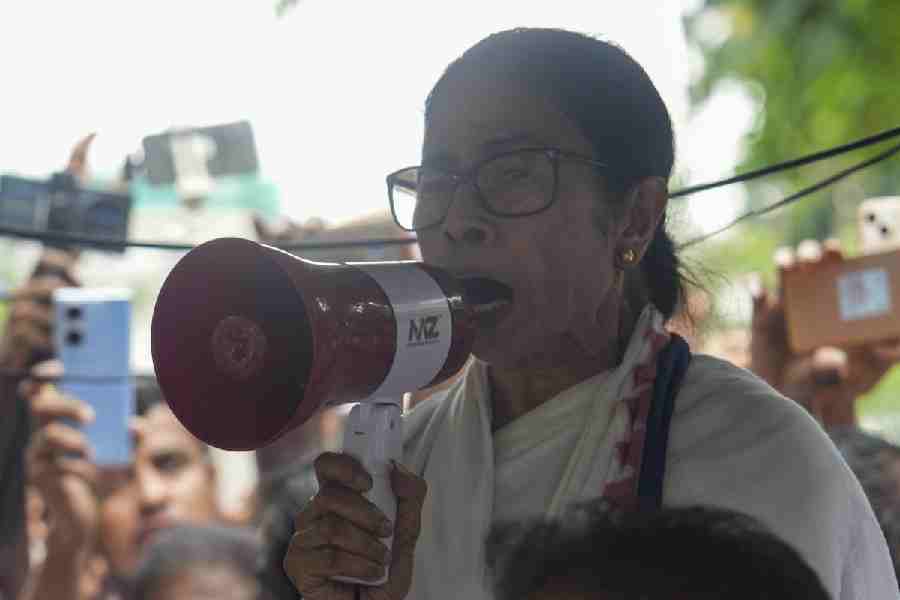
Sir — The election campaign is not restricted to the streets anymore. This round of assembly elections has seen political parties launch elaborate social media advertisements, mixing welfare messaging with attacks on political rivals to influence voters. In West Bengal, for instance, the campaign song of the Trinamool Congress, “Je lorche sobar daake”, is now the most-viewed political campaign song on YouTube. Reels, memes, and curated videos are thus flooding timelines. But as voters scroll, like, forward and comment, one wonders: are we choosing leaders anymore, or just the best social media manager?
Lovely Mitra,
Calcutta
Malevolent force
Sir — Ramachandra Guha’s article, “The destroyer” (April 18), correctly describes the president of the United States of America, Donald Trump, as a force that undermines America’s global standing. Guha’s assessment that Trump and his advisers have taken a leaf out of the playbook of modern autocrats like Narendra Modi is spot on. The Indian prime minister, in the garb of being an advocate for democracy, has weakened key democratic institutions. Even as Modi publicises developmental achievements, the foundational values of democracy seem to be steadily eroding in India.
Monidipa Mitra,
Calcutta
Sir — If Donald Trump acted wayward and whimsical in his first presidential term, his second stint in the White House thus far has revealed him as dangerously malevolent. In “The destroyer”, Ramachandra Guha outlines the many ways in which Trump has assaulted America. Guha, however, is less persuasive when he attributes Trump’s approach to the influence of leaders such as Viktor Orbán, Recep Erdogan and Narendra Modi.
Sukhendu Bhattacharjee,
Hooghly
Lost opportunity
Sir — India’s decision to withdraw its bid to host the United Nations Climate Conference, COP 33, in 2028 is a missed opportunity. It also marks a reversal of a proposal put forward by Prime Minister Narendra Modi during COP 28 in Dubai in 2023. Backing out of hosting a major climate summit could be perceived as India’s diminishing role in global diplomacy. One wonders whether financial constraints have played a role in this decision.
Modi’s critics have argued that the initial bid to host COP 33 may have been politically motivated to gain visibility before the 2029 general elections. The absence of an official explanation for backing out fuels the perception of indecision. If India aspires to global leadership, such retreats risk undermining its credibility.
Jang Bahadur Singh,
Jamshedpur
Sir — The Government of India’s decision not to host COP33 is unfortunate. India’s stance on critical issues such as climate finance and the principle of Common But Differentiated Responsibilities has been both significant and influential. As a major player in advancing renewable energy, India was well-positioned to host COP 33 after expressing interest two years ago.
In recent years, the global climate discourse has come under strain, with concerns over a diluted approach to meaningful action. Ignoring the escalating environmental crisis would be short-sighted. Hosting COP 33 would have allowed India to reinforce its leadership in the Global South and amplify the voices of vulnerable small island nations.
Himangka Kaushik,
Delhi
Heavy burden
Sir — Neelanjan Sircar’s article, “Electoral survival” (April 22), highlights a chilling reality about the impact of the Special Intensive Revision on the assembly elections in Bengal. While the immediate concern is the deletion of names from electoral rolls, we must address the deeper structural shift: the transformation of citizenship into a technocratic hurdle. The SIR effectively passes the burden of proof from the State to the individual. In a landscape where clerical errors are increasingly weaponised, citizenship is no longer a guaranteed social contract but a fragile data point dependent on a flawless paper trail. For the marginalised, this ‘datafication’ creates a digital wall that leads to administrative alienation.
Furthermore, the current climate of polling has transformed from proactive to defensive voting. When a community consolidates its vote primarily to repel a perceived threat, its bargaining power for socio-economic development diminishes. This creates a representation paradox: the community remains electorally relevant but politically stagnant as its support is taken for granted by the ‘protector’ party. This is eroding the syncretic fabric of Bengal.
Nilachal Roy,
Siliguri
New captain
Sir — In a significant managerial shift at Apple Inc, John Ternus has been named the new chief executive officer and is set to succeed Tim Cook. A seasoned insider with over 25 years of experience in hardware engineering at Apple, Ternus brings deep technical expertise to the role. His appointment signals a renewed push to align the iPhone maker with the fast-evolving dynamics of global technology.
Kirti Wadhawan,
Kanpur