Just politics
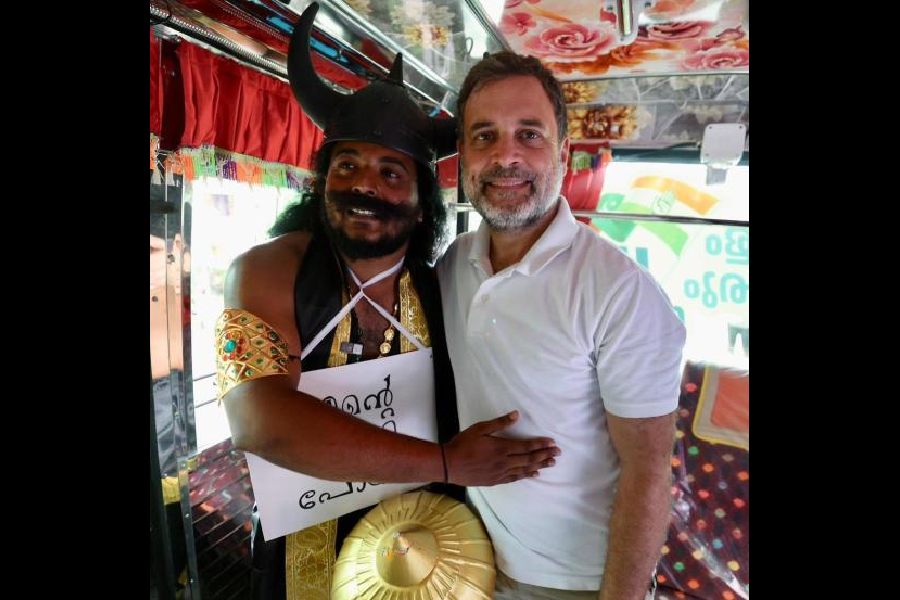
Sir — Politicians promising jobs before the elections is not out of the ordinary. But offering employment to Yamraj himself is quite extraordinary. During a bus ride in Balussery, Kerala, the Congress leader, Rahul Gandhi, encountered a man dressed as the god of death. The latter seemed deeply concerned about his employment prospects because a Rs 25 lakh health insurance scheme promised by the United Democratic Front threatens to disrupt the afterlife economy and thus his cushy job. Yamraj should know that political promises amount to little, whether it is a job offer or an insurance scheme.
Kakoli Das,
Calcutta
Innovative bite
Sir — Apple turned 50 this year. The first iPhone changed how ordinary people use technology (“Fruit of desire”, April 5). The device replaced buttons with a touchscreen and introduced simple software navigation. The app store later expanded possibilities of what could be done with a phone by allowing independent developers to create applications. These changes shaped smartphones and digital services. However, recent models appear incremental rather than transformative. Apple must invest in meaningful innovation instead of
minor updates. Consumers now expect breakthroughs comparable to 2007.
Future growth depends
on whether Apple can
create another product
that changes everyday
technology use.
Aranya Sanyal,
Calcutta
Sir — Steve Jobs always emphasised design and usability, which helped Apple stand apart from competitors. The first iPhone reflected this philosophy by prioritising software and user experience. Many companies later adopted similar approaches. Today, smartphone designs appear similar across brands. Apple’s advantage therefore requires renewed focus on usability improvements rather than cosmetic changes. Innovation in accessibility, battery performance, and durability would benefit consumers. Clear direction from Apple’s leadership will determine whether the company maintains influence in future technology development.
Bani Adhikari,
Calcutta
Sir — Apple must explore new categories such as wearable computing or augmented reality. Without new ideas, smartphone growth will plateau.
C.M. Nandi,
Calcutta
Different land
Sir — The vivid portrayal of Vietnam’s disciplined electoral process in “Hanoi diary” (Mar 31) by Uddalak Mukherjee raises an old but urgent question: is order preferable to dissent? The scenes from Hanoi, with quiet polling booths and dutiful citizens, stand in stark contrast to India’s noisy democratic theatre. Vietnam remains a one-party state dominated by the Communist Party, where political opposition is limited and civil liberties are restricted. Freedom House continues to classify the country as “Not Free”, citing tight controls on expression and civic activity. The economic achievements are impressive but prosperity without pluralism comes with long-term risks. India’s elections may appear chaotic, even exhausting. But that noise is the sound of disagreement, and disagreement remains democracy’s insurance policy.
Sourav Ash,
Calcutta
Sir — Uddalak Mukherjee asks a provocative question: is public docility the price of prosperity? But Vietnam’s development story is not merely a tale of authoritarian efficiency; it is also one of pragmatic governance. The country’s economic transformation since the doi moi reforms has been remarkable. Visitors to Hanoi thus encounter bustling streets, thriving cafés, and a confident middle class. These developments suggest that prosperity, even under a single-party system, can still improve lives in meaningful ways. Democracy is essential. But it is also worth acknowledging that governance models evolve differently across societies.
Anupam Neogi,
Calcutta
Sir — The description of Hanoi in Uddalak Mukherjee’s piece reminded me of a visit to Vietnam a few years ago. The mornings in Hanoi began with the clatter of scooters and the aroma of pho. Evenings near Hoàn Kiem Lake felt unhurried, almost contemplative. Yet beneath this calm lay an unmistakable sense of order: traffic flowed despite chaos, queues formed without argument, and public spaces felt remarkably safe. Vietnam’s tourism boom reflects this atmosphere. The discipline may stem not only from politics but also from history shaped by war, reconstruction, and collective effort. Watching locals practise tai chi by the lake at dawn, one senses neither oppression nor exuberant freedom, but something quieter: a society finding its own rhythm.
Sayantan Basu,
Calcutta
Sir — The most striking observation in “Hanoi Diary” is about India. India prides itself on dissent, yet recent debates around nationalism, abstention, and civic duty suggest a shift in tone. The article warns that authoritarian tendencies can emerge within democracies, particularly under charismatic leadership. Vietnam’s example offers both caution and clarity.
Aloke Kumar,
Gaya