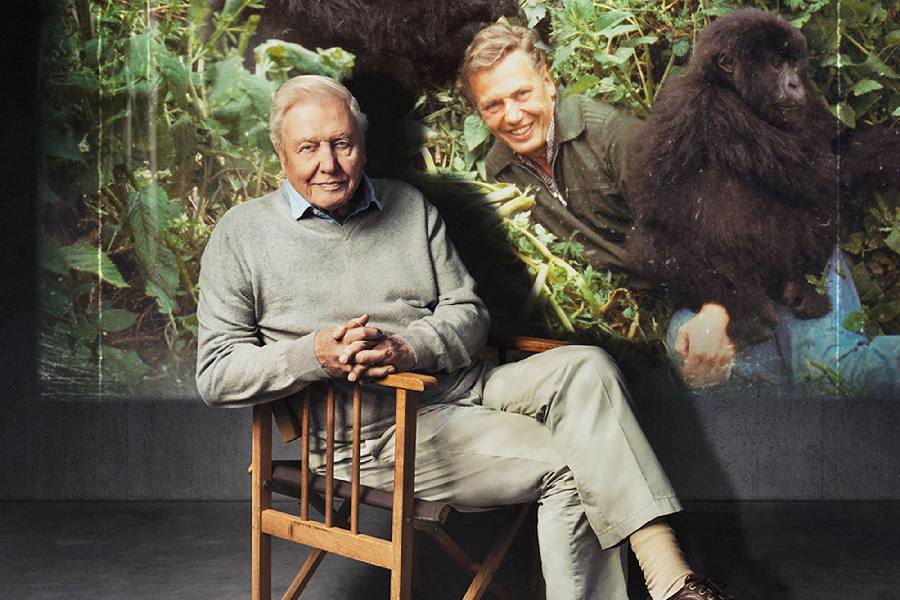
As he celebrates his hundredth birth anniversary, Sir David Attenborough remains one of the most consequential public educators of conservation in the modern age. Across seven decades of his life, Mr Attenborough made natural history central to popular consciousness. Through landmark documentaries such as Life on Earth, Planet Earth and Blue Planet, he has brought scientific observation, ecological curiosity and cinematic precision into millions of homes. His work ought to be viewed in conjunction — continuum — with other pioneers, such as Jane Goodall, who challenged rigid distinctions between humans and primates, Jacques Cousteau, who warned against the devastation of oceans, and Dian Fossey, whose work drew international attention to poaching and habitat destruction, among many others. Together, these crusaders argued that wildlife preservation was inseparable from moral responsibility and scientific understanding. Under Mr Attenborough, the BBC’s Natural History Unit also established the visual and the editorial grammar of modern wildlife film-making.
Yet the centenary celebrations must also confront the contradictions embedded within this legacy. Much of Western conservation emerged from a distinctly imperial gaze that treated Africa, Asia and Latin America as theatres of spectacle for European audiences. Early programmes, such as Zoo Quest, relied on extraction, capture and transportation of wildlife under conditions shaped by colonial privilege. The wider conservation framework surrounding these productions frequently erased indigenous stewardship while presenting nature as a pristine realm endangered primarily by local populations rather than by empire, industrial capitalism, and extractive economies. Mr Attenborough himself often framed ecological decline through the language of abstract humanity, sidestepping the unequal responsibilities of wealthy industrial societies. Critics rightly argue that this obscured histories of colonial violence and environmental exploitation. Fortress conservation, displacement of forest communities and neo-Malthusian anxieties around population growth all found indirect legitimacy within sections of mainstream wildlife broadcasting. These omissions matter because Mr Attenborough’s authority bears immense cultural power. Silence on political causes frequently functions as political positioning in itself.
Even so, reducing Mr Attenborough’s career to these limitations would amount to intellectual dishonesty. His documentaries generated ecological literacy on a planetary scale at a time when environmental destruction remained marginal in political discourse. Scientific reports and policy papers rarely move public imagination. Storytelling does. The power of — empathy in — Mr Attenborough’s chronicles created emotional proximity between audiences and ecosystems they would not encounter otherwise. Many contemporary ecologists, climate scientists and conservationists entered their professions because Mr Attenborough’s work produced serious engagement rather than passive admiration.
With climate change threatening the planet’s very existence, it is natural to ask whether Mr Attenborough’s work could be a catalyst in public and policy resistance towards the annihilation that looms. The outcome is uncertain: Mr Attenborough is a soldier in a markedly uneven battlefield. But there can be no doubt about the fact that he is among those who showed humanity the way to fight the fire.