Back in the 1990s and early 2000s, he would regularly visit 30B Harish Chatterjee Street to cover Mamata Banerjee, who was in the Opposition, says a retired journalist.
He continues, “Often, I would see an unassuming chubby boy with close-cropped hair, wearing a loose athletic vest or T-shirt, shorts and floaters playing gully cricket with other local boys, in a small vacant plot nearby. On days when none of the other kids was around, the bespectacled kid used to play by himself. Even on blistering afternoons, he would do the solo wall-batting drill for hours. His technique wasn’t bad but he wasn’t really a talent. Years later, I was shocked when Abhishek Banerjee came up to me at a post-victory celebration event in 2011 and introduced himself as that boy.”
When CPM goons attacked Mamata in August 1990 and brought a lathi down on her head, Abhishek was nearly three years old. The story goes that the only child of Mamata’s brother Amit and his wife Lata swore to avenge his aunt back then. He said something like — “Jara Didi-ke merechhe tader ami dekhe nebo… I will go after those who have assaulted Didi.” Abhishek, too, referred to her as Didi.
Mamata is one of six brothers and two sisters, and has a number of nephews and nieces, many of them accomplished in their own way. But for as long as those close to her can remember, she and Abhishek have shared a special bond. She never forgot the fierce pledge of the little boy.
A rebel Trinamool MP tells The Telegraph, “In the run-up to elections, while addressing people and during party meetings, she would defend her nephew’s divine right to rule, presenting that mythologised anecdote.” He adds, “She would draw attention to that photograph of herself with her head bandaged and proudly claim that Abhishek was only a child when he joined her political struggle. By tracing his political pedigree back to the nursery, she desperately tried to justify his ascent.”
***
In the strictest sense of the term though, there was no ascent. One minute Abhishek was just another boy, and the very next he was paradropped into the Trinamool as leader of YUVA, a party youth wing parallel to the actual Trinamool Youth Congress headed by Suvendu Adhikari.
“It was not as if in his pre-politics avatar he had the reputation of being a brat, nor was he the brightest bulb in the chandelier,” says another veteran journalist who has been tracking Mamata’s career for years.
Whatever little is known about Abhishek’s student life is from public records. Schooling from Nava Nalanda and M.P. Birla Foundation Higher Secondary School in Calcutta, and BBA and MBA from the controversial IIPM in New Delhi.
It is not surprising that when Abhishek began his political innings, he adopted a corporate approach. He marshalled the cyber team, experimented with website-driven party membership, advocated enforcement of rigorous administrative calendars.
He might have been inspired by his aunt to join politics but he did not
seem to like muscle-flexing street politics, and instead sought out the Sam Pitrodas, Farhan Akhtars and Leander Paeses for advice. He criticised factionalism within the party in his early speeches and preached rigid discipline.
***
In 2012, he got married to Rujira Narula, daughter of Gursharan Singh Narula, an established businessman from south Delhi with his commercial anchor in Bangkok. Narula has spent decades building export-import and hospitality ventures in Thailand and Rujira, by Abhishek’s own declaration, is a Thai citizen.
“The match was made by none other than Arun Jaitley,” says a Mamata loyalist. According to him, since their NDA days, Mamata and Jaitley had been on good terms. The engagement as well as the wedding reception were reportedly hosted at luxury hotels in New Delhi and attended by the country’s who’s who. Next to nothing is known about Abhishek and his parents’ assets from that time. But according to Mamata’s affidavit ahead of the 2011 elections, her total assets were ₹15 lakh.
In 2011, when Abhishek walked into Trinamool Bhavan, he did not confront party veterans such as Subrata Bakshi, Firhad Hakim, Partha Chatterjee, Sovan Chatterjee or Kalyan Banerjee. He systematically bypassed them. Whenever the old guard grumbled about “the IIT/IIM-type kids and their computers”, you knew they were talking about Team Abhishek.
When a senior leader from North 24-Parganas went up to Mamata in 2013 and complained that YUVA was creating a “party within a party”, she brushed it aside calling it a “harmless youth club”.
In 2014, Abhishek contested his first elections and won the Diamond Harbour Lok Sabha seat by a margin of 71,000 plus votes, defeating the CPM’s Abul Hasnat. One would think that was the turning point in his political career, except it was not. That came two years later.
Many invoke the Indira-Sanjay example to explain why the Mamata-Abhishek partnership proved disastrous for the Trinamool as well as Bengal. There are indeed many similarities, but only up to the crash.
On October 18, 2016, Abhishek’s SUV slammed into a stationary milk van on the Durgapur Expressway near Singur. His left orbital bone that encases the left eyeball was shattered. “That crash changed everything,” says an octogenarian politician. “That is when his unmitigated ascent truly began. That is when Mamata stopped caring about anybody else in the party, even out of pragmatic concerns,” he adds.
Abhishek had to undergo complex facial reconstruction surgery and other procedures, in India and abroad. From then on, any senior leader who dared to criticise his “highhandedness and arrogance” was met with an icy glare and prompt sidelining. Mamata saw it all as a lack of empathy for “the boy who had shed blood for the party”.
Mukul Roy was the first Mamata loyalist to leave the party in 2017.
***
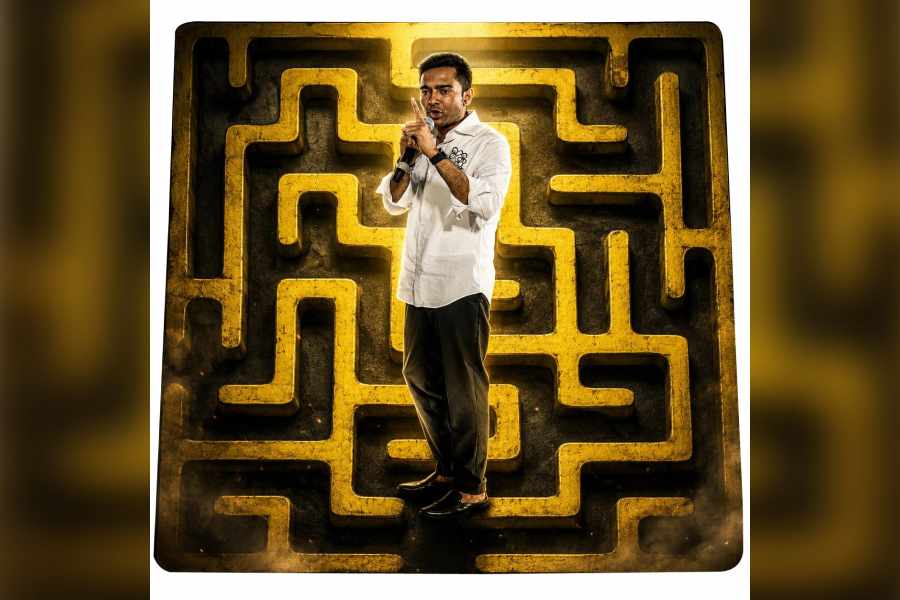
The party was changing and so was Abhishek. Gone was the chubby boy of Kalighat who had seemed content doing his solo wall-batting drill. The new Abhishek was lean, strapped with smart watches, fitness trackers, rings. He started wearing expensive brands. His friends’ circle now included Raghav Chadha, Akhilesh Yadav, Rahul Gandhi — the last apparently prefers him to his aunt. He worshipped Prashant Kishor. He began to socialise with young industrialist friends. Nearly everyone says he trusts no one more than his lawyer Sanjay Basu. Somewhere along the way, he also turned globetrotter — according to details provided to the Parliament secretariat.
Mamata’s Trinamool had been a chaotic, decentralised syndicate of local satraps swearing by her; the Abhishek variable transformed it into a rigid monoculture through I-PAC. Ideology, human emotion and relationship-building were replaced with spreadsheet metrics and bloodless elector-targeting, all of it allegedly coupled with extortionary activities. Abhishek tried to govern a volatile old guard using digital surveillance and consultant clipboards. “This tech-bro takeover required an unprecedented volume of capital, forcing the systematic bypassing of traditional funding,” says a core constituent of the Ritabrata Banerjee-led Assembly rebel bloc.
“Traditional mass leaders found themselves placed under the dictatorial supervision of unimaginative, 20-something consultants reporting to ABO or Abhishek Banerjee’s Office on Camac Street,” he adds.
***
Abhishek became larger than life within the party ranks, deriving his power from a supremo who behaved less and less like party leader and more and more as doting aunt to her “Babu”. “She gives, he takes,” says a multi-term south Bengal MP now in the rebel bloc. “There has been a lot of tension between the two over the old versus new issue, and his impatience to succeed her. She gets hurt by these things but cannot remain angry with him for long.”
The old party continued to disintegrate. Arjun Singh, Suvendu Adhikari, Tapas Roy, all left. “The biggest price of Abhishek’s elevation was the departure of Mamata’s lethal asset, the present CM Suvendu Adhikari,” says political analyst Subhamoy Maitra. Ahead of the 2026 polls, at Abhishek’s bidding, the party dropped 74 sitting MLAs to bring in new faces, many with questionable credentials, and relocated 15 others. Of the 74, 51 lost. Among the 15, only three won. Rebel Trinamool leader Sukhendu Sekhar Ray says, “Had Mamata won this time, she would have been forced to make him deputy CM, with key portfolios such as home and finance.”
Pinning the collapse of the Trinamool on Abhishek alone is reductionist logic. “Once she conquered Bengal, Mamata set about vandalising it,” says a retired senior IAS officer. “Corruption was not invented by Abhishek. Illegal mining cartels and construction syndicates thrived long before he joined,” he adds.
But for all that it cannot be denied that Mamata became who she is on her own steam. Her politics might be flawed, but she is a mass leader. Abhishek, everyone agrees, has no learning curve, nor has he shown serious intent to serve the state he was so eager to inherit. An ambitious corporate boss with limited vision, a lost prince who misplaced an entire kingdom.