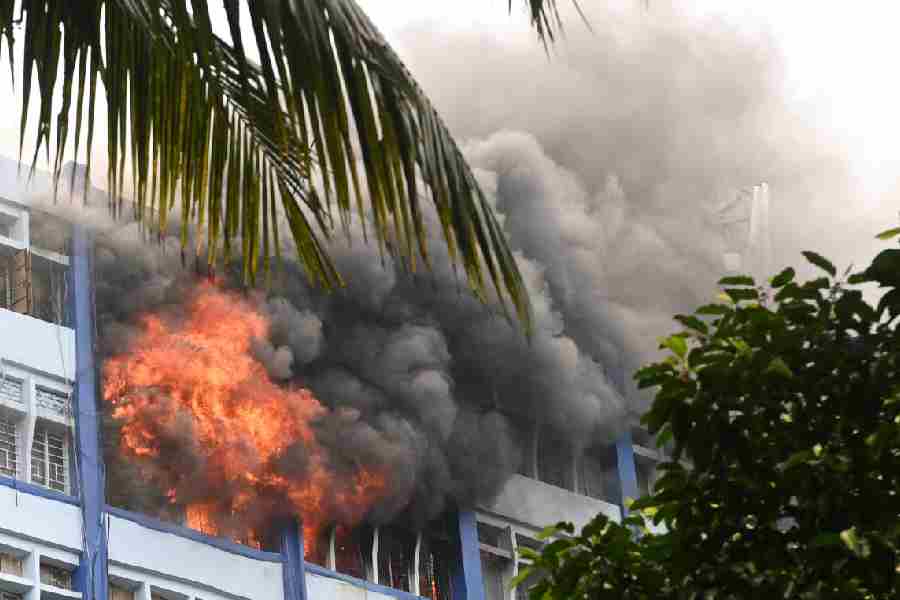
A fire that tore through several floors of a government office block in Alipore on Wednesday has raised questions that the dark smoke has yet to clear.
A special investigation team (SIT) of Kolkata Police has been formed to probe the cause and extent of the damage. But what began as a routine inquiry into an accidental fire has quickly escalated into something more fraught — because among the things destroyed were several thousand electronic voting machines.
What was destroyed
The fire gutted the ninth floor of the New Administrative Building, within the compound of the Alipore criminal court on Baker Road, where approximately 4,000 EVMs were stored under the custody of the sub-divisional officer (SDO) in charge of Alipore Sadar, the main administrative centre of South 24-Parganas district.
Police said the machines were of two kinds — polled and unpolled. The polled EVMs were from the recently concluded Assembly elections, covering constituencies including Kasba, Behala East and West, Metiaburuz, Jadavpur and Satgachia — all falling under the SDO’s jurisdiction. Computers belonging to several departments, containing what officials described as crucial data, were also destroyed.
Why the EVMs mattered
Under election norms, EVMs are kept in secure strongrooms after polling so they can be produced if a candidate challenges the result in court. In Bengal — as in Tamil Nadu, Kerala, Assam and Puducherry — results were declared on May 4. Any losing candidate has 45 days from that date to file a challenge. That window has not yet closed. The destroyed EVMs, in other words, remained live evidence.
What happens now
Senior officials in the state election commission said that if EVMs are destroyed in a fire, retrieving the data is nearly impossible. The fallback, they said, are the sealed voter-verifiable paper audit trail (VVPAT) slips — paper records that allow a manual count of votes if required.
Sources said the VVPAT slips are stored in a different location, in keeping with the protocols laid down by the Election Commission of India. Senior officials, however, refused to divulge the location.
How the fire spread
The fire broke out around 9.40am on June 10, before offices had opened for the day. Seventeen fire tenders battled the blaze for over 14 hours before bringing it under control late that night. Fire and emergency services minister Kaushik Chowdhury raised a pointed question: how did flames that began on the third and fourth floors reach the eighth and ninth floors, where the EVMs were stored?
Fire department officials offered an explanation. For several hours, they said, flames kept leaping from windows across multiple floors. The building was laden with combustible material — computers, furniture, plywood partitions — and electrical wiring ran through the floors. Even the staircase had papers and other flammable material dumped along its sides, providing a ready channel for the fire to climb.
Security for the EVMs
Senior officials of the South 24-Parganas district administration said the ninth-floor room was partitioned, and the EVMs from the Assembly elections were kept under CCTV surveillance with armed security personnel posted outside. When the fire broke out, the guards came downstairs. The CCTVs were destroyed in the blaze.
Officials are now trying to establish whether the cameras were IP-based — which would have allowed remote footage retrieval — or conventional units whose recordings would be lost with the hardware. “We are trying to find out whether these were IP CCTVs or not,” a senior official said. “If not, then we will find out why IP CCTV was not installed despite a work order to do so.” The implication is pointed: a work order for IP cameras existed, but it is unclear whether it was ever carried out.
The SIT
The initial police complaint, filed by an additional district magistrate of South 24-Parganas to the deputy commissioner of police (south), was lodged before the full scale of the damage was known. Once it emerged that thousands of EVMs had been destroyed, a separate complaint was filed with the Election Commission of India, and the investigation was elevated. A four-member SIT, headed by an assistant commissioner of police, was constituted on Friday.
What it will examine
The SIT’s inquiry will focus on: which floor the fire first broke out on, and when it was spotted; who first alerted the fire department and the police; who was aware that EVMs were stored on the upper floors, and what level of security was in place; what the forensic report concludes about the fire’s cause and nature; and whether the fire was deliberately set — and if so, to what end.