All politics is grounded in a particular way of relating to the past. More than any future vision, it is this rear view mirror on history which guides the formation of political identity and the possibilities of political action.
Since 2014, the ruling Hindu nationalist ideology has given us ample evidence of its obsessive concern with installing the Savarkarite narrative of Indian history as the popular ‘common sense’. For Savarkar, Indian history essentially meant the history of the Hindus as they gradually came to self-consciousness through their struggle against a perceived “non-self” or “common foe” — Muslims. That history started in earnest around 1000 CE when Mahmud of Ghazni “crossed the Indus” and invaded “Sindhustan”. “That day, the conflict of life and death began,” wrote Savarkar.
A large apparatus within Bollywood has been marshalled to bring this delirious imagination of history to life in digitally-enhanced, mytho-historical spectacles. The ‘Hindutva historical’ genre has churned out movies like Chhaava, Tanhaji, Padmaavat and Samrat Prithviraj. Added to it is the companion genre of the ‘Hindutva contemporary’ where the frame of the mythic ‘Hindu-Muslim’ existential struggle is transposed on events in the last few decades, the Muslim antagonist now shown to be allied to secular forces. This includes the recent blockbuster, the Dhurandhar series, along with films like The Kashmir Files and The Kerala Story.
In everyday politics, history is routinely served up as “analogue, inspiration, or warning”, as the historian, Matthew Karp, put it. But the most potent political usage of history comes from encoding it within an epochal narrative of ‘revenge’. The politics of ‘avenging history’ can take many forms. We all know what a reactionary politics of avenging history looks like. We see it in the detention camps in Assam and the everyday harassment or, worse, lynchings of minorities all over the country. This kind of systemic violence against minorities has been the defining material outcome of the Narendra Modi years — the distilled residue of all the toxic propaganda pumped out in this period, from WhatsApp forwards to films. We also see this in the genocide in Gaza, perpetrated by a Zionist project that launders its violent settler colonialism through its claim to avenge the history of the Holocaust.
But what does a progressive politics of avenging history look like? All we need to do is cast our gaze back at, well, the bulk of 20th-century history. The motive of avenging historical wrongs, for example, powered the great upsurges of communism and anti-colonial nationalism. Mao Zedong described Chinese communism to his comrades as the vehicle through which the Chinese people could unite and “work unceasingly” to overthrow the “two great mountains” of feudalism and imperialism. Only by breaking down these mountains, Mao argued, could the Chinese avenge the “century of humiliation” imposed by American and European imperialists who, from the mid-nineteenth century onward, had seized their lands, exploited their labour, and reshaped their economy along imperial lines.
Until the 1970s, India also held close to the anti-colonial nationalism of Jawaharlal Nehru which zealously guarded national sovereignty against the creeping dependencies of neo-colonialism. In a 1972 essay for the influential American magazine, Foreign Affairs, titled “India and the World”, the then prime minister, Indira Gandhi, forthrightly affirmed India’s kinship with the struggles of the Global South. “With the non-aligned countries in Asia, the Middle East, North Africa, and sub-Saharan Africa, there exists a special understanding and cooperation based on a common interest in safeguarding freedom and a shared struggle against colonialism, neo-colonialism, and racialism,” wrote Indira Gandhi.
The mainline understanding of colonialism viewed it as a system of political domination, nurtured by racial hierarchy, which was established for the purpose of economic exploitation. As Marcello De Cecco explained in Money and Empire, Britain extracted wealth from India not through the direct seizure of gold or money but by reorienting its economic structure and trade relations toward the export of primary commodities, effectively locking it at the bottom of the global value chain. The resulting export surpluses were then channelled to finance and offset Britain’s persistent current-account deficits.
Given this legacy, post-colonial Indian nationalism conceptualised sovereignty as representing much more than territorial control or parliamentary rule. Sovereignty meant collective self-assertion in determining the design and the purpose of the economic structure, pushing back against all externally imposed constraints. The State-led industrial development of Nehru, Sukarno, and Gamal Abdel Nasser, by building the base of industrial infrastructure long stifled by imperial rule, represented an assertion of both economic independence and political sovereignty. That strategy can be judged as an extravagant folly only if we believe the fable that India achieved full freedom from colonial domination on the day of Independence — the crippling legacy of centuries of economic dependency dissolved overnight at the midnight tryst with destiny.
The end of the Cold War saw India and China diverge in their projects of avenging history. While the Chinese leadership continued to assert continuity in the historical mission of the party-State among the Mao, Deng and Xi periods and held onto sovereign control over its money and markets, the Indian elites bought into the comforting paradigm of Francis Fukuyama’s ‘end of history’. The decade of Manmohan Singh’s premiership came to symbolise this prevailing impulse towards ever-closer strategic alignment with the Anglosphere, crystallised by the high-point of the Indo-US nuclear deal. The scope of sovereignty was restricted to making only those legal and institutional changes (the mantra of ‘reforms’) that might help the free market solve collective problems.
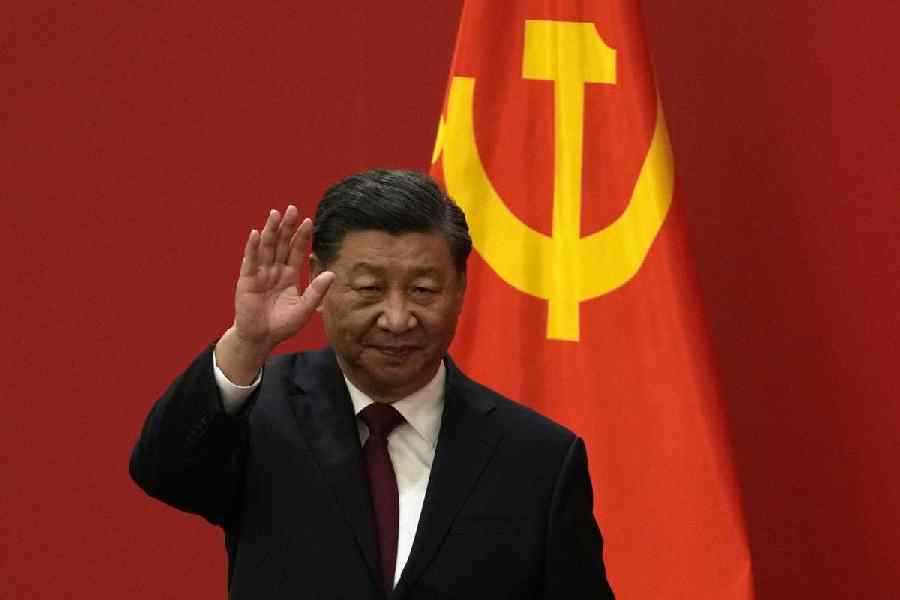
One might instructively compare here the “Chinese dream” propounded by Xi Jinping and the ‘India dream’ associated with Manmohan Singh. The Chinese dream is a collective, State-led and historically-guided vision of making China a prosperous, strong and technologically advanced nation. Xi Jinping first unveiled the “Chinese dream” slogan at Beijing’s National Museum in front of the “Road to Revival” exhibition — an epic narrative that traced China’s trajectory from its ‘century of humiliation’ under foreign domination to its projected national rejuvenation under communist party rule.
By contrast, the ‘Indian dream’ offered by Manmohan Singh and his team of neoliberal technocrats was a copy of the American dream, promising the comforts of upward mobility and middle-class consumption to an aspirational electorate. By the 2010s, that middle class dream had run out of steam. Only so many millions could escape the social Darwinist struggle and ascend to the upper middle class. Many more were left under-employed or unemployed in a financialised economy dominated by an oligarchic elite. The pathetic state of India’s urban infrastructure, sanitation, housing, and drinking water stand as a stark reminder of the hollowness of the vision.
More importantly, the Congress regime offered no compelling narrative of history or an avenging historical project and was thus replaced by a party-regime that had one. But the Modi regime’s narrative of avenging history has little to do with avenging colonialism. In fact it is quite striking that a former British colony can allow the reigning Anglo hegemon to dictate its foreign and trade policies. The leadership remains mute at the constant stream of patronising put-downs, such as the recent comments from a deputy secretary in Delhi stating that the United States of America will not “allow India” to rise in the way China did.
The French orientalist, Ernest Renan, famously observed that nations are defined by what they choose to forget and what they choose to remember. In China, the dominant historical memory still centres on the ‘century of humiliation’ at the hands of imperial powers — not on the Manchu origins of the Qing which are largely absorbed within a broader civilisational narrative. In India, by contrast, the public discourse has become preoccupied with the Ghaznavids, Khiljis and Mughals rather than with the more consequential — and still enduring — institutional legacy of colonial rule. The former has fostered a forward-looking nationalism oriented toward technological progress and strategic competition with former imperial powers. The latter functions as a cover for communal mobilisation — reflecting an elite political culture still shaped by colonial mentalities of hierarchy and control and prone to equating decolonisation with narrow chauvinism rather than structural transformation.
Asim Ali is a political researcher and columnist