The defection to the Bharatiya Janata Party of seven Rajya Sabha members from the Aam Aadmi Party has prompted three sorts of reactions. The first is aimed at the defectors, who are being seen as shameless opportunists. The second is aimed at the AAP supremo, Arvind Kejriwal, who, it is said, sought to erect a personality cult around himself, and in the process drove away many able individuals from his party. The third advances the argument that no sensible opponent of Hindutva should have voted for AAP in the first place, since the anti-corruption movement this party had its roots in was supported by the Rashtriya Swayamsewak Sangh, and since as chief minister of Delhi Kejriwal repeatedly flaunted his Hindu credentials and notoriously did not even visit the non-violent protesters against religious discrimination camped in Shaheen Bagh.
There is merit in each of these criticisms. The defectors indeed appear to be motivated by fear or greed rather than moral or ideological conviction, Kejriwal is insecure about others in the party getting too much attention, and AAP has been less than firm in standing against the dangerous majoritarianism of the ruling party. Nonetheless, whereas for many observers the existential crisis that AAP now faces prompts a sense of schadenfreude, manifesting scorn and contempt, for this writer it prompts a certain sadness. For there were things that AAP has done in the thirteen-and-a-half years of its existence that have helped deepen Indian democracy.
One reason to look at AAP more kindly is the nature of its past electoral successes. For an altogether new party, without deep pockets or an organisational infrastructure, to win two successive elections in Delhi was a hugely impressive achievement. The scale of its victories was staggering — 67 out of 70 seats in 2015, and 62 out of 70 in 2020. Besides, they defeated the Congress and the BJP, both parties which had held sway in Delhi and at the national level. Then, in 2022, AAP also came to power in Punjab. This hat-trick of David vs Goliath style victories was unprecedented in our democratic history, giving succour to those of us who would like to think that in the world of Indian politics money and muscle do not always prevail.
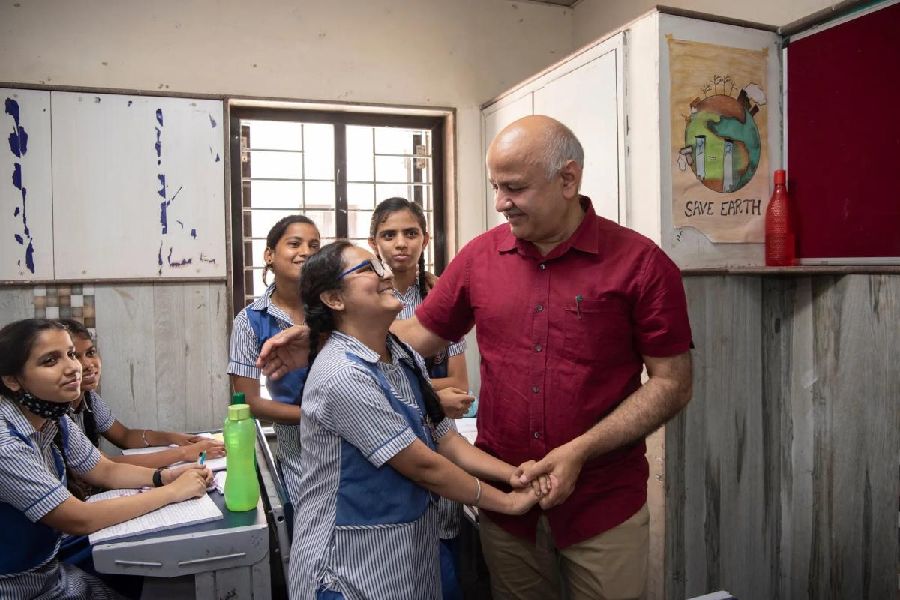
Another, and even more important, reason to appreciate AAP is its record of governance when in power in Delhi. I would particularly single out its impressive work in reforming school education. On coming to power in 2015, AAP doubled the financial allocation to this sector, and set about improving school infrastructure. New schools and classrooms were constructed, and the maintenance and upkeep of existing buildings radically improved. School principals were empowered, given larger discretionary budgets, and made less dependent on the whims of the educational bureaucracy.
AAP’s educational reforms were aimed at giving public schools greater autonomy, and at motivating teachers to improve learning outcomes. As Yamini Aiyar writes in her book, Lessons in State Capacity from Delhi’s Schools, the teaching programme aimed at “building a strong foundation among all students in reading, writing, arithmetic”, and in “bridging the gap between current learning levels and the academic demands of their class”. To achieve these aims, classes were reorganised into three clusters according to learning levels. New innovations included a cadre of specially selected ‘mentor teachers’, tasked with having these programmes implemented; summer camps and reading melas for younger students; the production of new textbooks; and a ‘happiness curriculum’ oriented around stories with a life lesson on which students engaged in group discussions.
Aiyar’s book documents in detail how these different yet complementary innovations were implemented, and the changes they were able to effect in the teaching and learning environment. Her account pays due attention to the critics of the scheme. Nonetheless, her analysis makes it evident that the education system inherited by AAP in Delhi was “a sinking ship”, a ship which the new government was able to steady while steering it in a new direction. The “primary achievement” of AAP’s reforms, she writes, was “the slow and steady introduction of a new vocabulary within the education system, all the way down to the frontline”. What was done in the education sector in Delhi between 2016 and 2020, concludes Aiyar, allows us “a more hopeful view of what can be done if we invest in the state and preserve its democratic impulse”.
The prime mover behind these reforms was the education minister, Manish Sisodia. An educationist who worked closely with Sisodia told me that four features marked his approach to the sector. First, he had a real appreciation and respect for teachers. Second, the minister sought to foster a deep connection between parents and the schools where their children studied. Third, he urged schools to focus above all on children; nurturing those who were lagging behind, providing opportunities for them to grow. Fourth, he worked assiduously to humanise the curriculum and the entire educational process. His was not a managerial or technocratic approach to education but a people-centred one, paying proper attention to the key stakeholders in the school system: teachers, parents, and children.
I would add a fifth feature: a willingness, so very rare among Indian politicians, to listen to and take advice from the best scholars and NGOs in the field. Sisodia was also unusual among politicians in being very accessible and approachable. The minister was visible on the ground, regularly visiting schools, convening meetings with teachers and principals. Moreover, he built a team around him that was equally passionate about education.
In the board examinations for the year 2018, Delhi government schools had a 96% pass percentage, the best in the past twenty-one years. Notably, government schools did even better than private schools. But beyond these tangible numerical outcomes, the reforms were making the entire schooling experience more pleasurable and less stressful; for children, teachers, and parents alike.
These educational reforms suffered a setback after 2020, partly because of the Covid pandemic, and partly because AAP’s re-election that year set the BJP-led Union government even more firmly against it. In 2022, Satyender Jain, the PWD minister who had worked closely with the education minister in improving school infrastructure, was arrested; in 2023, Sisodia followed him into jail, and in 2024 the chief minister himself was put behind bars. These acts of the Union government were motivated by political rivalry and vengefulness, and one fall-out was a slowing down of the visionary reforms through which AAP was seeking to improve the previously moribund public school system.
While in power, AAP also tried to improve public health facilities. A 2019 field study by researchers at IIT Delhi concluded: “Based on our assessment, Mohalla Clinics are delivering good result in terms of equality in accessibility and affordability of primary healthcare. Since these clinics are mostly located in underdeveloped areas with poor infrastructure, they are ensuring better geographical access to health services. These clinics are also reducing time and costs involved in commuting and waiting to avail the treatment.”
AAP’s work in health and education was carried out amidst the unremitting hostility of the Union government. The home minister, Amit Shah, worked overtime to paralyse everyday governance in the city, not least by weaponising the office of the lieutenant-governor. This hostility intensified further after AAP won power in Punjab, whereupon the BJP began to see this upstart party as a long-term threat to its political dominance in northern India, and set about arresting its most important leaders.
I write this while elections are being held in four states where AAP is not a contender. Of the parties that are, the BJP talks of Hindu pride and offers financial handouts; the Trinamool Congress and the Dravida Munnetra Kazhagam talk of regional pride and offer financial handouts. Education and health policy are barely visible on the campaign trail, though better schools and hospitals are surely far more important to the long-term happiness of citizens than having a few more rupees at hand or exalting one’s religion at the expense of another’s.
ramachandraguha@yahoo.in