The word rigging has returned to national headlines courtesy the intense spotlight on the Assembly election battle between the ruling Trinamool and challenger BJP, but it has been part of Bengal’s vote for years. So much so that it’s almost a tradition.
The day ballot boxes were opened for the counting of votes in the Barrackpore Lok Sabha in March 1977, bundles of ballot papers were found inside, all stamped on one candidate.
“Aapnara ki itihaas niye o likhchhen naki [Are you writing on history too]?” asked Sougata Roy, the four-time Dum Dum MP, who won the Barrackpore Lok Sabha seat that year.
The Telegraph Online asked Roy about the allegations of rigging against him in that particular election. “Abhijog uthechhilo, chapa pore gechhe [Allegations were raised, they died down],” the veteran politician replied.
One Bengal Congress leader remembered the event as “shameful.”
“Booths were surrounded, the Opposition polling agents were not allowed to enter,” he said.
The CPM’s Tarit Baran Topdar, who went on to represent Barrackpore for two decades at a stretch, told The Telegraph Online: “Never before or after 1977 has anyone seen such a thing.”
While he was MP, Topdar himself and the CPM would stand accused of similar “crimes” during its 34 years of uninterrupted rule of the Left Front in Bengal.
Rigging is an unsavoury side of Bengal’s electoral history. No party – be it the Congress, the CPM and the Trinamool – can deny it, though everyone points to the other.
In Bengal, it would be difficult to find a person unfamiliar with the word rigging, which has become integral to the conduct of elections in the state.
The 2026 Assembly polls have been different in many ways. The en masse deletion of voters from the electoral rolls was just one part of it, which generated heat for political reasons.
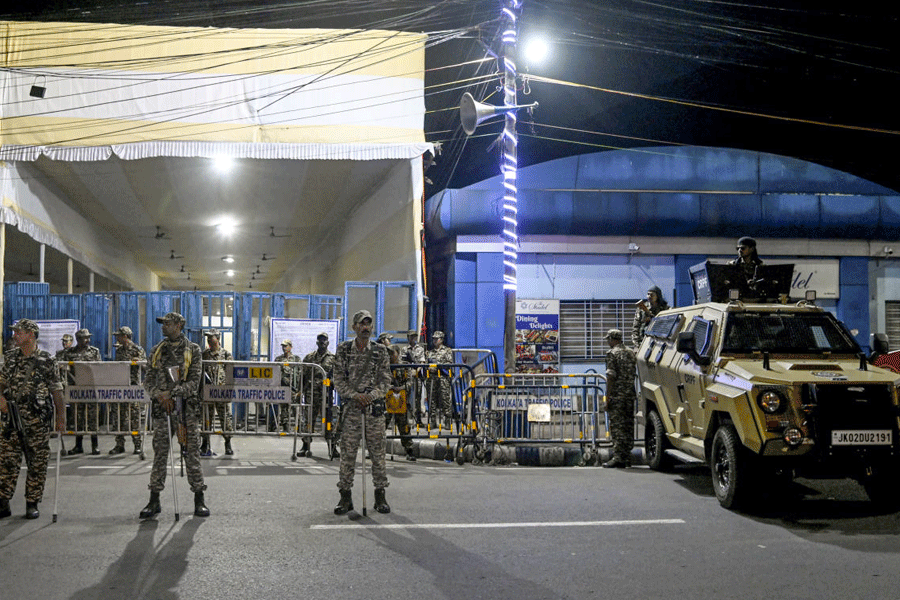
The other was the large security blanket using personnel and technology that made it near impossible for the ruling party to employ the various tricks that it had used in the past.
Rigging is one of the many tools that come under the umbrella of electoral fraud.

Netaji’s ‘unfair means’ to CPM’s ‘scientific rigging’
The freelancers that the Congress had in its heyday for poll management were replaced by the CPM’s cadres. Through these cadres, the CPM had penetrated into every sphere of Bengal’s lives – including the households – throughout the 1980s and 1990s.
During the Left rule, where the CPM was the prime force, the term “scientific rigging” was introduced into the political lexicon of Bengal. Now, Wikipedia even has a page devoted to it.
“Scientific rigging is a term referring to a number of malpractices used by political parties to win elections in West Bengal state in India,” the page says. “These malpractices may include booth capturing, party cadres impersonating genuine voters, polling agents beaten up threatening voters not to vote for the opposition etc. These malpractices are generally achieved through blatant use of government power and organisation of political parties. The term was used by the opposition to the Left Front government in West Bengal.”
On September 18, 2015, when the Mamata Banerjee government declassified 64 files on Netaji Subhas Chandra Bose that ran into 12,744 pages, file number 40 carried a letter attributed to one Jagat Prasanna Gupta from 1940 detailing why his aunt had to withdraw from the civic polls in Calcutta.
Bose was then the alderman of the Calcutta Municipal Corporation. The letter, intercepted by the district intelligence branch in Barisal (now in Bangladesh), stated: “My aunt withdrew the candidature on the day of election. The people of Subhas Bose were taking all sorts of unfair means openly. Complaints to the returning officer were of no avail and so we left the place in disgust.”
The letter continued: “Unfair means in the matter of elections, spoken of by Subhash Babu, before the public, are all his imports. We are eyewitness to this.”
The allegations made by Jagat Prasanna Gupta hint at crudeness in the methodology. The CPM introduced science into the practice, but did not abandon crudity altogether.
In every locality, surveys were carried out on the number of voters. After the headcount, many voters were classified into three categories: dead or D, left or L and absent or A. The last category comprised reluctant voters who did not step out of their homes on polling day.
Many voters likely to vote for the opposition parties were identified and deleted from the electoral rolls during the revision of the voter list. Opposition party workers most likely to engage in polling duty at the booths were coerced into looking the other way or forced out when the polling took place.
Dummy candidates and their agents helped outshout the Opposition’s suspicion and challenge to any voter.
During the Left heyday there would be something called the “shadow camp” hidden from the public eye where cadres would help remove ink from the fingers of those who had already voted. Those impersonating the dead and shifted voters were trained at these shadow camps just ahead of polling with enough details of the actual voter’s home and family members to throw off track any challenge.
The system worked fine till the late TN Seshan when he was chief election commissioner introduced photo-identity cards for voters. Mamata Banerjee, then the principal Opposition leader in Bengal, had made the demand several times.
The crudity involved locking down apartments in Calcutta and its outskirts, bombs being hurled in specific areas through the night to scare voters from turning up at the booths next morning.
“After the milk bottles and newspapers were delivered, the gates would be locked for the day till the polling got over. This happened year after year,” said a resident of Bhabanipur.
Topdar claimed much of the “scientific rigging” charge was exaggerated.
“There were instances of false-voting in some booths. In my area we lost in Naihati, we lost in Noapara. Arjun Singh won from Bhatpara. If we had such an invincible machinery we would have won all the seats,” Topdar reasoned.
The Trinamool era
What was science during the CPM’s rule became an art in the last 15 years of Trinamool.
A few examples from Diamond Harbour, the Lok Sabha constituency of Trinamool’s national general secretary Abhishek Banerjee from where he is breaking victory margin records in successive elections, illustrate the point.
In the 2019 Lok Sabha elections, in one particular polling station only one voter had cast his vote in favour of the CPM nominee. The remaining 1,046 votes went to Abhishek. Later analysis of the result showed in 178 polling stations the TMC leader had received over 90 per cent of the vote share, and in 572 polling stations the vote share was above 75 per cent.
Four years prior to the Lok Sabha polls, during the municipal polls in Bhatpara, a voter from ward 21 in polling station 124 was told someone from the ruling party would accompany him to the enclosure and “show” which button to press. The voter would not agree and left without voting.
In the 2016 Assembly elections The Telegraph had reported that a dead voter and three absent voters were among the 331 voters in Binpur constituency’s Laljol village’s booth number 18 who had cast their votes.
Over the years, the Opposition parties in Bengal have alleged “ghost voters”, voting continuing beyond the polling hours, where only beeps were heard from inside empty polling premises.
The allegation is that ruling party polling agents remain inside the booth and in connivance with the polling personnel – all employees of the state government – cast the votes of those who did not come to vote after driving away polling agents from rival political parties.
The ruling Trinamool has always denied the charges.
But instances like these are countless in Bengal’s elections over the decades, irrespective of the party in power.
Tapas Roy, this year’s BJP nominee for Maniktala Assembly seat in Kolkata, started his political career with the Congress before moving to the Trinamool and then to the BJP.
He had faced attacks from alleged CPM goons while contesting the municipal polls from ward 48 on a Congress ticket in 1990 and the following year contesting from the erstwhile Vidyasagar constituency in north Calcutta. The Congress workers in the booth fled to save their lives.
“From 2013 to 2024 there have been no clean elections in Bengal,” Roy told The Telegraph Online. “This time it has been different.
“When a party loses people’s support they resort to any means to win the votes,” he added.

What’s different this time
From the 2014 Lok Sabha election onwards, the opposition parties have repeatedly alleged that the central forces deployed in Bengal were not mobilised properly.
The 2026 Bengal Assembly polls saw a departure.
The Election Commission took unprecedented steps like deploying roughly around 2.5 lakh central force personnel for each of the two phased polls, 100 per cent webcasting coverage and CCTV cameras even around the areas surrounding the premises where elections were held.
A week before polling, trouble-mongers in every constituency were identified. The central forces gave them two options, surrender or leave the area before polling.
On the eve of voting, patrolling and sudden visits were intensified in known trouble spots. Instead of marching on the highways and main thoroughfares as they had done in past elections, the forces went deep inside the villages.
The day of polling, the personnel were in the trouble spots ensuring no voter was stopped from going to the polling station.
Apart from the control rooms run by the poll officials, at the CRPF’s 3rd Signal Battalion’s office in Rajarhat, another control room was set exclusively to monitor the movements of the central force personnel in real time.
Decisions on troop movement were taken on the basis of feedback from the personnel with bodycams, instead of waiting for a message from the district election officer. As a result the Quick Response Teams could move in the shortest time at the hint of slightest trouble.
Some of the ruling party candidates had privately complained about their “men” being arrested while polling was on.
Sougata Roy, who is a Trinamool MP now, admitted that the 2026 Bengal Assembly polls have been “fair.”
“This time it hasn’t happened. Scope of manipulation and domination in the booths was less,” he said.
Asked why every ruling party takes to the rigging route, the scholar-politician replied: “It is easier to grab the votes of the absent and dead voters. Whoever can dominate the booth gets the votes.”
Every party in Bengal has captured this machinery and stayed on in power for long stretches of time. The BJP has effectively attacked this machinery using the power of the Indian State.
The Trinamool on its part alleges that the means of rigging have become sophisticated – the national Opposition, too, has alleged the clean-up of the voter rolls has been weaponised by the BJP – and has been keeping vigil outside strong rooms where EVMs are stored.
Whether all that is enough, we will know on Monday.