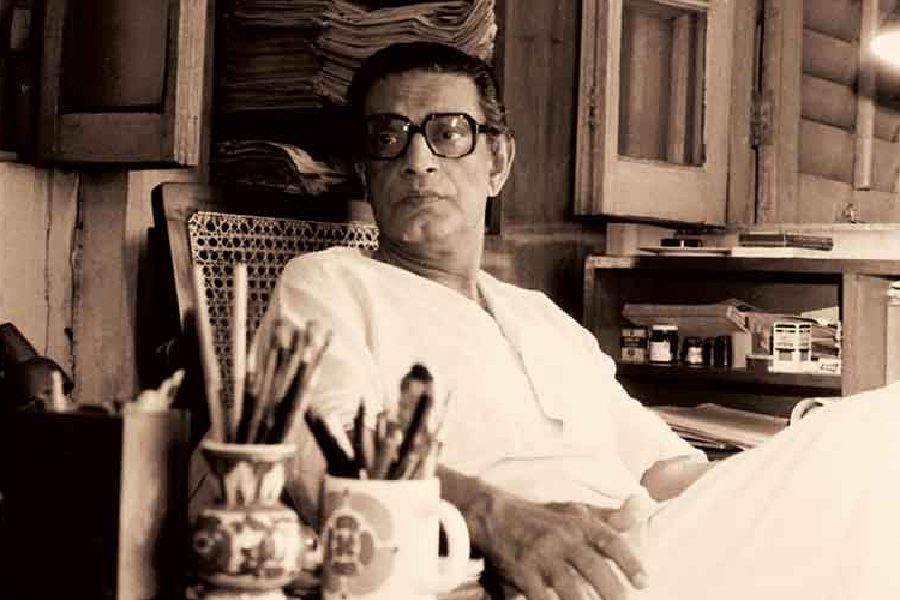
More than a century after his birth, Satyajit Ray’s films continue to speak directly to the present. From questions of morality and personal compromise to the pressures of modern life, contemporary filmmakers say the concerns he explored decades ago remain largely unchanged today.
On Ray’s 105th birth anniversary, four filmmakers told The Telegraph Online that his work endures not due to nostalgia, but because it still reflects the realities of contemporary life.
Filmmaker Sudeshna Roy felt that immediacy while watching a restored version of Pratidwandi. “The problems faced by the youth then still persist,” she said. What stands out for her is Ray’s restraint. “He never judged his characters. There’s always a quiet humour, a lightness of touch, even when he’s dealing with serious issues.”
Roy drew a parallel with Rabindranath Tagore, calling Ray similarly timeless. “Despite his stature, he never looked down on people. His gaze was always at eye level. That’s what makes his work feel so honest. He explores human life in a way that feels simple on the surface, but there’s a depth and sophistication that Indian cinema still hasn’t matched.”
For Aniruddha Roy Chowdhury, the key to Ray’s relevance lies in his exploration of values. Films like Jana Aranya, Seemabaddha and Mahanagar, he said, continue to hold up a mirror to society.
“The circumstances have changed, the numbers have changed, but the compromises remain the same,” he said. “If we keep compromising, where do our values go?”
What makes Ray’s storytelling powerful, he added, is how grounded it is. Big moral questions emerge from small, everyday decisions. “That’s where life reveals itself,” he said.
Chowdhury also pointed to how films like Nayak still feel contemporary in the way they explore inner conflict and self-reflection. But beyond that, he sees Ray’s work as a reminder of something that is slowly slipping away.
In a world driven social media validation, he believes Ray’s honesty feels even more necessary. “We are living in a make-believe world. Ray’s films bring you back to reality. They make you reconnect with yourself.”
Actor-director Anant Mahadevan, who adapted Ray’s Tarini Khuro in Hindi, approached Ray from a different angle, focusing on the courage behind his work. “We celebrate him as a master, but we don’t talk enough about how he began,” he said, referring to Pather Panchali.
“At the time, he was working in advertising. To choose a story like that and stick with it for years without any guarantee takes conviction.”
Mahadevan feels that sense of conviction is often missing today. “There are too many pressures now — commercial, social, even ideological. It’s harder to break away from the formula,” he said, describing Ray’s films as “fresh air in a polluted cinematic space.”
Filmmaker Suman Ghosh broke down Ray’s legacy into three parts: his intellect, his craft and his themes.
Recalling a recent visit to Ray’s personal library, Ghosh spoke about the range of his influences. “The books and journals he read were incredible. It shows how wide his thinking was, and that reflects in his films.”
On the technical side, he pointed to the precision of Ray’s filmmaking, from the cinematography of Subrata Mitra to the music shaped by Ravi Shankar and Ali Akbar Khan. “His sense of economy — how much to show, how much to hold back — is something filmmakers still learn from,” he said.
But it is the themes that stand out most. Ghosh pointed to Hirak Rajar Deshe as an example of how Ray anticipated political realities. “The idea of an authoritarian ruler feels very relevant today, not just here but across the world.”
He also mentioned Ganashatru and its exploration of the tension between science and belief, as well as Mahanagar’s take on women’s independence. “These are not issues of the past. We are still dealing with them.”