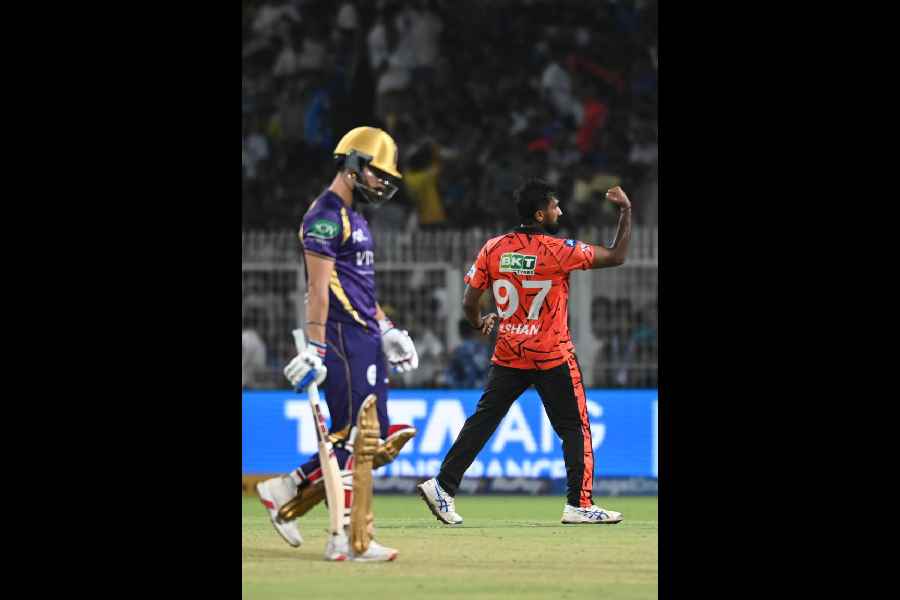
A glorious shock hit European football last week. Barcelona, the once all-conquering Spanish club that has won the leading pan-European cup three times since 2006, was widely expected to win again this year. Instead, it was thrashed, smashed, chewed up and spat out by Germany’s Bayern Munich.
Why rejoice? Because Barcelona rely on a tactic of sleep-making tedium: never even risk being tackled and losing the ball. Pass it to a nearby team-mate first. This works, sure. But it puts football, as a spectacle, on a par with synchronized swimming or a century by Geoff Boycott.
This tactic, in Spanish and now in English, is called tiki-taka; in pre-Barcelona English, click-clack, perhaps, or today, tip-tap. And here’s an off-field thought. Why do we have these colloquial ‘echoing’ words — double-headers, I’ll call them, like those trains pulled by two engines?
English has many (as do Indian languages, I’m told, such as Hindi’s pustak-vustak — books — or Bengali’s boi-toi): hip-hop, knick-knack, zigzag, dilly-dally (delay) or higgledy-piggledy (all mixed up), for example. A few are baby-talk: bow-wow or piggy-wiggy. Slightly older children may be told to put on their jim-jams (pyjamas) and slip-slops (slippers, quite distinct, in word-formation as in fact, from an adult’s flip-flops).
Most double-headers, though, are for inter-adult use, but, being colloquial, seldom figure in dictionaries. Look hard for them, though, and you’ll find many surprisingly old: hodge-podge (a jumble) goes back four centuries, its synonym mish-mash two more. Flim-flam (humbug or a trick) is found in the 1500s, so too whim-wham (an odd idea or a trifle; now dead, though whimsy-whamsy survives as an adjective). Some double-headers are simple mimicry, such as a horse’s clip-clop, the pitter-patter of rain, the ding-dong of a bell; how this became a fight I’ve no idea. A clock’s tick, tock began as tick-tack; other languages have a similar word, whence, perhaps, Barcelona’s tiki-taka, the ball often being passed from A to B and then B to A. Tick-tack — no kin to Hindi’s theek-thaak — later became a way of signalling; hence the tick-tack men on English racecourses making mysterious hand signals to bookies.
In some double-headers neither half of the word means anything; as in zigzag, see-saw or the jim-jams (19th-century for a ‘fit of the creeps’; today’s ‘pyjamas’ sense is quite distinct). More often, one half has a meaning, while the other merely or nearly echoes it. In baby-talk that’s useful: it makes the word clearer to the infant ear. But why among adults? Who needs wishy-washy, say (sloppy or thin, like a soup — or an excuse), jingle-jangle, chit-chat or tittle-tattle (both gossip, in different senses). Or nig-nog — common in my army days, though rarely with racist connotation; it just meant a man bad at his job. Or teeny-weeny, as rhymed with bikini.
In many languages, this phenomenon — linguists call it reduplication — intensifies the meaning of one half or the other, much as we may say he was a bad, bad man. That is occasionally true in English. He was in tip-top form means that he was at his very best, not just in top form. And a few of the words I’ve cited have similar effects: jingle-jangle, say, or tick, tock, suggesting that the noise concerned goes on and on. But not so most of our double-headers.
So why use them? My own explanation is simple: humans enjoy playing with sounds. Note how many double-headers have a high-pitched i vowel in the first half, a lower a or o in the second. I recollect a delightful humorous novel, By the Sea, by the Sea, whose American author suggested, apropos of evolution, forget Darwin, plants and animals simply have fun trying out strange colours and shapes. OK, he was joking, but since I find double-headers fun, I’ll make this piece the front half of one, and pick the topic up in two weeks’ time.