 |
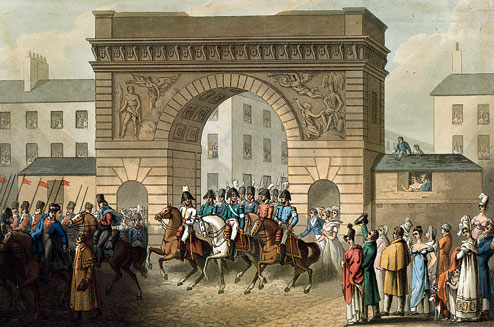
| Emperor Alexander I of Russia and his imperial staff enter Paris after the Battle of Paris, 1814 |
Frederick the Great of Prussia, chastened by the experience of fighting the Russians in Europe’s Seven Years War (1756-63), advised his successors to “cultivate the friendship of these barbarians.” Russia’s arrival as a European Great Power in the 18th century, starting with Peter the Great and sealed in its closing decades by the Empress Catherine, was an epochal endeavour whose failings, writes the British military historian, Christopher Duffy, obscured “the magnitude of the achievement.” It provides the canvas to Russia’s victory over Napoleon. How this came about and why is the subject of this riveting book. Dominic Lieven, the author of several works on the Russian Empire in the 19th century along with a study of Russian diplomacy in the years leading up to the First World War, has produced a scholarly tour de force of exceptional depth and quality. He has mined a mountain of primary sources in Russian, German and French (and a vast range of secondary texts): every event, large and small, has been exquisitely calibrated, giving the final product an impressive architectonic form. Professor Lieven, who teaches Russian history at the London School of Economics, complains that English school and university textbooks, groaning under the spectacular deeds of Wellington and Nelson, make scant acknowledgement of Russia’s epic contribution to Napoleon’s fall — an imbalance he seeks to redress in this imposing tome.
Napoleon Bonaparte bestrode Europe like a colossus. Friends and foes alike were agreed on his transcendent military genius, volcanic energy and unquenchable ambition. A “Child of the French Revolution,” as he described himself, he used its forceps to facilitate the birth of the French Empire from the womb of the Republic, secure the dominance of the emergent bourgeoisie, and sowed the seeds of nationalism across the Continent. His was an astounding career. A Corsican-born corporal, he rose to be a general at 27 and Emperor by 1804, aged 34. British naval supremacy, an obstacle to his ambition to become the master of all Europe, was to be surmounted through the Continental System, a mechanism designed to throttle British trade. Tsarist Russia, a multi-ethnic autocracy, ruled by the Romanov dynasty, drew its authority from the loyalty of a landed aristocracy, gentry and peasantry, with serfdom at the bottom of the pile. State power, leavened by the Orthodox faith, refracted the messianic vision of Russia’s historic tryst in the comity of nations. Napoleon’s rout of the armies of the Third Coalition at the Battle of Austerlitz in December 1805, included Russia. Tsar Alexander I, grandson of Catherine the Great, was scarred by the humiliation. Russia became a reluctant participant in Napoleon’s Continental System. An iconic meeting between the Emperor and Alexander on a barge in the middle of a river in the summer of 1807 discussed the terms of Russian compliance amidst ornate displays of courtliness and flattery. Russian distrust boiled and bubbled as favoured French firms were awarded special licences to trade with Britain, with no exemptions for the Russians. Britain, in any case, was gaining considerable traction through its burgeoning commerce with South America, an empire divided between debilitated Spain and Portugal. Reading the runes, Russia began to prepare for a likely French invasion of compliance. Two young agents of unusual ability, Karl von Nesselrode, 27, and Alexander Chernyashev, 22, were attached to the Russian mission in Paris. Together with Christopher Lieven, the head of the Russian mission in Berlin, they provided compelling intelligence of the French preparations for war. In March 1810, Russia began to devise its response. Alexander’s Minister of War, Barclay de Tolly, and his commanders drew up a plan of action. To counter the Napoleonic penchant for large battles at the start of a campaign, the Russians imposed on the French Emperor a war for which he was ill-prepared. Their preferred option of strategic retreat, harassment and stiff rearguard resistance wore down the invading French formations. Field Marshal Mikhail Kutuzov, the charismatic military hero, took charge as Commander-in-Chief within a month of the 500,000-strong Grand Army’s arrival on Russian soil on June 24, 1812. Kutuzov’s appointment galvanized the troops, who cheered the news of his return. Napoleon entered a burning Moscow on September 15 and settled in the Kremlin to await the expected arrival of a beaten Alexander suing for peace. The Tsar told an official: “I will grow my beard down to here,” pointing to his waist, “and will eat potatoes with the very last of my peasants rather than sign a peace that would shame my dear fatherland… Napoleon or me, I or him, we cannot both rule at the same time; I have learned to understand him and he will not deceive me.”
The trap was laid, Kutuzov was to reveal later. Winter was closing in and the Grand Army, desperately short of food and supplies, was adrift. Napoleon’s fatally delayed exit from Moscow on October 15 saw the first snowfall. Cossack horsemen shredded the Grand Army all the way to the Russian border. Alexander’s grand strategy would settle for nothing less than the exorcism of Bonaparte’s baleful shadow.
The action shifted to Germany, where Russian feats, far from home and daunting logistical challenges to contend with, were greater still. A coalition of Russia, Austria and Prussia, of which Alexander was the prime architect, outwitted Napoleon to secure the diplomatic high ground, enabling the generals to outthink and outgun his forces. Beginning in 1813, the restored Grand Army eventually staggered back to France and the denouement of regime change in Paris in the summer of 1814. Sir Charles Stewart, the British representative at Alexander’s headquarters, having watched the parade of the Russian Guards crossing the Rhine wrote admiringly and apprehensively that, “It is impossible by any description to give an exaggerated idea of these troops… when one considered what they had endured… some who had emerged from Tartary bordering the Chinese empire, traversed their own regions and marched, in a few short months, from Moscow across the Rhine, one was lost in wonder, and inspired with a political awe of that colossal power.” Men of the Russian earth, forest and aristocratic salon had reduced the once invincible god of war to a mortal with feet of clay.