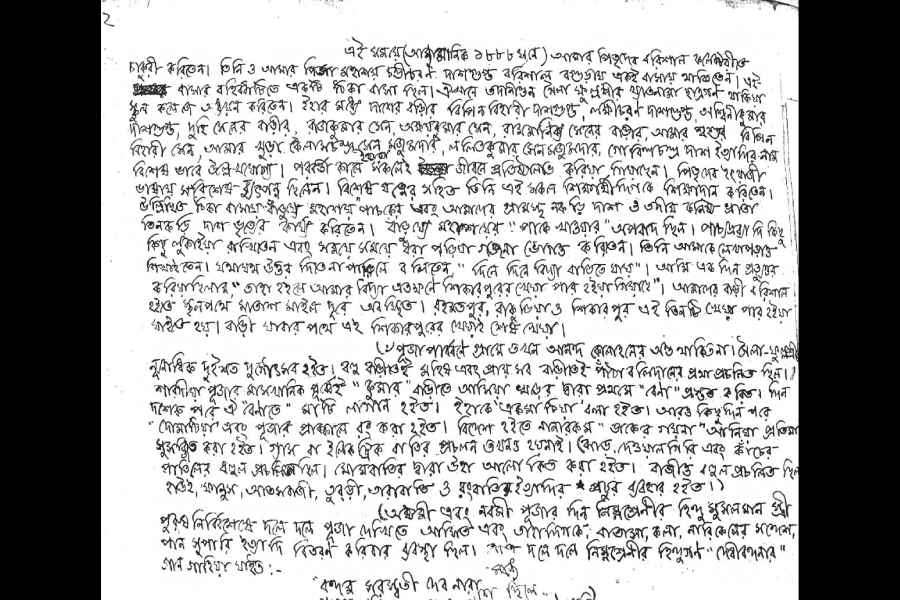
Though I have always thought of myself as a Bangal, a person with genealogical roots in East Bengal, my first visit to Bangladesh was only in 2016 when I spoke at a couple of places and visited my ancestral place in Barisal. Everywhere on that trip, the warmth and the friendliness of the people — in university and college campuses, on the street, in buses and catamaran — was spontaneous and unmissable. Reading about the ongoing unrest in Bangladesh, and the festering anger against India, I look back not only to that trip but also to a remarkable document, a memoir (unpublished) that my grandfather, who worked for most of his life as a government servant in the Barisal (his native land) and Faridpur districts of undivided Bengal, dictated primarily to my father during 1948-52 when he was a septuagenarian blinded by glaucoma.
Today’s column, therefore, is an unavoidably personal one in which I try to combine autobiographical vignettes and bits of family history with our national histories. I was born in the 1960s, a decade and a half after Partition. My parents, who grew up in West Bengal and Bihar, had few memories of their birthplaces in East Bengal. I, therefore, was never privy to a real, lived experience of Partition’s ‘loss’ and, yet, carried an ‘inheritance of loss’ at one remove. I connected intimately to these obscure objects of desire — like East Bengal in general, and desh as an imaginary homeland in Barisal, the ancestral place of my parents, in particular. I did this by forging an ancestry on the basis of a complicated crafting of various nostalgias, of villages ‘remembered’ at several removes, of relations long extinguished by history, of the ‘pain’ of a Partition experienced only through the shadow lines of reading, conversing, imagining, and memorialising.
I grew up in a West Bengal mofussil town with limited personal exposure to the upheavals of 1947 and of 1971 in Bengal’s history yet with deep cultural ties to eastern Bengal through my family. The language and the cultural inflections of Purba Banga shaped my earliest experiences of home, kinship, and belonging. Over time, I trained myself to think of myself as a Bangal, identifying Barisal as my desh, an anchor for my incipient sense of identity and belonging. This sense of identity, however, remained largely untouched by the history of Partition. In my family’s memories, Barisal was recalled as an idyllic, affective landscape — a frozen ‘Golden Bengal’ of abundance, warmth, and intimacy, unmarked by displacement or loss.
As a student of history, my understanding of Partition was fundamentally transformed a few years ago when I re-read the memoir closely. It opened a new window for me onto the lived realities of late-colonial eastern Bengal. Writing in the immediate wake of Partition, my grandfather, Hemanta Kumar Sengupta, feared that the emergence of new nation-states and the dispersal of kin across borders would upend genealogical knowledge and familial connections. His memoir was thus an act of preservation, an attempt to document a world that was already becoming irretrievable. Written by a lifelong government employee in the colonial education department, it also complicated easy binaries between ‘collaborators’ and nationalists, with Hemanta emerging as a figure deeply sympathetic to anticolonial politics and quietly disdainful of imperial authority.
Perhaps the most striking feature of the memoir is a counterintuitive portrayal of Hindu-Muslim relations in eastern Bengal. Against dominant narratives of an inexorable communal polarisation, Hemanta records a world of dense interdependence, with Muslim neighbours routinely participating in Hindu festivals and Hindus, in turn, sharing social and ritual spaces with Muslims. The emergence of a distinct Muslim political identity in the late 19th and the early 20th centuries appears in the memoir as a complex, uneven process rather than a straightforward march toward Muslim and Hindu ‘separatism’.
One of the memoir’s most significant aspects is a series of deeply personal encounters. Muslim figures recur in Hemanta’s life not as abstract representatives of a community but as friends, mentors, patrons, colleagues, and saviours. In 1907, when Hindu-Muslim relations were strained by the anti-Partition (1905) movement in Bengal and riots broke out in Mymensingh, Hemanta — working as a schoolteacher in Faridpur while nurturing a hobby as a collector and compiler of ephemera — was gifted a full set of the Encyclopedia Britannica (9th edition), worth the princely sum of Rs 300, by the estate’s impoverished zamindar, Syed Akbar Chowdhury. Senior Muslim officials named Kazi Majed Bux and Khondkar Afsaruddin Ahmed nurtured Hemanta’s career, protected his family during moments of crisis, and sustained lifelong bonds of affection and respect. Mahmud Suhrawardy — uncle of colonial Bengal’s last premier (analogous to today’s chief minister) — not only hosted Hemanta for a few days in his house for a school inspection tour in 1912 but also arranged for Brahmins to cook his meals and help him observe his ritual vows during the period of mourning following his grandfather’s death. In 1926, a year defined by communal riots across India, a Muslim doctor named Dr Azam — he refused to charge a fee — provided a miraculous herbal cure for Hemanta’s ill wife when Western medicine had failed and a surgery was deemed life-threatening. In short, my grandfather’s life as a government servant and private individual in late-colonial Barisal proceeded along little side streams and tributaries of history that came to be watered regularly by the kindness of the communal ‘Other’ even as his ‘homeland’ toddled and then hurtled towards the fateful severance of 1947.
Hemanta was displaced from his beloved Barisal to Bardhaman in 1931 due to a transfer order intended to make room for a Muslim official. But he kept up a regular correspondence with his Muslim friends and mentors right up to Partition and commented in his memoir in 1950 — even as riots were breaking out in Dhaka and Barisal — that such friendships would appear ‘fictional’ in the context of contemporary Hindu-Muslim antagonism. The memoir ends its section on colonial Bengal with a ‘redemptive’ episode on the night of August 14, 1947, when one of Hemanta’s sons — by a fortuitous happenstance — got to accompany the outgoing Bengal premier, Huseyn Shaheed Suhrawardy, on a nocturnal car tour of the city to witness Hindus and Muslims celebrating Independence together. At 2 am, the two men sat in the Nakhoda mosque, sharing faluda and kulfi in a fleeting moment of intercommunal peace as a new nation was being born.
For me, reading my grandfather’s memoir reconfigured Barisal — once an abstract signifier of putative origins — into a tactile yet elusive ‘lost land’, layered with a historical complexity I was not aware of before. Hemanta himself, though not a Partition refugee in the conventional sense, emerged as a displaced figure — emotionally unmoored after his transfer in 1931 and writing from a place of belated exile. As I see relations between India and Bangladesh increasingly framed by border anxieties, citizenship disputes, and competitive nationalisms, that moral and affective world comes back into sharp relief with a nagging insistence.
Perhaps Hemanta’s memoir stands as a quiet indictment of our present, reminding us that Bengal was once a region where coexistence was not an abstract ideal but an everyday practice sustained through trust and reciprocity. Recovering these private, intimate histories hidden in family archives will not solve contemporary conflicts, but maybe they will expand the horizons of what we are able to imagine. In an age of a seemingly unending animosity between India and Bangladesh (among other neighbours), the memoir’s testament to interconnected lives serves as both a historical correction and a moral challenge — urging us not only to remember that another
Bengal once existed but to reclaim it together.
Jayanta Sengupta is Director, Alipore Museum; jsengupt@gmail.com