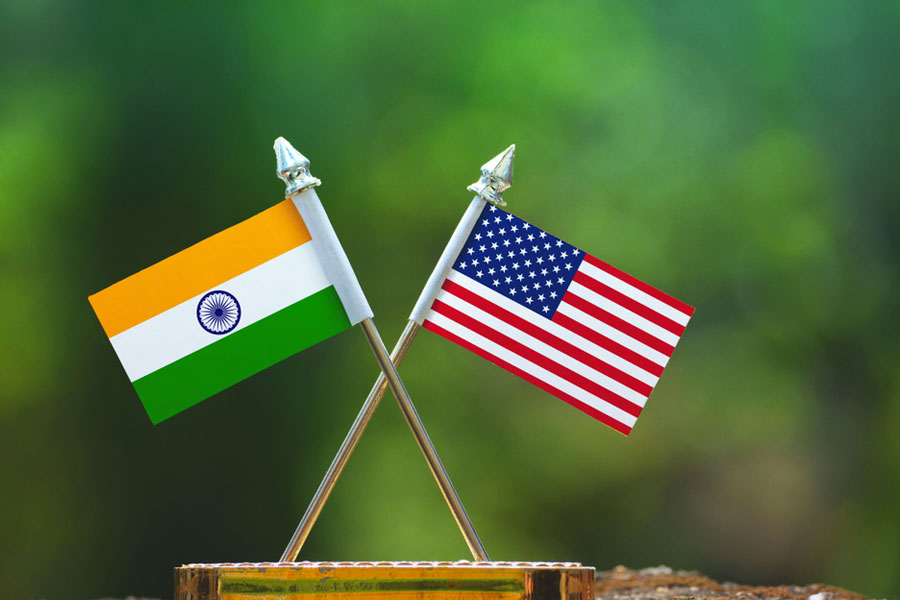
The trade deals that India signed with the United States of America and the European Union are being hailed as pivotal to our economic journey, as if they can usher in limitless possibilities. While the finer details of the trade agreements, particularly with the US, are yet to be worked out, questions remain about what India has to concede. The US and the EU need our markets for many reasons, including dumping their agricultural surpluses.
Most commentators have cheered the India-US framework, but I am sceptical for two major reasons for our small and dryland peasantry, which forms the backbone of our workforce and agriculture. One, Indian farmers have been reeling under distress for a long time — almost three decades, in the rapidly restructuring economy. Two, buoyancy at the top hardly ever translates into prosperity at the bottom. That has been the experience since 1991 when India was liberalised and it was said that globalisation will help farmers.
The 2025-26 Economic Survey remarks that while it contributes to nearly one-fifth of the national income, agriculture and allied activities account for a whopping 46.1% of India’s workforce, making the sector central to our overall growth and trajectory. In other words, if agriculture fails, the country fails. Flagging land fragmentation, limited access to irrigation, lack of quality inputs, and low levels of mechanisation and investments as major challenges, the Survey notes that livestock, fisheries, horticulture and other allied activities are steering the sectoral growth (4.5%), not crop agriculture in which most farmers are stuck.
This year’s budget, coupled with the India-US trade deal, does not inspire confidence that the agrarian economy will cope with impending challenges. First, small farmers — 90% of Indian farmers have holdings less than a hectare — will not be able to compete in global markets in the face of growing imports. Second, non-farm employment is being given a royal burial. Third, if India imports from the US what its interim framework commits to, the unorganised, agriculture-allied sector with millions of small livelihoods will face organised, industrialised and heavily-subsidised US corporate-farms.
India has also committed to soybean oil imports. This will be devastating for soybean farmers in vast stretches of central India. Indeed, we import nearly 15 million tonnes of edible oil (nearly 60% of our domestic demand) to meet the rising demand, and even that approach was abhorrent. Instead of incentivising its own farmers, particularly in rain-fed regions, to grow a variety of oilseeds to become self-reliant in edible oil production, India has been incentivising the palm plantations in Indonesia and Malaysia. The US-India trade deal will endanger the ambitious oilseeds mission, unless the Union government cushions farmers with price, budgetary support and assured procurement.
The Economic Survey emphasised productivity, value chains and market integration, while remaining silent on how such transitions will absorb a farm population dominated by small and marginal cultivators with little liquidity. The underlying assumption appears to be that consolidation — of land, markets and supply chains — is both inevitable and desirable. For years, dryland farmers combated agrarian distress through fragile escape routes: migration and non-farm employment through MGNREGA. These exits are now narrowing. Climate stress, global trade volatility and domestic policy alignment are converging to hit small-scale farming. The rural backlash will not be immediate but it will be enduring: farmers leaving agriculture without alternatives, villages hollowing out, and a food system increasingly detached from farmers who sustain it. A budget can ignore this reality for a year. A trade deal can defer the reckoning for a decade. But farms, eventually, send the bill back.