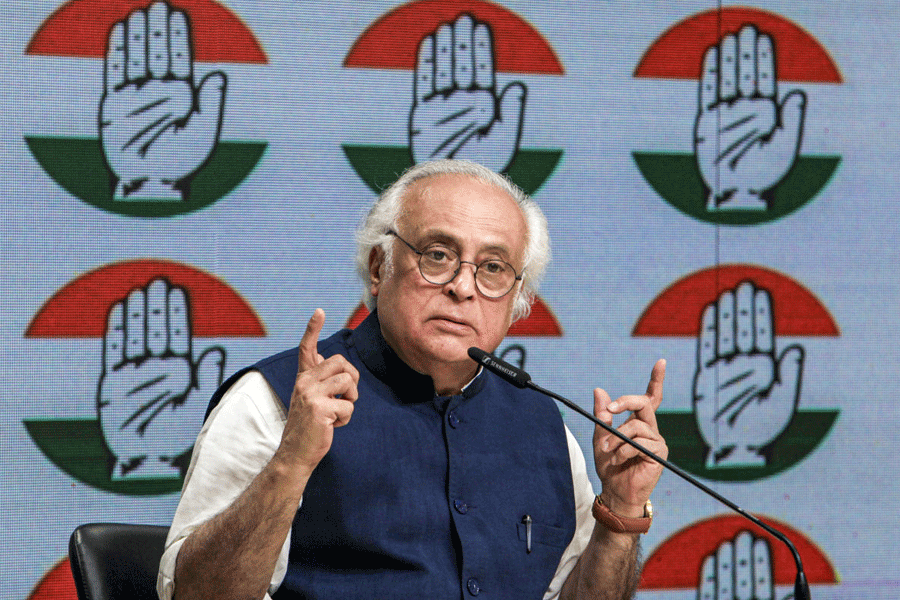
The Congress on Friday said the SHANTI Act was passed to favour the Adani Group, following Adani Power’s incorporation of a nuclear energy subsidiary.
Senior Congress leader Jairam Ramesh alleged that the Sustainable Harnessing and Advancement of Nuclear Energy for Transforming India (SHANTI) Act, 2025, had been “rushed through” in the last session to benefit a particular business house.
“In my speech in the Rajya Sabha, I had said that the SHANTI Bill was being enacted to favour the favourite. Now we know the real meaning of SHANTI — Shriman Adani’s Nuclear Tech Initiative,” Ramesh said in a post on X.
The legislation replaces the Atomic Energy Act of 1962 and creates a framework for private participation across the nuclear value chain, including plant construction, ownership and operation, as well as fuel fabrication and related activities under a licensing regime.
Adani Power confirmed that it had incorporated Adani Atomic Energy Limited as its wholly owned subsidiary.
In a regulatory filing to the BSE and NSE dated February 12, 2026, the company said the Certificate of Incorporation was received from the Central Registration Centre, Registrar of Companies, on February 11.
The disclosure was made under Regulation 30 of the SEBI (Listing Obligations and Disclosure Requirements) Regulations, 2015.
The move comes amid a broader policy push by the Centre to expand private-sector involvement in nuclear energy.
The SHANTI Act grants statutory status to the Atomic Energy Regulatory Board and introduces a comprehensive licensing framework covering construction, ownership, operation and decommissioning of nuclear plants, along with fuel fabrication, enrichment within notified limits, and transport and storage of nuclear materials.
The government has set a target of 100 GW of nuclear capacity by 2047. NITI Aayog, in its report Scenarios Towards Viksit Bharat and Net Zero, projects that installed nuclear capacity could rise from about 8.8 GW at present to over 300 GW by 2070, supported in part by Small Modular Reactors.
Adani Power, part of the Adani Group, is India’s largest private thermal power producer, with an installed capacity of 18,110 MW across multiple states and a 40 MW solar project in Gujarat.
While the Congress has framed the development as evidence of corporate favouritism, the new framework allows any eligible private firm to apply for licences under the prescribed regulatory regime.