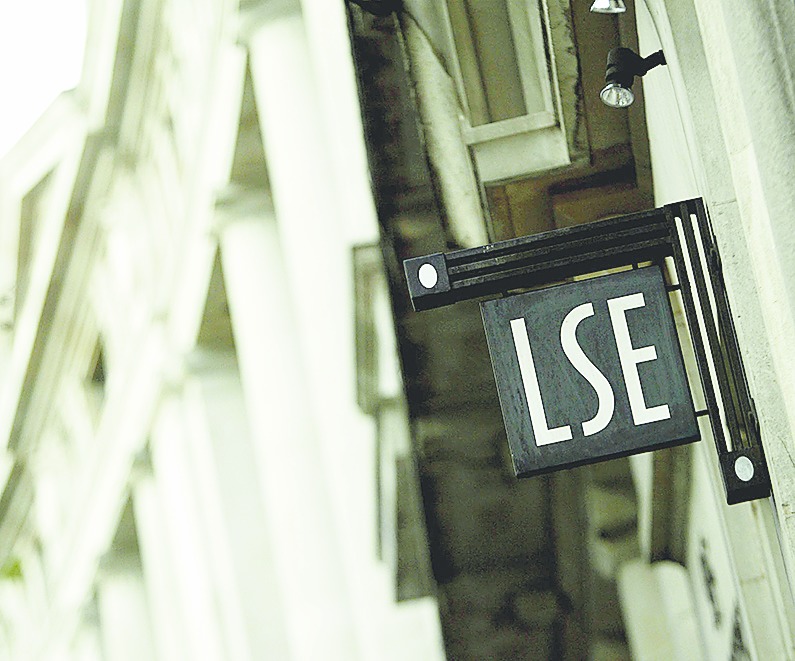

Many an economist, starting from Baron Desai of Clement Danes, would be familiar with the old building of London School of Economics in Clare Market, a gully opposite the Indian High Commission in Aldwych. Its foundation stone was laid in 1920 by King George V, grandfather of the Queen who knighted Lord Desai. By the time Queen Elizabeth II ascended the throne, however, LSE was firmly under the control of Harold Laski, a radical leftist. So she never went near it - until November 5, 2008, when she opened its new building in Lincoln's Inn Fields, just a couple of hundred yards north of the old building.
The professors of the School gathered at the entrance, welcomed the Queen when she arrived, and took her up to the senior common room, half an hour before the inauguration. That was a year after the housing bubble burst in the United States. In the previous boom, banks, which were sitting on mountains of cash and running short of borrowers, had lent to poor tenants to buy their slummy residences and become house-owners. The indigents did not mind that at all; but many of them did not have the income to pay interest on the loans, let alone repay the loans. American banks are tough, and are backed by laws that are enforced. As was written in the mortgage contracts, the banks started to repossess the homes, turn the poor out, and sell off the properties. Property prices collapsed; the banks could not recover their loans, and ran out of money to give fresh loans. They called back loans given to financial investors, who started selling off securities; interest rates shot up. Soon the crisis spread from New York to the rest of the developed world.
The Queen is not poor. She - rather, the royal family - owns palaces including Buckingham Palace and Windsor Castle. But they are held in trust, and she cannot sell or rent them out. She has a fantastic collection of paintings going back centuries; but that too is not under her control. Her wealth is a state secret, but she no doubt holds considerable financial assets and properties, whose income goes towards financing her none-too-modest expenses. So she shared in the travails of the rich that the crisis of 2007 unleashed. Her salary - sorry, Civil List payment - of £7.9 million a year had not been raised for two decades.
As they had sherry in the senior common room, she told Professor Luis Garicano that the situation was awful and asked: "If these things were so large, how come everyone missed them?" He obviously did not expect the turn of the conversation, and had some difficulty in responding. He told her, "At every stage, someone was relying on someone else, and everyone thought they were doing the right thing." The question he was asked received enormous publicity, and had many an economist thinking.
Crises are not new; they go back to the 19th century, if not earlier. After much debate, Joseph Schumpeter presented a theory towards the end of the nineteenth century, that trade cycles are caused by innovations. An innovation reduces costs or introduces new products. Innovators make spectacular profits. Their success attracts imitators. Investment floods into the industries experiencing innovation. The rise in investment boosts aggregate demand; its rise leads to a boom. At some point, the capacity created by the investment begins to outrun demand, capacity utilization falls, profits contract, and the investment boom collapses. Eventually, demand catches up with capacity, new innovations arise, and a new boom begins.
The question is, which innovations led to the boom that was ended by the 2008 crisis? My first answer was that it was innovations in information technology. The IT boom began in the United States with the innovation of the portable computer in the 1970s; the 1990s were the peak of the IT boom. But then I realized that the timing was wrong. The IT boom tapered down after 2000; so it cannot explain the 2008 crisis. By the time I realized this, the crisis was long past, and I stopped thinking about it.
But Desai - the Lord - thought diligently, and wrote a book, Hubris, earlier this year in which he claimed to have the answer. He turned to Nikolai Dmitriyevich Kondratiev, who became a junior minister in the cabinet of Kerensky in 1917. The government did not last long; but Kondratieff (as his name is spelt in the West) survived the Bolshevik revolution, and founded an Institute of Conjuncture in 1920 in Moscow, after Konjunktur, the word Germans used for the trade cycle. Two years later, at the age of 30, he wrote his seminal work, The World Economy and its Conjunctures During and After the War. He read economic cycles of roughly half a century each in the history of capitalism. In Desai's view, a new Kondratieff cycle started in the 1970s. It peaked a quarter of a century later, and turned down then; 2008 was one of the episodes of the downturn. It is a possible conjecture about the current conjuncture; but Desai gave no evidence for it. I do not think it needs to be taken seriously.
I would rather go back to an article Eric Helleiner wrote in the Annual Review of Political Science four years ago. He traces the cause of the 2008 crisis to a financial innovation, namely securitization. It involved packaging loans which had similar risk profiles, and selling the packages. The packaging averaged and hence reduced the risk. More risky packages had lower prices and hence yielded higher interest, and institutional investors such as banks and mutual funds could choose packages that best suited their risk-and-return preferences. Packages, called mortgage-backed securities (MBSs), were invented in the 1970s by Fannie and Freddie, nicknames of what were essentially security risk insurers set up by the US government. A market soon developed in the MBSs.
Then in the 1990s, financial firms packaged the MBSs into what were called collateral debt obligations (CDOs); and a derivatives market developed in this packages. A few big financial institutions dominated the markets. They were not under the discipline of any regulator; so they did not have to follow risk reduction strategies such as minimum cash requirements imposed on banks. When poor borrowers who had taken the mortgage loans, which were the foundation of all the complex financial products, stopped repaying them, the entire edifice of huge financial institutions that traded frantically in the complex securities came down crashing. That was the foundation of the crash of 2008.
And why did no economist see it coming? Because no one realized that the variety of financial products that blossomed in the US was an innovation, or that the innovation spread the risk of default on the housing loans, but did not reduce the risk. Not only that; it created a gap between objective and subjective risk. The traders thought that they would sell before the securities became worthless. But the securities' worth depended on everyone believing that they had some worth; once the worth came to be doubted, the risk shot up to 100 per cent, and contagion closed down the market.