|
|
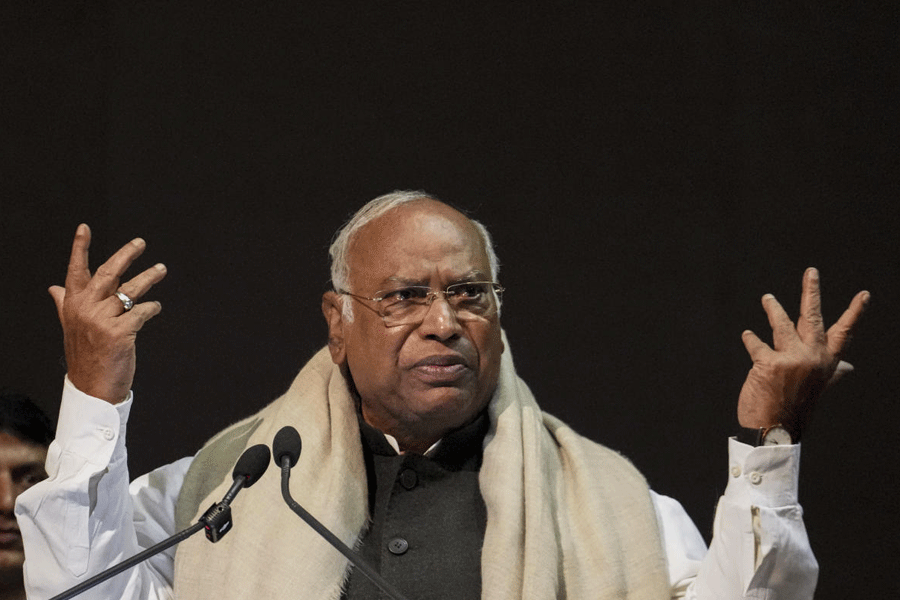
| Aneurin Bevan (extreme left) visiting Delhi in 1953 |

Unfortunately, it was no longer possible to take a boat this time; the passage which took four weeks on P&O SS Strathmore then took eight hours on British Airways this time.
In 1956 as now, Britain had a Conservative government; Winston Churchill, who led it through World War II, had resigned as prime minister the year before and given way to Anthony Eden, probably the most handsome prime minister of Britain in the last century. He was reputed to have inherited his looks from his mother, Frances Grey. But he was known to have a short temper — which led Rab Butler, his rival in the Conservative Party, to call him half-mad baronet, half-beautiful woman. He was not a great speaker. But I had no way of knowing this, for there was no television, at least not within my reach in Cambridge, in 1956.
In any case, I was strongly anti-conservative, since the Conservative Party was the party of Winston Churchill, the last imperialist, who called Gandhiji the naked faqir. My hero was Aneurin Bevan, whom I heard in St Mary’s Church soon after I reached Cambridge. I am not sure he said something like that in the speech I heard, but in a speech he gave just about then, he said, “Sir Anthony Eden has been pretending that he is now invading Egypt in order to strengthen the United Nations. Every burglar of course could say the same thing, he could argue that he was entering the house in order to train the police. So, if Sir Anthony Eden is sincere in what he is saying, and he may be, he may be, then if he is sincere in what he is saying then he is too stupid to be a prime minister.”
He started his life as a miner — he went down a coal mine when he was 12. He had an engaging Welsh accent spiced with a stammer (we Indians are supposed to have a Welsh accent). As minister of health in the 1940s, Bevan built up the British national health service. Bevan knew where he stood; he once said, “We know what happens to people who stay in the middle of the road. They get run over.” Churchill hated his guts; on various occasions he called Bevan the merchant of discourtesy, the minister of disease, and a squalid nuisance. In his enormous history of World War II, he quoted Bevan extensively and critically, but did not take his name. Bevan had no such qualms. He once said that Churchill was a man suffering from petrified adolescence. Another time he said, “He [Churchill] never spares himself in conversation. He gives himself so generously that hardly anyone else is permitted to give anything in his presence.”
He did not think much of my tribe of economists either. For all his brilliance, Bevan was considered too volatile, and lost the election to the leadership of Labour Party in 1955 to Hugh Gaitskell; it was about him that Bevan said in 1951: “It has been perfectly obvious on several occasions that there are too many economists advising the Treasury, and now we have the added misfortune of having an economist in the Chancellor of the Exchequer himself”. On another occasion, he had this to say about Gaitskell: “I know that the right kind of leader for the Labour Party is a kind of desiccated calculating-machine who must not in any way permit himself to be swayed by indignation. If he sees suffering, privation or injustice, he must not allow it to move him, for that would be evidence of the lack of proper education or of absence of self-control. He must speak in calm and objective accents and talk about a dying child in the same way as he would about the pieces inside an internal combustion engine.”
That was half a century ago. While I was in Britain this time, another campaign was on in the Labour Party. The contestants were two brothers, David and Ed Miliband. Both were competing for the leadership of the party, which fell vacant after Gordon Brown led it to a defeat in the general election this year and resigned. They are both sons of Polish immigrants. Their grandparents met in Belgium, whence they migrated to Britain. It is like two Bangladeshi brothers becoming leaders of the Bharatiya Janata Party. Both grew up in north London, and went to “comprehensive” schools — the British name for government schools. Then they both went to Corpus Christi College in Oxford, and read politics, philosophy and economics — the standard arts degree course Oxford offers. David, who is four years older, got excellent results in his school leaving examinations, and got a First in Oxford. He then went and did a Master’s degree in politics in Massachusetts Institute of Technology. Ed finished more modestly with an MSc in economics from London School.
Both were active in the Labour Party, and were rewarded when it came to power in 1997. David became head of Tony Blair’s policy unit; he won a seat in the 2001 election, and became minister in the cabinet office (what we call principal secretary in our government) in 2004. The same post was given to Ed when Gordon Brown became prime minister in 2007; David was made foreign secretary.
In January 2009, he came to India, and was taken to spend a night by Rahul Gandhi in Shivkumari Kori’s hut in Simara village. When he met our foreign minister, he greeted him with a cheerful “Hi, Pranab!” which upset the extremely honourable minister no end. He made the obvious point that the best antidote to the terrorist threat in the long term was cooperation: “Although I understand the current difficulties, resolution of the dispute over Kashmir would help deny extremists in the region one of their main calls to arms, and allow Pakistani authorities to focus more effectively on tackling the threat on their western borders.” Indians, in the government as well as in the media, went berserk.
It goes without saying that David was not diplomatic as Secretary of State; I doubt if he was any more in his subsequent career. Ed is more of a politician; he won the election because he got the support of trade unions, which are a power in the Labour Party. But David is a rare politician: he does not let conventions cloud his thinking, and he says what he thinks. Long may he continue to do so.